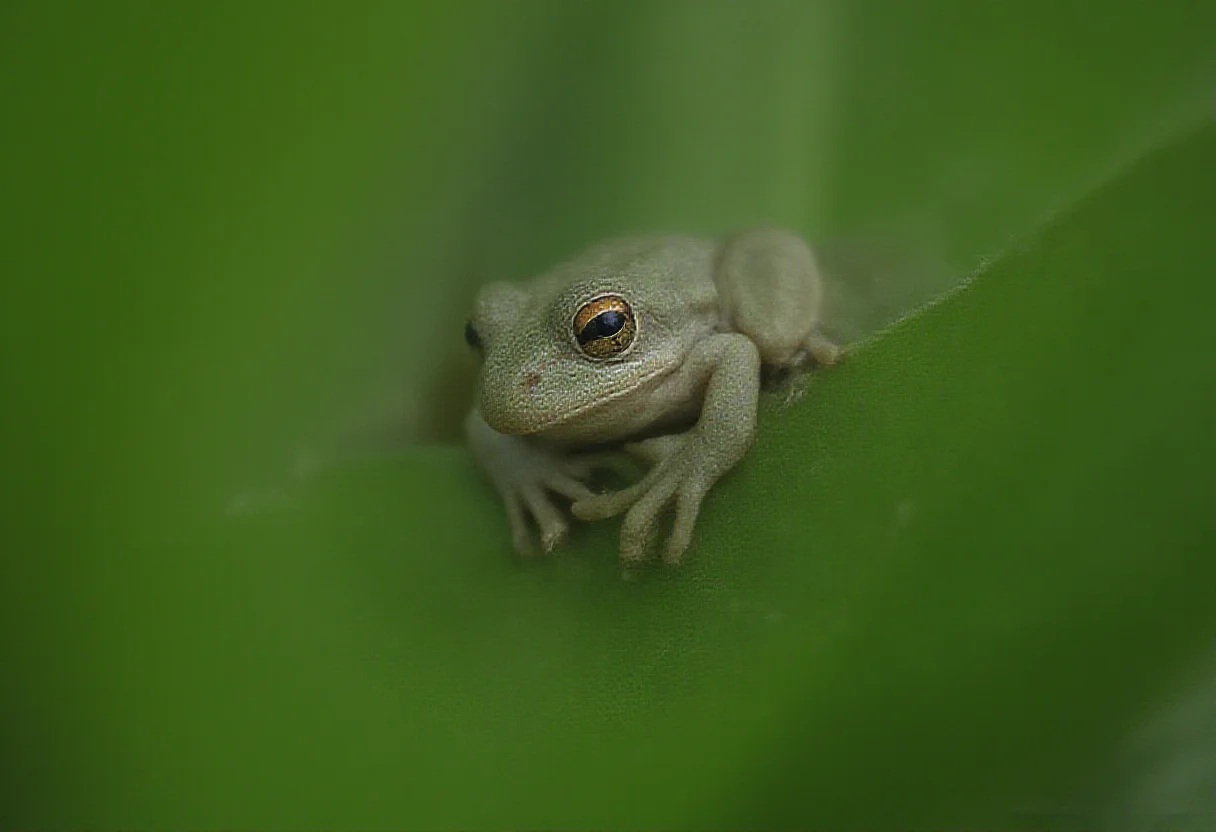
How Much Does a Tree Frog Weigh? Species Compared
There is no single tree frog weight, because tree frogs are many species. Gray treefrogs average about 7 grams, red-eyed tree frogs weigh about 6 to 15 grams, and most adult White’s tree frogs weigh 50 to 90 grams. Females are larger than males in the red-eyed and White’s tree frog sources, so weight can differ by sex, but Animal Diversity Web lists no sexual dimorphism for gray treefrogs.
Among the species here, adult tree frogs range from about 3 cm to 11 cm long. Asking what a tree frog weighs is like asking what a bird weighs.
This page gives sourced weights for three well-known species and explains what changes a frog’s weight. For the group itself, read what a tree frog is.
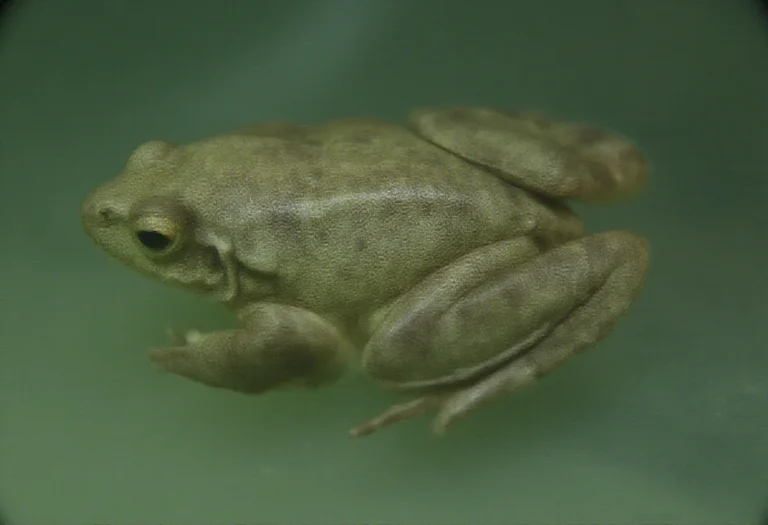
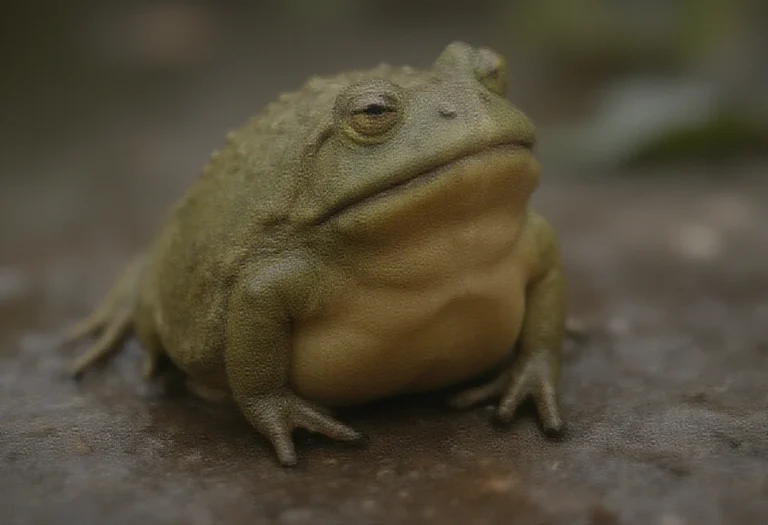
How this was made: prepared with AI assistance and checked against the sources listed at the end. Images are AI-generated illustrations, not photographs of real animals or products.
Key Takeaways
- Weight varies by species: from about 7 g to 90 g in the examples below.
- Gray treefrogs average 7.175 g in one reference.
- Red-eyed tree frogs weigh about 6 to 15 g.
- White’s tree frogs usually weigh 50 to 90 g as adults.
- Females tend to be larger than males.
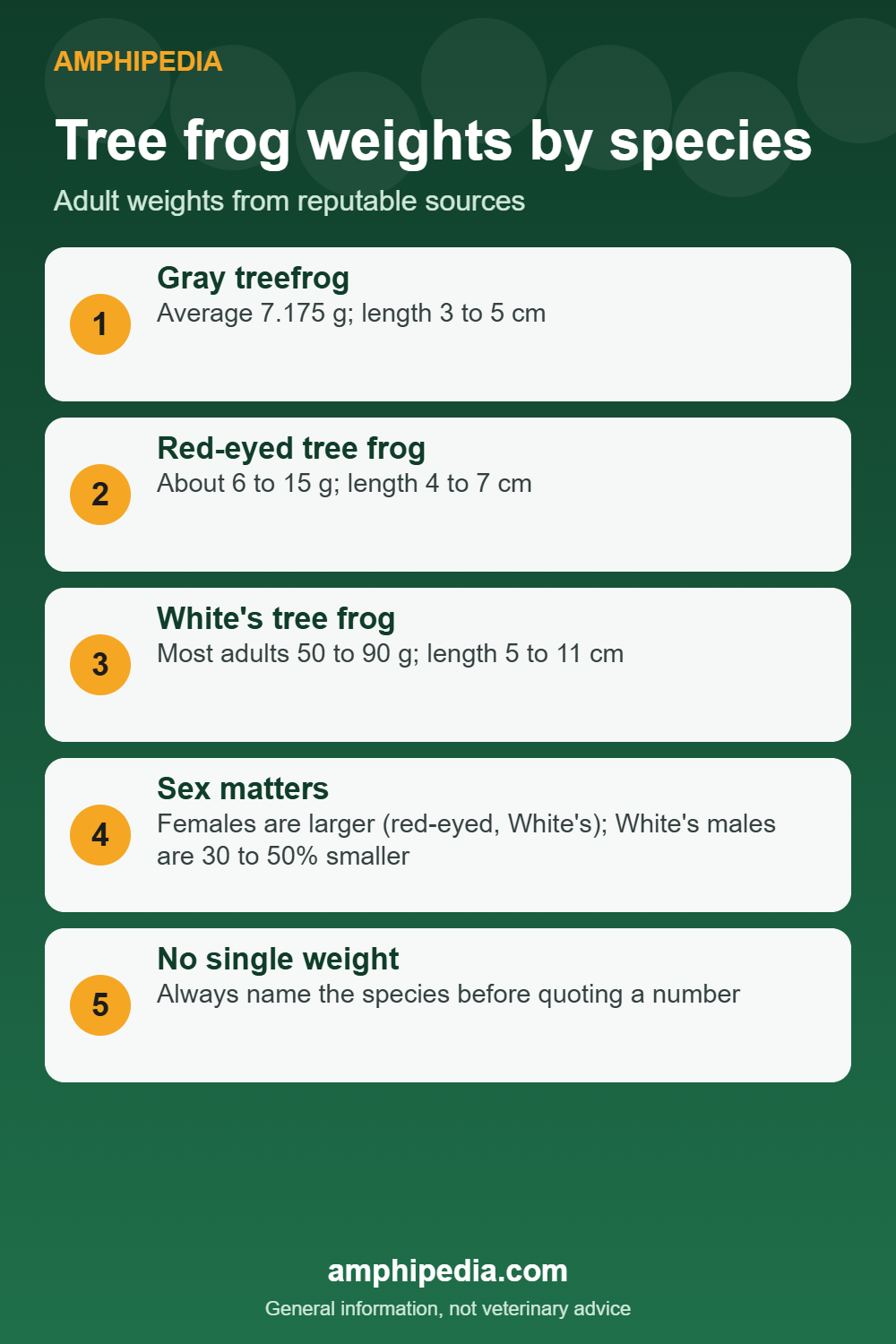
Pin this infographicShare on Facebook
Tree frog weights by species
The table gives adult weights from two sources: the University of Michigan Animal Diversity Web and the Lafeber veterinary information sheet. Weight data was found only for these three species in reputable sources, so only these are shown.
| Species | Adult weight | Adult length | Source |
|---|---|---|---|
| Gray treefrog (Hyla versicolor and H. chrysoscelis) | Average 7.175 g | 3 to 5 cm | Animal Diversity Web |
| Red-eyed tree frog (Agalychnis callidryas) | About 6 to 15 g | 4 to 7 cm | Animal Diversity Web |
| White’s tree frog (Litoria caerulea) | Most adults 50 to 90 g | 5 to 11 cm | Lafeber |
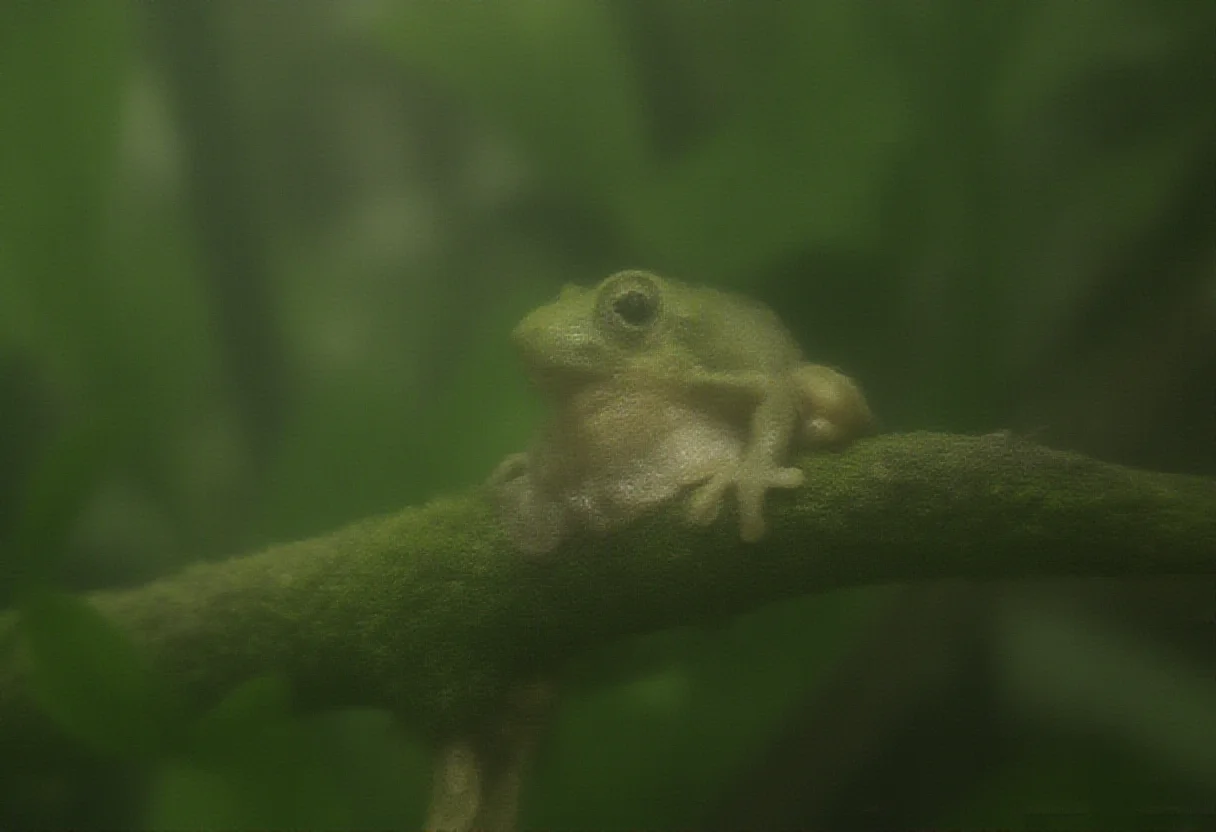
Gray treefrog
Animal Diversity Web lists an average mass of 7.175 grams for gray treefrogs. It gives no mass range. Length ranges from 3 to 5 centimetres, and the record is 6 centimetres.
The page covers the eastern gray treefrog and Cope’s gray treefrog together and does not separate their measurements.
Red-eyed tree frog
Adult red-eyed tree frogs weigh about 6 to 15 grams and measure 4 to 7 centimetres, according to Animal Diversity Web. Females are the larger sex.
Weight within the range depends on the individual frog, its sex and its health, but the source does not break it down further.
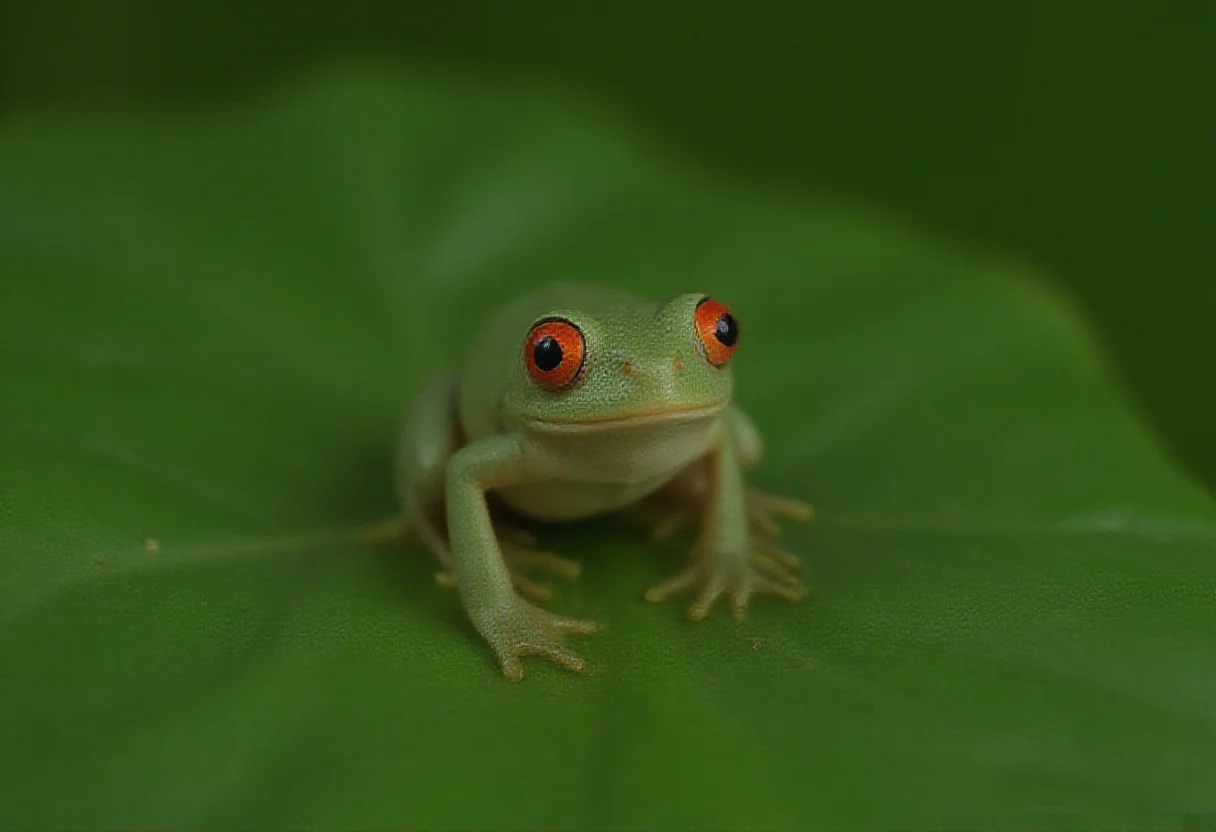
White’s tree frog
Lafeber, a veterinary information site, says most adult White’s tree frogs weigh 50 to 90 grams. Length is 5 to 11 centimetres. The Zoological Society of London gives a maximum length of 11.5 centimetres.
The source does not break weight down further by age, health or sex.
Why sources differ
The Aquarium of the Pacific length range for White’s tree frogs is larger than the Lafeber range. Both are given as ranges, and they may measure differently or describe different populations.
Because sources disagree, treat any single number with caution. A range is more honest than a single figure.
What affects a frog’s weight
The sources show two clear factors. First, species: the heaviest example here is more than ten times heavier than the lightest.
- Species and body size
- Sex: females are the larger sex in the red-eyed and White’s sources
- Age, health and feeding: the sources do not quantify these
A word on the 10 to 15 gram figure
Some pages give a single typical weight of 10 to 15 grams for tree frogs. That fits the red-eyed range well and is close to gray treefrogs, but it is far too low for White’s tree frogs.
Use a species name when asking about weight. A single figure for all tree frogs will mislead.
Length, lifespan and sex differences by species
Weight is one measurement among several, and the sources report others. The table pulls together what each source states for the three species above, so the weights can be read in context.
| Species | Length | Sexes | Lifespan |
|---|---|---|---|
| Gray treefrog | 3 to 5 cm, record 6 cm (ADW) | No sexual dimorphism (ADW) | Captive average 7 years; wild unknown (ADW) |
| Red-eyed tree frog | 4 to 7 cm (ADW) | Females tend to be larger (ADW) | About 4.1 years captive average, over 8 reported; wild average 5 years (ADW) |
| White’s tree frog | 5 to 11 cm (Lafeber); up to 11.5 cm (ZSL); females 10 to 15 cm snout to vent (Aquarium of the Pacific) | Males about 30 to 50 percent smaller (Lafeber); about 1 inch smaller (Aquarium of the Pacific) | 20+ years (Lafeber); up to 23 years in a protected setting (Aquarium of the Pacific) |
The gray treefrog entry matters most for the sex question. Animal Diversity Web states there is no sexual dimorphism in gray treefrogs, so the “females are larger” rule does not hold for every species. It holds in the red-eyed and White’s sources only.
Lifespan figures also differ in setting. Red-eyed tree frogs average about 4.1 years in captivity and 5 years in the wild per ADW, while White’s tree frogs are reported at 20 years or more. A heavy, long-lived frog is not the same thing as a small, shorter-lived one, so the species name needs to come first.
From tadpole to adult weight
ADW gives some early-stage sizes for the gray treefrog. Tadpoles measure 3.2 to 3.8 cm long, and froglets at metamorphosis are about 1.5 cm snout to vent. It gives no weights for these stages, so no figure for a young frog should be assumed from the adult average.
Diet changes with growth. ADW says gray treefrog tadpoles graze on algae and detritus, while adults eat mainly insects and their larvae, plus mites, spiders, plant lice, harvestmen and snails. Adults may also eat smaller frogs, including other treefrogs. The Aquarium of the Pacific says White’s tadpoles are omnivores that eat algae, mosquito larvae, drowned insects and other tadpoles.
Red-eyed tree frogs are nocturnal carnivores that mainly eat insects such as flies, grasshoppers and mosquitoes, according to ADW. The source gives no exact quantities of food, so it does not link diet to body weight.
A size rule for Florida: the Cuban tree frog
Weight and size matter for identification as well as curiosity. The University of Florida IFAS publication on the Cuban treefrog gives a simple rule: any treefrog in Florida longer than 3 inches is almost certainly a Cuban treefrog.
The same publication says most adult Cuban treefrogs measure 1.5 to 2.5 inches, not including outstretched legs, and that females are much larger than males and can exceed 6 inches in body length. It gives no weights. Compare this with the gray treefrog, which ADW lists at 3 to 5 cm (about 1.25 to 2 inches).
UF/IFAS names the barking treefrog and Cope’s gray treefrog as the natives most likely to be confused with Cuban treefrogs. Size is one clue only. It also lists exceptionally large toe pads, large bug-eyes, warty skin and a yellowish wash in the groin and armpits.
The publication says Cuban treefrog skin secretions irritate the eyes and nose, and advises wearing gloves or using a plastic bag as a glove and washing hands afterward. It adds that the secretions cause excessive salivation in dogs and cats that bite the frogs, and seizures have been reported, so keep pets away.
Tracking a pet frog’s weight
No source here gives a healthy weight for pet tree frogs. The numbers in the table describe species averages and ranges, not targets for an individual. Do not feed or restrict a frog to hit one.
The MSD Veterinary Manual advises owners to log appetite and behaviour and to weigh animals regularly if practical. A written record gives an exotics vet something to work with when a frog seems thin. Find one through the ARAV directory at arav.org/professionals.
Lafeber, a veterinary information site, notes that feeding frequency differs by age: gut-loaded insects daily for juvenile White’s tree frogs and 2 to 3 times weekly for adults. It also gives a supplement schedule, which this post does not repeat because the right schedule is a question for a vet.
More species from Animal Diversity Web
Three more tree frog pages on Animal Diversity Web show how patchy weight data is. They were checked after the main table was written and are listed here so the gaps are clear.
| Species | Mass (ADW) | Length (ADW) | Sexes (ADW) |
|---|---|---|---|
| Cuban treefrog (Osteopilus septentrionalis) | About 57 g on average | 2.5 to 12 cm | Females larger, may reach nearly twice the male’s size |
| American green treefrog (Hyla cinerea) | No mass given | 34 to 62 mm total length | Females tend to be larger |
| Pacific treefrog (Pseudacris regilla) | Average adult mass 0.35 g | 2.5 to 4.8 cm | Females larger, sexes differ in colour and pattern |
The Cuban treefrog figure of about 57 g fits with the White’s tree frog range (50 to 90 g) and with the UF/IFAS note that females can exceed 6 inches. Even so, ADW gives only an average, with no separate figure for males and females, despite saying females may reach nearly twice the male’s size.
The American green treefrog page gives lengths but no mass, so this post does not quote a weight for it. Do not estimate one from the gray treefrog, because body shape differs between species.
The Pacific treefrog entry looks wrong next to the others. An adult mass of 0.35 g for a frog 2.5 to 4.8 cm long is far lighter than the 7.175 g given for a gray treefrog of similar length. It was not possible to cross-check this figure with a second reputable source, so it is shown only as what ADW lists and should not be relied on.
This is a good example of why one database page is not enough. When a number looks odd, look for a second source, and when none exists, say so. That is also why this post uses ranges and names the source next to each figure.
Frequently Asked Questions
How much does a tree frog weigh?
It depends on the species. Gray treefrogs average about 7 g, red-eyed tree frogs 6 to 15 g and White’s tree frogs 50 to 90 g.
How much does a gray treefrog weigh?
Animal Diversity Web lists an average of 7.175 grams.
How much does a red-eyed tree frog weigh?
About 6 to 15 grams, according to Animal Diversity Web.
How much does a White’s tree frog weigh?
Most adults weigh 50 to 90 grams, according to Lafeber.
Are female tree frogs heavier than males?
Females are the larger sex in the red-eyed and White’s tree frog sources. Lafeber says White’s males are 30 to 50 percent smaller.
Why do sources give different sizes?
Sources may measure differently or describe different populations. Ranges are shown and each source is named.
Bottom Line
Tree frog weight spans about an order of magnitude, from a few grams to nearly 100. Always name the species before quoting a number.
For more on the group, read what a tree frog is and why a frog is an amphibian.
Sources
- Animal Diversity Web: Hyla versicolor (gray treefrog), accessed 31 October 2026
- Animal Diversity Web: Agalychnis callidryas (red-eyed tree frog), accessed 31 October 2026
- Lafeber: Basic information sheet, White’s tree frog, accessed 31 October 2026
- Zoological Society of London: White’s tree frog, accessed 31 October 2026
- Aquarium of the Pacific: White’s tree frog, accessed 31 October 2026
- University of Florida IFAS: Cuban treefrog (UW259), accessed 13 November 2026
- MSD Veterinary Manual: Environment and Husbandry for Amphibians, accessed 13 November 2026
- Animal Diversity Web: Osteopilus septentrionalis (Cuban treefrog), Hyla cinerea (American green treefrog) and Pseudacris regilla (Pacific treefrog), accessed 13 November 2026
One Comment