What to Do If Your Frog Won’t Eat: A Step-by-Step Check
If your frog won’t eat, check the basics first: temperature, humidity, water quality, prey size and time of day. Reduce stress and keep a log of food, weight and conditions. Never force-feed or medicate a frog yourself. Lack of appetite can signal illness, so if the problem continues after you fix the setup, contact an exotics vet.
A frog that refuses food is a common worry, and the right response is calm, not drastic. Often one setup detail is off. Sometimes the frog is unwell.
This guide gives a checklist you can follow in order, a table of ranges from veterinary sources, and clear signs that mean it is time to call a vet. For feeding technique, see our guide on getting a frog to eat.
How this was made: prepared with AI assistance and checked against the sources listed at the end. Images are AI-generated illustrations, not photographs of real animals or products.
Key Takeaways
- Check temperature, humidity and water before changing food.
- Match prey size, movement and feeding time to your species.
- New or stressed frogs may refuse food for a while.
- Keep a log of appetite, weight and conditions.
- Lack of appetite and trouble catching prey can signal illness.
- Do not force-feed or medicate. Call an exotics vet.
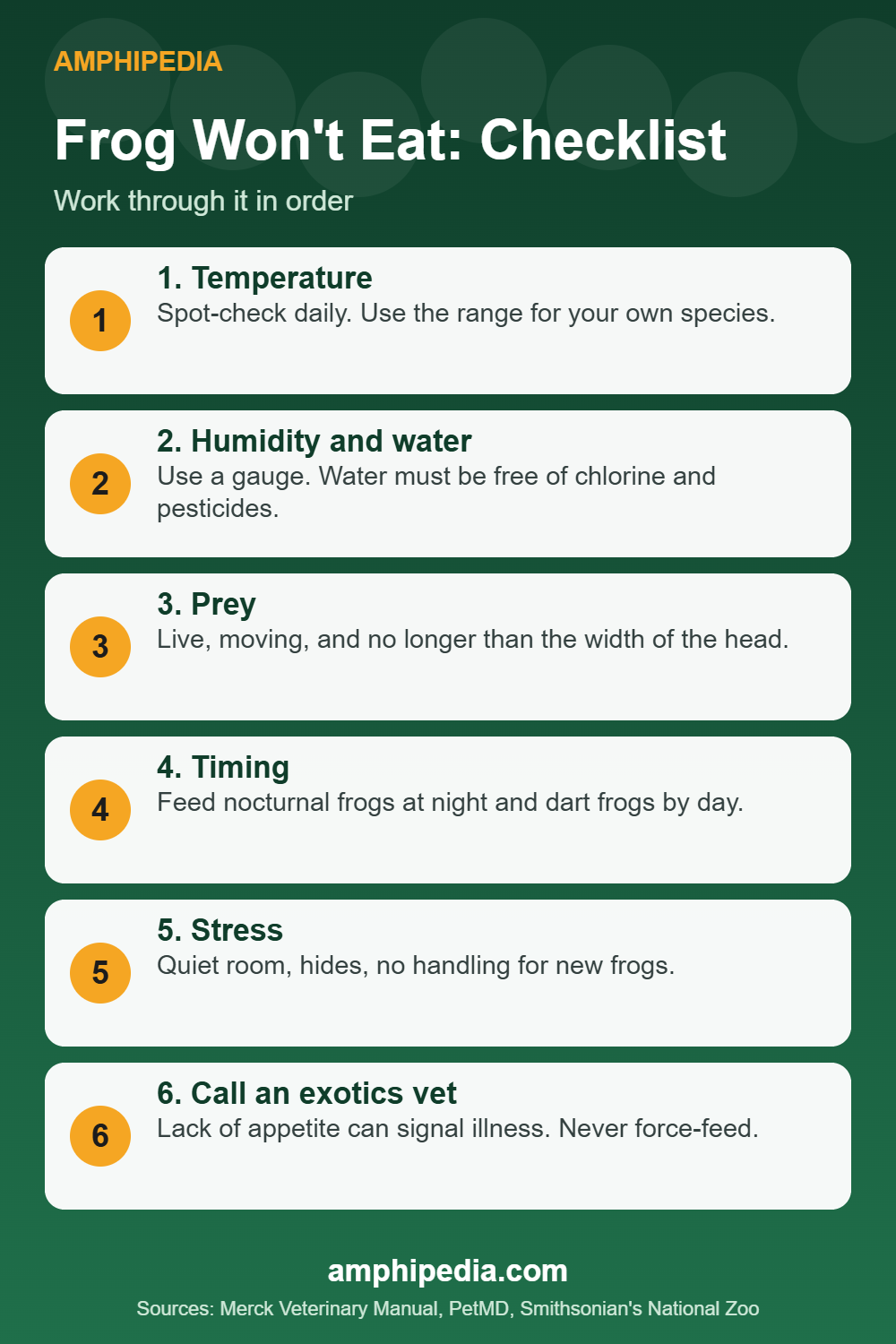
Pin this infographicShare on Facebook
Step 1: Check the temperature
Merck Veterinary Manual says each species has a preferred optimal temperature zone and that suboptimal conditions commonly cause infectious and nutritional disease in tropical amphibians. It advises spot-checking enclosures daily.
Ranges differ by species. A White’s tree frog handout gives 75 to 85 F by day and 68 to 75 F at night. Smithsonian’s National Zoo keeps its tropical frog habitats between 70 and 75 F. Use the range for your own frog.
Step 2: Check humidity and water
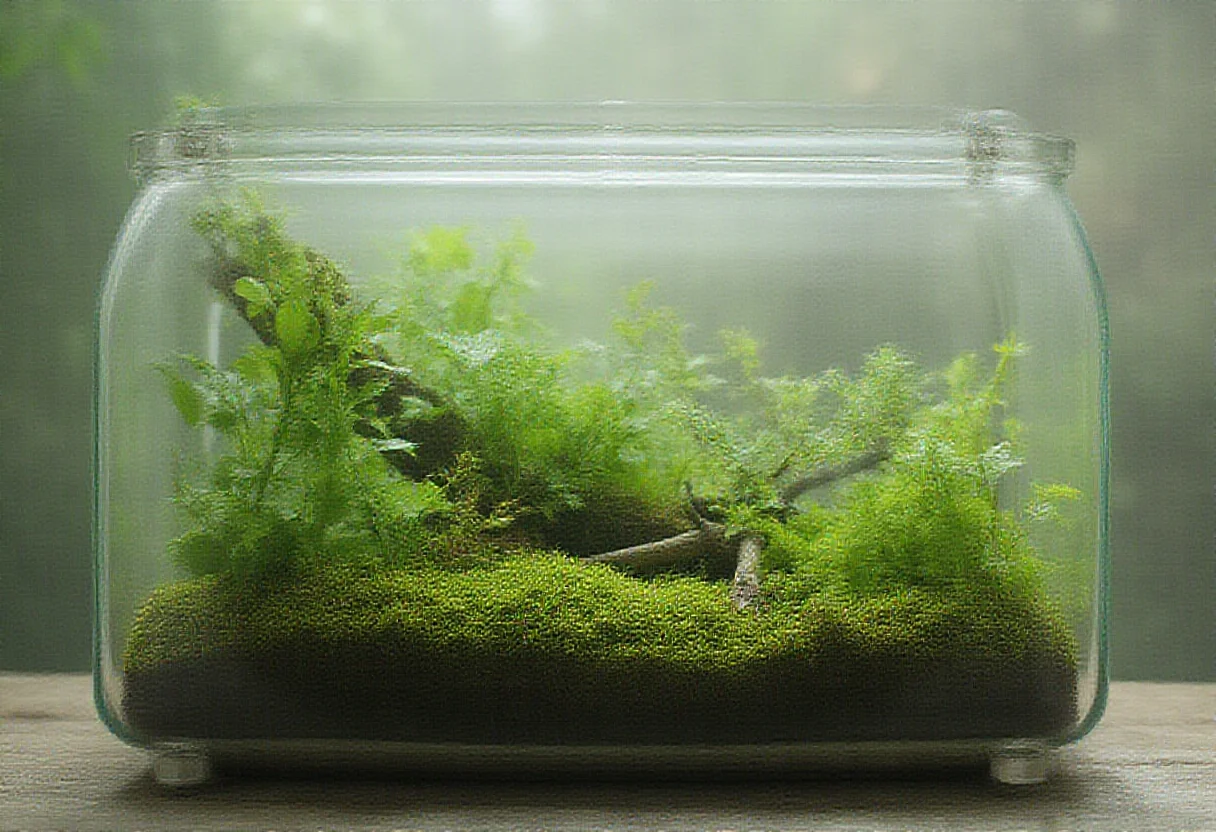
Merck says tropical species may need 85 to 90 percent humidity, and the White’s tree frog handout gives 60 to 70 percent for that species. Check your species and use a gauge, not a guess.
Water must be free of chlorine, ammonia, nitrite, pesticides and heavy metals, according to Merck. Replace the dish water daily, as frogs often defecate in it. Dirty or untreated water can stress a frog.
| Check | Reported range | Source |
|---|---|---|
| White’s tree frog, day | 75 to 85 F | White’s tree frog handout |
| White’s tree frog, night | 68 to 75 F | White’s tree frog handout |
| Tropical frogs, general | 75 to 80 F | Merck |
| Tropical frogs at a zoo | 70 to 75 F | Smithsonian’s National Zoo |
| Humidity, White’s tree frog | 60 to 70% | White’s tree frog handout |
| Humidity, tropical species | 85 to 90% | Merck |
Step 3: Check the prey
Prey should suit the frog’s size. Reptiles Magazine says feeder insects should be no longer than the width of the frog’s head between its eyes. Josh’s Frogs says most dart frogs will not eat prey much over one eighth of an inch.
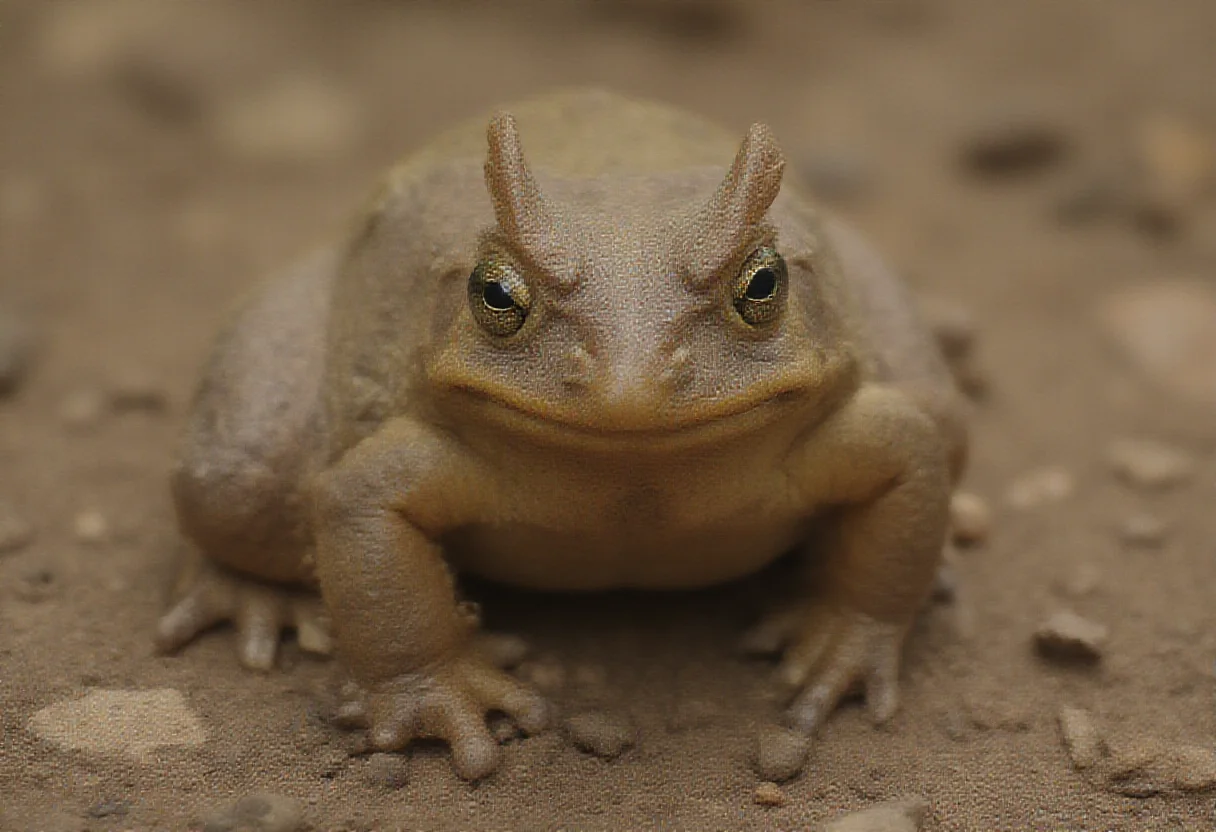
Frogs hunt by sight, so offer live, moving prey. Smithsonian’s National Zoo says fast-moving prey catches a frog’s attention. Dead or still insects are often ignored. Ambush hunters such as the horned frog sit motionless and wait for prey to pass, relying mainly on sight, according to Animal Diversity Web.
Step 4: Check the time of day
Nocturnal frogs eat after dark, and diurnal frogs eat by day. A White’s tree frog handout says to feed at night, when frogs are active and more likely to eat right away. Animal Diversity Web describes the green and black dart frog as diurnal.
A frog that sits still at noon may be perfectly normal. See when frogs eat at night to match your feeding to your species.
Step 5: Check for stress
Smithsonian’s National Zoo notes that stress can weaken a frog’s immune system and that rapid changes can be harmful. Merck recommends quarantine of 6 to 8 weeks for new amphibians, with disturbances kept low.
Move the enclosure out of busy spots, avoid handling, and avoid rearranging the decor. Give the frog plants and hides. Give a new frog time to settle before judging its appetite.
Check the lighting cycle
Light can affect a nocturnal frog’s behaviour. PetMD advises 10 to 12 hours of light a day for green tree frogs, then lights off or a nocturnal or infrared bulb so the frog can rest. The White’s tree frog handout advises against white light at night.
If the enclosure is lit around the clock, a nocturnal frog may stay hidden and miss its feeding window. Put the lights on a timer and give the frog a real night.
Step 6: Review diet and supplements
A diet of one insect type can lead to imbalance, according to the White’s tree frog handout. Rotate feeders and use supplements as your vet advises. Merck says supplements prevent nutritional disease and that most invertebrates lack key vitamins.
Overfeeding can also blunt appetite. The handout says obesity is common. If a frog is plump and eating less, it may simply be well fed. Check the weight and your schedule.
- Check temperature with a thermometer at frog level.
- Check humidity with a gauge.
- Test and change the water.
- Resize and refresh the prey.
- Feed at the right time for your species.
- Reduce disturbance for several days.
- Record everything in a log.
Is it a skipped meal or a real problem?
Not every skipped meal is a problem. A White’s tree frog handout says adults eat every two to three days, or two to three times a week, so a frog that skips a day is behaving normally. Juveniles are fed daily, so a missed day matters more.
Look at the pattern over several scheduled feedings, not one night. A frog that skips one feeding but eats the next is different from one that refuses everything for a week. Your log will show the trend.
A simple log you can copy
Merck advises keeping a log of appetite and behaviour, and regular weight checks may be beneficial. The table shows the columns to track. The rows are examples of how to fill it in.
Take a photo of the frog and the enclosure each week. A vet can compare photos with the frog in the clinic.
| Date | Food offered | Eaten | Temp and humidity | Notes |
|---|---|---|---|---|
| Day 1 | Small crickets | 4 of 6 | Day 78 F, 65% | Active at dusk |
| Day 3 | Roaches | 0 of 4 | Day 78 F, 65% | Hiding all evening |
| Day 5 | Smaller crickets | 3 of 6 | Day 80 F, 65% | Quiet room, no handling |
Signs that mean call a vet
PetMD says lack of appetite and inability to catch prey are signs of possible health problems. If you see either after fixing the setup, contact a veterinarian with amphibian experience, which you can find through the ARAV directory at arav.org/professionals.
The White’s tree frog handout also notes that obesity can make the supratympanic ridge overgrow and nearly cover the eyes, making it hard to see and eat. A vet can assess that.
What a vet may check
Merck lists common diagnostics for amphibians as fecal parasitology, water quality testing, skin scrapes, PCR assays for chytridiomycosis and ranavirus, gill biopsies and blood work. A vet decides which tests fit your frog.
Bring your log, photos of the enclosure, the temperature and humidity readings, and the foods you use. This helps the vet find the cause faster.
What not to do
Do not force-feed. Do not give medicine, vitamins or home remedies without veterinary advice. Do not offer human food, which PetMD says frogs should not receive. Do not move the frog to a new enclosure unless advised.
Do not ignore a refusal just because the frog still looks healthy. Keep a close eye on weight, skin, posture and activity, and write down any change.
Related guides
For technique, read how to get your frog to eat and our dart frog guide. For schedules, see how often frogs eat and drink.
Use a temperature gradient, not a single reading
Merck says each species has a preferred optimal temperature zone, and that a thermal gradient inside that zone lets most amphibians regulate their own body temperature. One reading in one corner can hide a cold or hot spot.
Measure in three places: the warm side, the cool side and the spot where the frog sits. Merck advises spot-checking enclosures daily. Smithsonian’s National Zoo notes that even tropical frogs do not tolerate extreme heat, so add warmth in small steps and recheck. For one species, the Panamanian golden frog, the zoo says temperature swings stress the animals and weaken the immune system. Steady temperatures are worth the effort.
If your frog is aquatic, check these instead
Aquatic frogs such as African dwarf frogs do not hunt crickets, and their appetite depends on the water.
- Water: WWF lists filtered, dechlorinated water with a pH between 6.5 and 7.8, kept at 68 to 78 F (about 20 to 26 C).
- Testing: Merck recommends weekly tests for temperature, pH, hardness, ammonia, nitrite and nitrate in aquatic setups.
- Food: WWF lists sinking carnivore pellets plus thawed bloodworms, blackworms and brine shrimp. Merck also names white worms and tubifex worms as foods for adult amphibians.
- Tankmates: WWF says African dwarf frogs can share a tank with friendly aquatic species only if those are well fed, because the frogs may eat them or be eaten.
- Leftovers: Merck says to remove uneaten food and waste daily.
Vary the menu from sourced feeders
A frog that ignores the same insect every night may only need a different one. Smithsonian’s National Zoo lists soldier flies, fruit flies, bean beetles, worms and crickets, and notes that fast-moving crickets catch a frog’s attention. Merck names earthworms, bloodworms, crickets and mealworms for adult amphibians.
Variety also helps nutrition. Merck says amphibians cannot make carotenoids, so they need a source of vitamin A, and that supplements prevent nutritional disease. Ask your vet which supplement suits your species instead of guessing.
A seven-day reset plan
Change one thing at a time so you can tell what worked. This plan only applies after the frog has had time to settle in.
- Day 1: measure temperature in three spots and check humidity. Correct any drift, then replace the water.
- Day 2: clean the dish, test the water if the frog is aquatic, and add no new decor.
- Day 3: offer fresh, correctly sized live prey at the hour your species is active. Remove anything uneaten.
- Days 4 to 6: leave the frog alone except for scheduled feedings and write down every result.
- Day 7: read the log. If the frog refused every scheduled feeding, or any warning sign appeared, call an exotics vet.
Frequently Asked Questions
Why is my frog not eating?
Common reasons are the wrong temperature or humidity, prey that is too big or still, stress, or illness.
How long can a frog go without food?
The sources reviewed give no safe number. Call an exotics vet if the refusal continues after you fix the setup.
Should I force-feed my frog?
No. Only a vet should assist-feed.
Is it normal for a new frog not to eat?
It can be. New frogs need time, and Merck recommends a 6 to 8 week quarantine with low disturbance.
Can stress stop a frog from eating?
Yes. Smithsonian’s National Zoo notes that stress weakens immunity and that rapid changes are harmful.
Where can I find an exotics vet?
Use the ARAV directory at arav.org/professionals.
Bottom Line
A frog that stops eating needs a methodical response. Check heat, humidity, water, prey, timing and stress, and write everything down.
If the refusal continues, call an exotics vet rather than trying home fixes.
Sources
- Environment and Husbandry for Amphibians, Merck Veterinary Manual. Used for: Temperature, quarantine, diagnostics.
- Housing for Amphibians, Merck Veterinary Manual. Used for: Humidity, water.
- Diet for Amphibians, Merck Veterinary Manual. Used for: Supplements.
- How to Keep Your White’s Tree Frog Healthy, Happy and Safe (Companion Amphibian Care Series, K. Krause DVM, 2018). Used for: Temperature, humidity, feeding time, obesity.
- How to Care for Frogs, Smithsonian’s National Zoo. Used for: Prey movement, stress.
- Frog Care 101, PetMD. Used for: Appetite loss as a health sign.
- What to feed your frog, PetMD. Used for: No human food.
- Keeping and Breeding Red-eyed Treefrogs, Reptiles Magazine. Used for: Prey size.
- How often and how much to feed dart frogs, Josh’s Frogs. Used for: Dart frog prey size.
- Dendrobates auratus, Animal Diversity Web. Used for: Diurnal activity.
- Reptiles and amphibians, CDC. Used for: Salmonella and hygiene.
- Find a veterinarian, ARAV. Used for: Exotics vet directory.
- Responsible Pet Guide: African dwarf frog, WWF. Used for: Aquatic frog water range, pH, food and tankmates
2 Comments