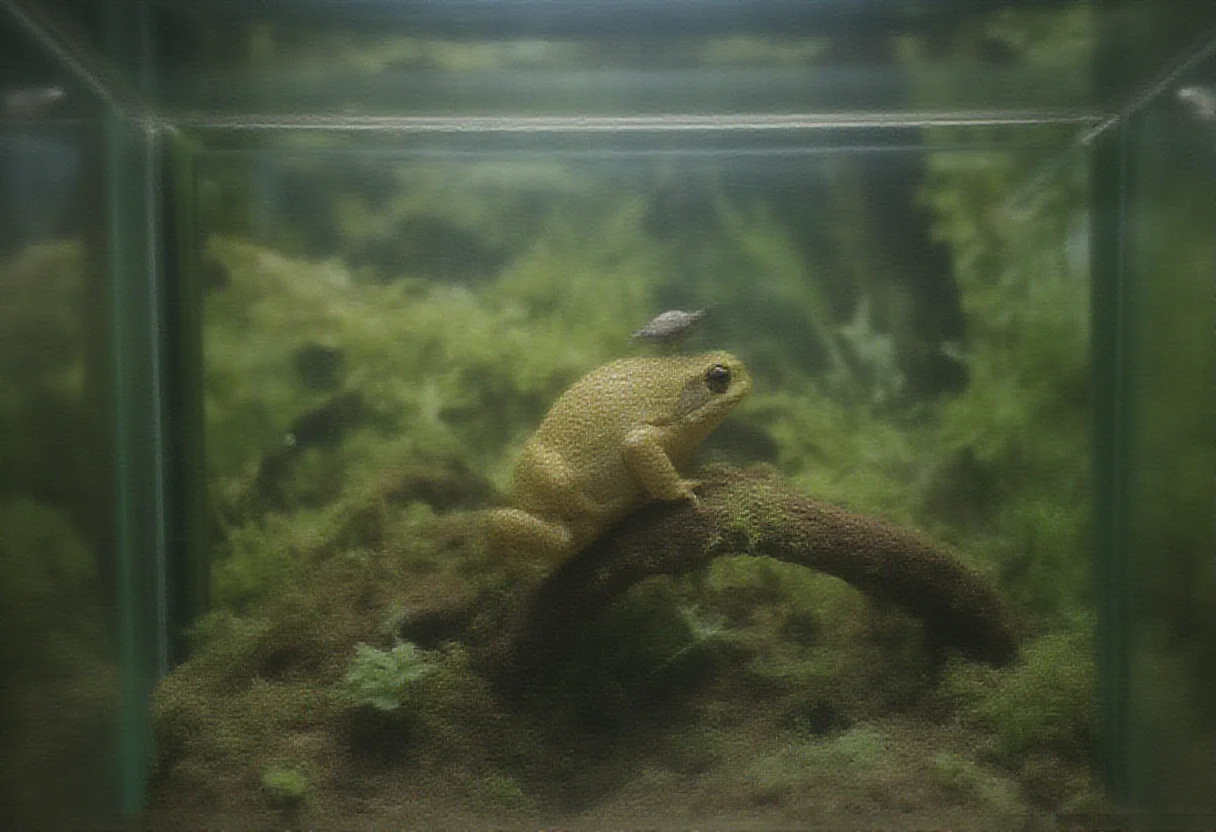
How Many Times Do Frogs Eat a Day? Meals by Age
Most frogs eat no more than once a day. Young frogs may get one meal daily, while many adult pet frogs eat every two to three days. Wild frogs have no fixed count, because ambush hunters eat whenever suitable prey passes within reach. In captivity, offer only what your frog finishes in about 15 minutes, then remove the rest.
People often ask whether a frog should eat several times a day. For most pet frogs, the answer is no. One meal a day is the upper limit, and many adults do better with fewer.
This guide looks at meals per day by age and species, what counts as one meal, and why more food is not better.
How this was made: prepared with AI assistance and checked against the sources listed at the end. Images are AI-generated illustrations, not photographs of real animals or products.
Key Takeaways
- One meal a day is the usual maximum, and mainly for juveniles.
- Adult White’s tree frogs eat every 2 to 3 days, and adult green tree frogs every other day.
- A meal means the insects a frog finishes in about 15 minutes.
- Wild ambush frogs eat when prey passes, with no fixed count.
- Overfeeding causes obesity and can shorten a frog’s life.
- Rotate food types and dust prey with supplements as your vet advises.
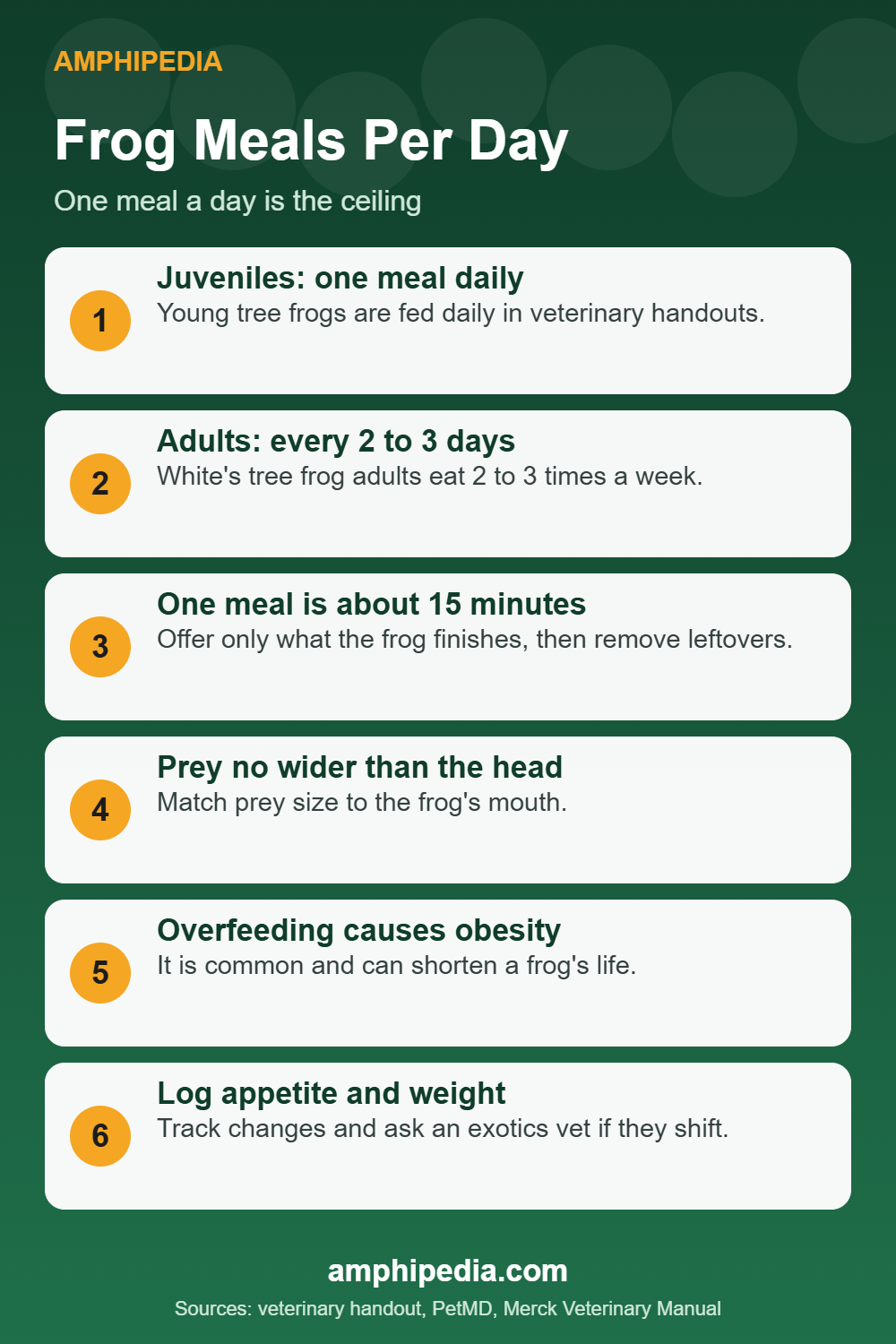
Pin this infographicShare on Facebook
The short answer by age
Juvenile frogs are growing fast, so they get fed more often. A veterinary care handout for White’s tree frogs says juveniles eat daily, subadults and adults every two to three days, and adults two to three times a week.
PetMD gives a similar pattern for green tree frogs: daily for juveniles and every other day for adults. Neither source suggests feeding several separate meals in one day.
What counts as one meal
PetMD advises offering only as many insects as the frog can eat within 15 minutes. Prey should be no wider than the frog’s head. The same article says to dust insects with calcium and multivitamin powder before feeding.
A meal is therefore a short session, not a bowl left out. Remove live insects that are still loose after the session so they do not stress the frog or nibble on it.
- Choose prey no wider than the frog’s head.
- Dust prey with the supplement your vet recommends.
- Offer a small number of insects.
- Watch for about 15 minutes.
- Remove anything uneaten.
Meals per week by species
Different species and housing systems use different rhythms. The table collects the schedules reported by veterinary, university and retailer sources.
Use it as a guide to ranges, not as a fixed rule for your frog.
| Situation | Meals | Source |
|---|---|---|
| White’s tree frog, juvenile | 1 per day | Companion Amphibian Care Series handout |
| White’s tree frog, adult | Every 2 to 3 days | Companion Amphibian Care Series handout |
| Green tree frog, adult | Every other day | PetMD |
| Dart frogs | 3 days a week | Josh’s Frogs (retailer) |
| Lab frogs on pellets | Every other day | Rutgers University SOP |
Dart frogs and small prey
Dart frogs eat tiny prey, so their meals look different. Josh’s Frogs, a retailer, says most dart frogs will not eat prey much over one eighth of an inch. It feeds on Monday, Wednesday and Friday and says daily feeding is possible but not required.
The same page suggests placing a banana slice as a feeding station. If few flies are left at the next feeding, give the same amount. If many remain, skip a feeding and feed less.
Wild frogs have no fixed count
Animal Diversity Web describes the horned frog as a wait-and-ambush predator that eats almost any prey that fits in its mouth. Such a frog eats when food arrives, which can mean several meals one week and none the next.
That wild pattern is not a model for a pet. In captivity, food is always available, so the keeper has to set the limit.
Why more food is not better
The White’s tree frog handout warns that obesity is common and can shorten lifespan. It can make the supratympanic ridge overgrow and nearly cover the eyes, which makes it hard to see and eat.
PetMD warns that waxworms are high in fat and that feeding only waxworms can cause obesity. Mealworms are high in chitin, and large amounts can cause constipation.
Signs you may need to adjust
Merck Veterinary Manual advises keeping a log of appetite and behaviour, and regular weight checks may help. A frog that gains weight steadily may need smaller or fewer meals.
If a frog stops eating for several scheduled meals, review temperature, humidity and water, then talk to an exotics vet. See our guide on what to do if your frog won’t eat.
Related guides
For water needs and weekly planning, read how often frogs eat and drink. For food choices, see the best food for a White’s tree frog.
Build a feeding routine step by step
The sources above give ranges, not a single schedule. A routine turns those ranges into something you can repeat. Start with the conservative end of the range for your frog’s age and adjust from there.
- Identify the species and life stage, since a juvenile and an adult of the same species are fed differently.
- Pick fixed feeding days, such as Monday, Wednesday and Friday for dart frogs or every second day for an adult tree frog.
- Choose prey no wider than the frog’s head, as PetMD advises.
- Dust or gut load the prey (see the next section).
- Offer a small number of insects and watch for about 15 minutes.
- Remove any live insects left loose, then write down what was eaten.
Keep the days the same from week to week. A regular rhythm makes it easier to notice when a frog eats less than usual.
After two or three weeks, review the log. If your frog finishes every meal quickly and its weight holds steady, the plan is working. If insects are regularly left over, cut the portion before you change the days. Make one change at a time so you can tell which change made the difference, and share the pattern with your vet at the next check-up.
Why live food and supplements matter
The Merck Veterinary Manual says long-term care of most captive amphibians requires live food. Most adult terrestrial and aquatic amphibians eat invertebrates such as earthworms, bloodworms, springtails, fruit flies, fly larvae, mealworms and crickets. Some species eat vertebrate prey, so check what your species needs.
Merck also says vitamin and mineral supplements are needed to prevent nutritional disease. It lists three methods:
- Gut loading insects, which means feeding the insects a nutritious diet before they are offered.
- Using commercial diets that are high in calcium.
- Dusting insects with a powdered multivitamin that contains vitamin D3 and calcium.
Merck adds that amphibians cannot synthesize carotenoids, so they need a dietary source of vitamin A. Ask your exotics vet which product and schedule suit your species, because over-supplementing is also a risk.
How a lab schedule compares
A husbandry procedure from Rutgers University shows how research colonies handle feeding. For the frogs in that procedure, staff feed every other day (Monday, Wednesday, Friday) with a pelleted diet and give a set number of pellets per animal. They remove leftover food 2 to 3 hours after feeding and replace the water.
That procedure covers a specific laboratory setup, so do not copy its pellet counts or water routine for a pet. What carries over is the pattern: fixed days, measured amounts and prompt removal of leftovers. This matches the “every other day” pattern in the table above for many adult frogs.
Keep a simple feeding log
Merck advises keeping a log of appetite and behavior, and says regular weight checks may be beneficial. The advice appears in its section on quarantine, but the same habit helps any keeper. A log also gives your vet real data if something goes wrong.
| What to record | Why it helps |
|---|---|
| Date and food offered | Shows whether the schedule is being kept and whether food types are rotating |
| How much was eaten in about 15 minutes | Spots a frog that is eating less or more than usual |
| Weight, if you can weigh safely | Shows slow gain or loss that the eye can miss |
| Supplement used | Prevents missed or doubled doses |
| Behavior notes | Records hiding, activity changes or unusual posture |
Common feeding mistakes to avoid
- Feeding on demand. A frog that follows your hand is not necessarily hungry.
- Offering prey that is too big. PetMD advises prey no wider than the head.
- Relying on one food. PetMD warns that waxworms are high in fat and mealworms are high in chitin.
- Leaving live insects in the enclosure overnight, where they can stress or nibble on the frog.
- Skipping supplements or guessing the amount.
- Treating wild feeding as a model. Ambush hunters eat when prey passes, but a pet has food on tap.
When to ask an exotics vet
Talk to an exotics vet if a frog refuses several scheduled meals in a row, loses weight over time or gains weight steadily despite small meals. Bring your feeding log, the species name and details of the enclosure temperature, humidity and water.
You can find an exotics vet through the ARAV directory. This page gives general information, not veterinary advice.
Frequently Asked Questions
How many times a day should a frog eat?
At most once a day, and that mainly applies to juveniles. Many adults eat every two to three days.
Can I feed my frog twice a day?
The sources reviewed do not recommend it. Overfeeding causes obesity, which is common in captive frogs.
How much should a frog eat at once?
Offer only what it can finish in about 15 minutes, according to PetMD.
How often do dart frogs eat?
One retailer feeds dart frogs three times a week, and says daily feeding is possible but not required.
How often do wild frogs eat?
There is no fixed rate. Ambush hunters such as horned frogs eat when prey passes by.
Do baby frogs eat more often?
Yes. Juvenile tree frogs are fed daily in the veterinary handouts reviewed.
Bottom Line
For most pet frogs, one meal a day is the ceiling, and adults usually need far less. Age, species and body condition decide the rhythm.
Define a meal as what the frog finishes in about 15 minutes, rotate foods, and track weight.
Sources
- How to Keep Your White’s Tree Frog Healthy, Happy and Safe (Companion Amphibian Care Series, K. Krause DVM, 2018), accessed 12 November 2026 (schedule, obesity, supplements).
- Green tree frog care sheet, PetMD, accessed 12 November 2026 (meal length, prey size, schedule).
- What to feed your frog, PetMD, accessed 12 November 2026 (waxworms, mealworms, supplements).
- Ceratophrys cornuta, Animal Diversity Web, accessed 12 November 2026 (wild ambush feeding).
- Environment and Husbandry for Amphibians, Merck Veterinary Manual, accessed 12 November 2026 (live food, supplements, appetite log and weight checks).
- How often and how much to feed dart frogs, Josh’s Frogs, accessed 12 November 2026 (retailer schedule, feeding station).
- Terrestrial amphibian husbandry SOP 3.12, Rutgers University, accessed 12 November 2026 (lab feeding every other day, leftover removal).
- Reptiles and amphibians, CDC, accessed 12 November 2026 (Salmonella and hygiene).
3 Comments