Where Do Newts Lay Eggs? Leaves, Ponds and Timing
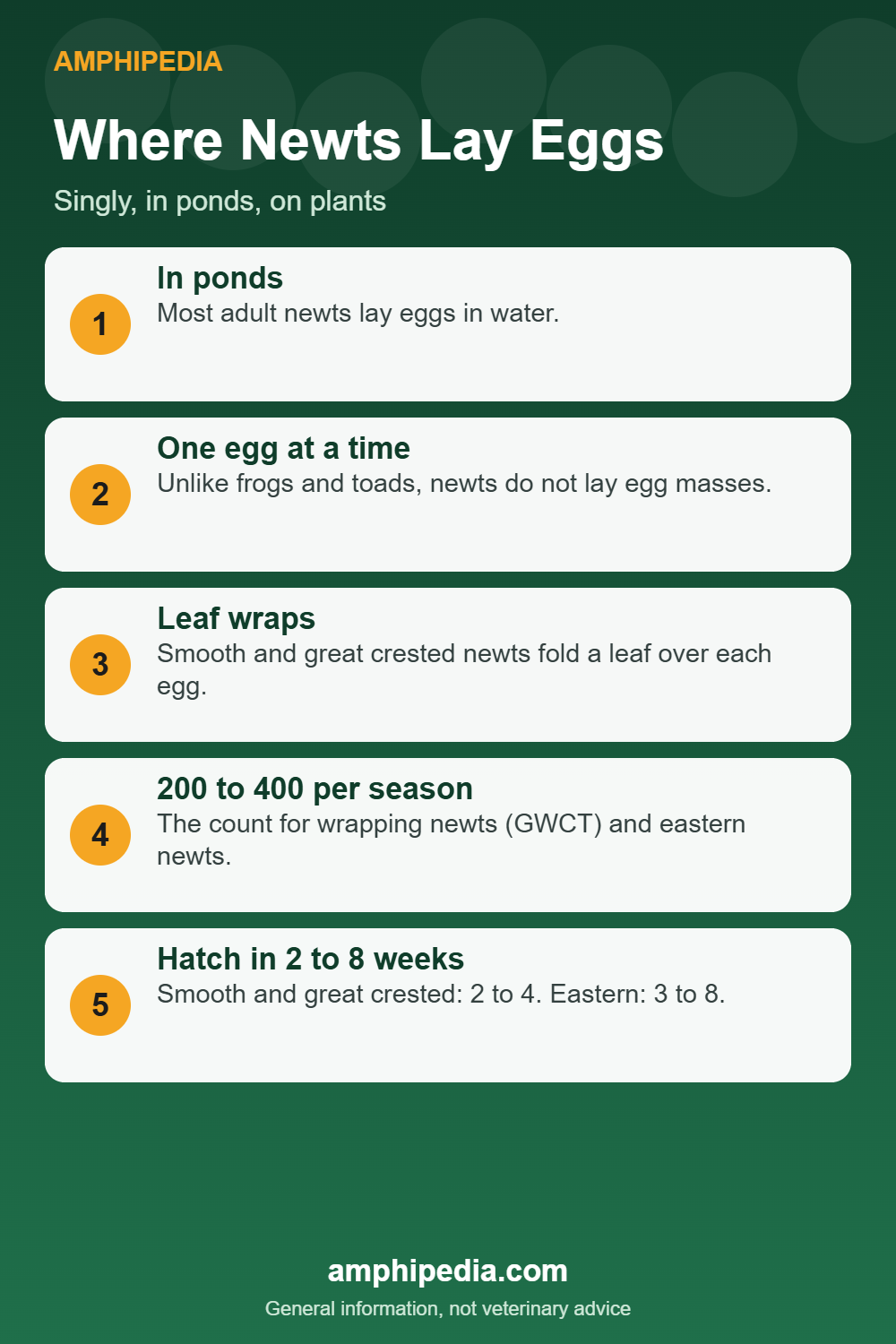
Most newts lay their eggs one at a time in water, usually on the leaves or stems of pond plants. Smooth and great crested newts fold a leaf around each egg with their back legs. Eastern newts attach single jelly-covered eggs to underwater plants, and a female lays 200 to 400 in a season. Hatching takes about two to four weeks for smooth newts and three to eight weeks for eastern newts.
Newt eggs are easy to miss. They are not laid in a big mass like frog spawn. Each egg is small, jelly-covered, and often hidden.
This guide covers where and how newts lay eggs, with numbers from wildlife trusts and research sites. For more on species groups, see newts vs salamanders.
How this was made: prepared with AI assistance and checked against the sources listed at the end. Images are AI-generated illustrations, not photographs of real animals or products.
Key Takeaways
- Most newts lay single eggs in water, not egg masses like frogs.
- Smooth and great crested newts wrap each egg in a folded leaf of a pond plant.
- Eastern newts attach eggs to submerged plants, and females lay 200 to 400 per season.
- Eggs hatch in about two to eight weeks, depending on species and temperature.
- A few newt species lay eggs on land or give birth to young, according to Britannica.
Pin this infographicShare on Facebook
The short answer: in ponds, on plants
Britannica states that most adult newts lay eggs in water, and the young pass through an aquatic larval stage. Newts breed in ponds, and the Game and Wildlife Conservation Trust (GWCT) notes that mature newts spend about a third of their lives in ponds, usually from February to July.
Unlike frogs and toads, newts lay eggs singly rather than in a mass.

How newts wrap eggs in leaves
Froglife says smooth newt females lay eggs singly on the leaves of aquatic plants, wrapping each one in the leaf. The GWCT says a female places a single egg on a thin, rounded leaf, such as water mint or speedwell, then folds the leaf over it with her back legs.
Great crested newts do the same, according to Froglife. A female may lay and wrap 200 to 400 eggs in a season, per the GWCT.
Egg facts by species
Sources differ in detail, so the table names each one.
| Newt | Where and how | Hatch or count (source) |
|---|---|---|
| Smooth newt | Single eggs on aquatic plant leaves, each wrapped in the leaf | Larvae hatch two to four weeks after laying (Froglife) |
| Great crested newt | Single eggs folded inside leaves of aquatic plants | Hatch about two to four weeks after laying (Froglife) |
| Eastern newt | Single jelly-covered eggs attached to submerged vegetation | 200 to 400 eggs per season, hatch in 3 to 8 weeks (Animal Diversity Web) |
| Rough-skinned newt | Each egg in a separate gelatinous coating, 3 to 4 mm | Hatch 3 to 4 weeks after laying (Animal Diversity Web) |
What do newt eggs look like?
Froglife describes smooth newt eggs as greyish-brown or dirty white, inside a transparent jelly capsule about 3 mm across. It adds that they are very hard to tell from palmate newt eggs.
Great crested newt eggs are white with a light yellow centre, in a jelly capsule about 4.5 to 6 mm across, per Froglife. The GWCT puts the eggs at about 5 mm.

When do newts lay eggs?
Timing follows the weather. Froglife reports that great crested newts leave winter sites in March or April to breed. Males perform courtship before eggs are laid.
The Animal Diversity Web says eastern newts breed from late winter into early spring, and females lay a few scattered eggs a day, so laying takes several weeks. The female swims away after laying and gives no care.
Do all newts lay eggs in water?
No. Britannica notes that a few newt species lay eggs on land, and a few give birth to miniature adults. Newts also differ in how long they stay in water, from fully aquatic to mostly land-living.
One source difference to note: New York wildlife officials describe clusters of 200 to 400 eggs on vegetation or fallen leaves, while the Animal Diversity Web describes single eggs. This likely reflects total clutch versus how eggs are placed.
If you find eggs in a pond
- Look, but do not move leaves or eggs.
- Do not collect eggs or larvae. Rules differ by place.
- Great crested newts have full legal protection in the UK, per Froglife.
- Wash your hands after any pond contact.
- Keep fish out of newt ponds if you can. The GWCT notes fish eat eggs.
Frequently Asked Questions
Where do newts lay their eggs?
Mostly in ponds, one at a time, on aquatic plants. Smooth and great crested newts fold a leaf around each egg.
How many eggs does a newt lay?
The GWCT says 200 to 400 in a season for a newt that wraps eggs. The Animal Diversity Web gives the same range for eastern newts.
Do newts lay eggs in clumps?
Mostly no. Froglife and the GWCT describe single eggs, unlike frogspawn. Some sources describe clusters, so check the species.
How long do newt eggs take to hatch?
About two to four weeks for smooth and great crested newts, three to eight weeks for eastern newts.
Do newts guard eggs?
The Animal Diversity Web says eastern newt parents give no care, and the female swims away after laying.
Can newts lay eggs on land?
A few species do, according to Britannica, but most lay in water.
Bottom Line
Newts lay eggs in water, one at a time, and often hide each one in a folded leaf. The count is high, but few survive to adulthood.
If you find eggs, leave them in place and enjoy the sight.
Sources
- Froglife: Smooth newt, accessed 31 October 2026
- Froglife: Great crested newt, accessed 31 October 2026
- Game and Wildlife Conservation Trust: Newts, accessed 31 October 2026
- Animal Diversity Web: Notophthalmus viridescens (Eastern Newt), accessed 31 October 2026
- Animal Diversity Web: Taricha granulosa (Rough-skinned Newt), accessed 31 October 2026
- New York DEC: Eastern (Red-Spotted) Newt, accessed 31 October 2026
- Britannica: Newt, accessed 31 October 2026
- CDC: Reptiles and Amphibians, accessed 31 October 2026