Amphibians as Pets: What to Know Before You Buy
Amphibians can be rewarding pets, but they are not low-maintenance. They need species-specific temperature, humidity and clean water, live food, and very little handling because their skin is delicate. They can carry Salmonella, and the CDC does not recommend them for households with children under 5, adults 65 and older or people with weakened immune systems. Many live for years, and local laws may apply.
Frogs, toads, newts and salamanders look easy to keep behind glass. In practice each group has strict needs.
This guide covers the main points that vets and government agencies stress, so you can decide whether an amphibian suits your home.
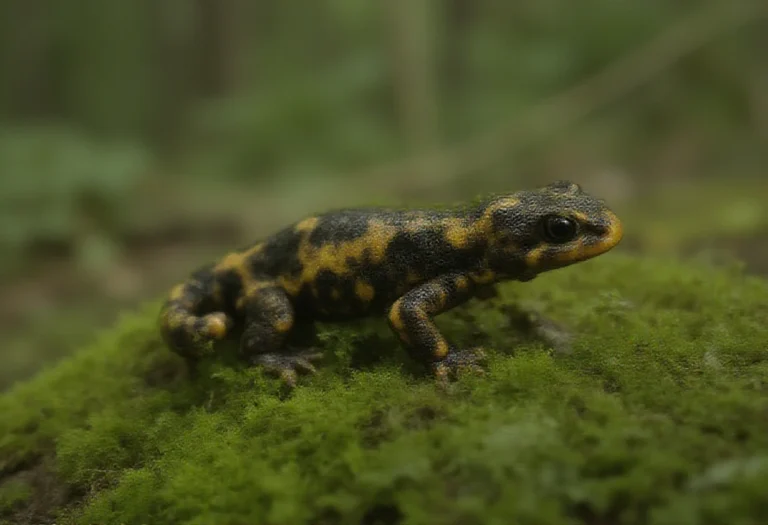
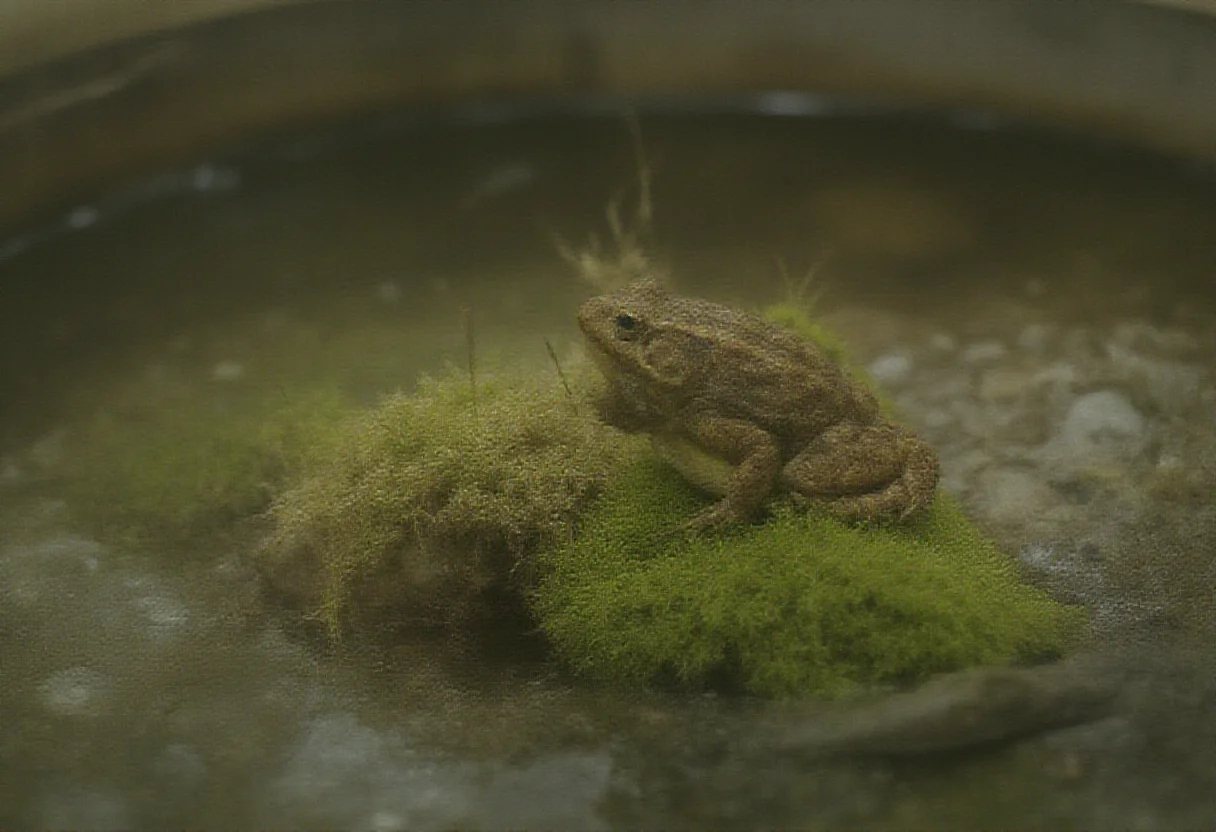
How this was made: prepared with AI assistance and checked against the sources listed at the end. Images are AI-generated illustrations, not photographs of real animals or products.
Key Takeaways
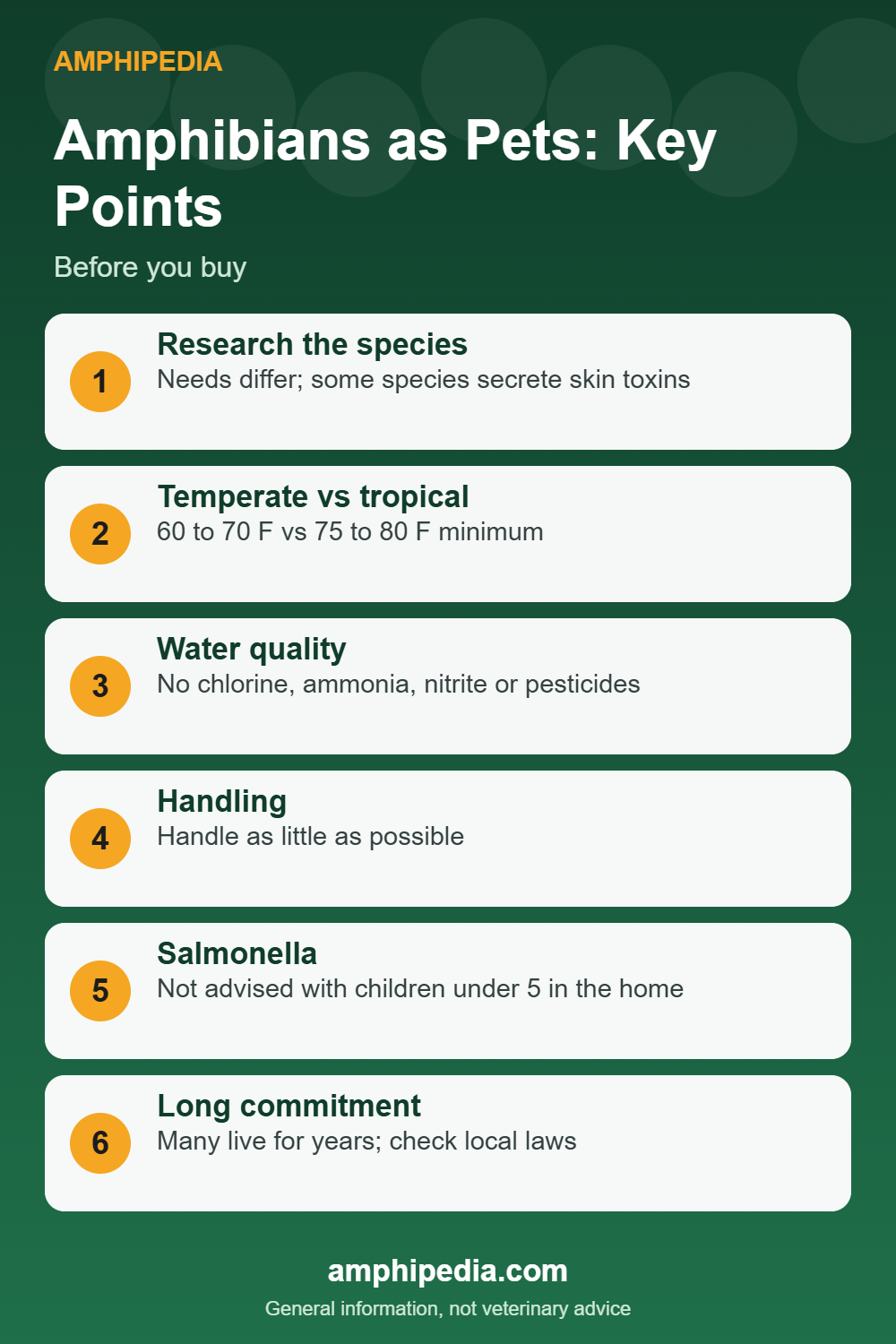
- Research the species first; needs differ widely between temperate and tropical animals.
- Handle as little as possible; skin is delicate and absorbs substances.
- Water must be free of chlorine and other contaminants.
- Salmonella is a real risk, and young children need extra care.
- Amphibians can live for many years, so plan for a long commitment.
Pin this infographicShare on Facebook
Know the species before you buy
A Texas A&M veterinary college article advises owners to research a species before buying. It notes that some species secrete skin toxins, which makes them less ideal pets.
Needs vary between groups. The same article gives temperate species at least 60 to 70 F with 75 to 80 percent humidity, and tropical species at least 75 to 80 F with 85 to 90 percent humidity.
Housing and water basics
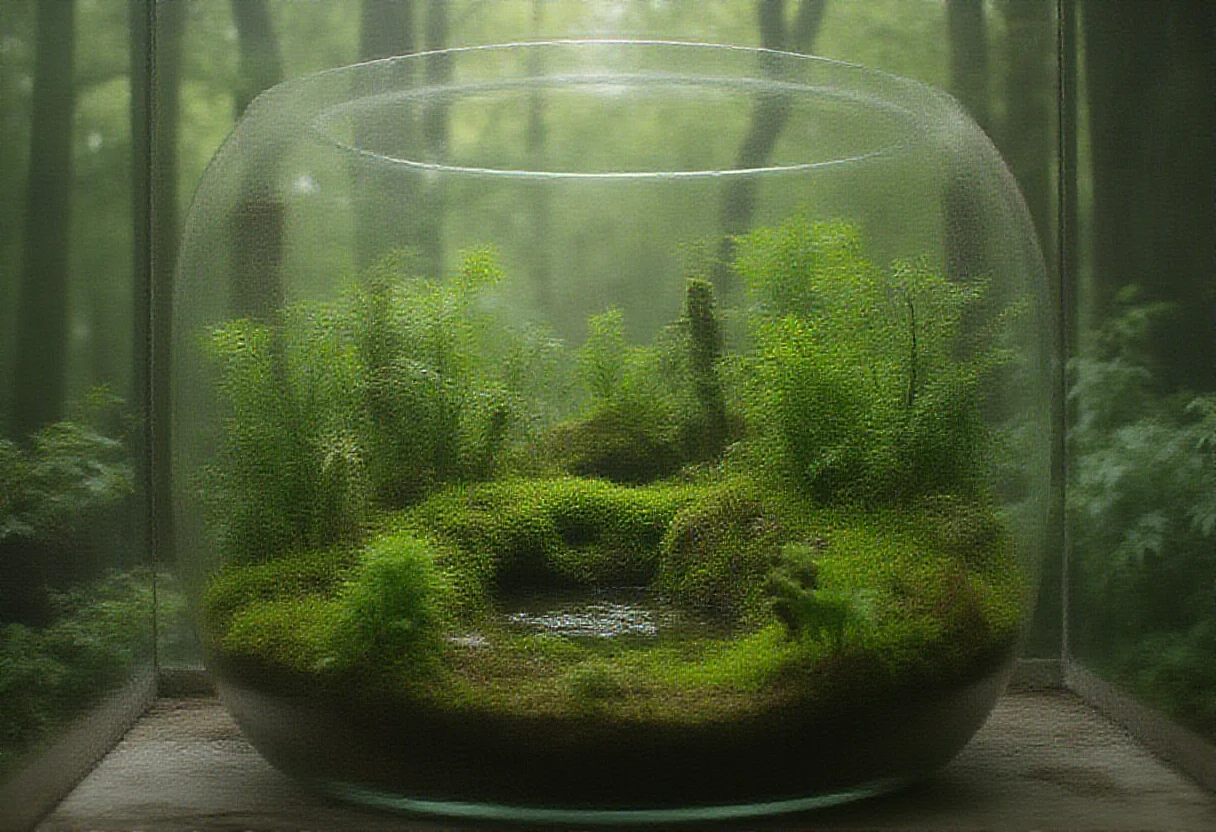
Agriculture Victoria says enclosures must be escape-proof and should mimic the natural habitat. Any rocks must be too large to swallow.
Water matters as much as air. Texas A&M advises water free of chlorine, ammonia, nitrite, nitrate, pesticides and heavy metals. Agriculture Victoria suggests a dechlorinator or bottled water.
| Need | Temperate species | Tropical species |
|---|---|---|
| Temperature | At least 60 to 70 F | At least 75 to 80 F |
| Humidity | 75 to 80 percent | 85 to 90 percent |
| Extra gear | Thermostat and gradient | Misting, humidifier or waterfall may be needed |
What do pet amphibians eat?
Agriculture Victoria says most amphibians eat only live invertebrates such as insects, crickets, wax worms and roaches. It advises dusting prey with a powdered vitamin mix.
Never feed insects that may have been exposed to insecticides or other chemicals. Small, active species eat about daily, while larger, less active ones eat about once a week, per the same source.
Handling: less is better
Texas A&M says amphibians should not be handled more than absolutely necessary. If you must, wear disposable gloves with any powder rinsed off.
Agriculture Victoria warns that excessive handling can damage the skin, cause stress and invite infection. Wash your hands before touching an animal, since residue can harm it.
Treat amphibians as animals to watch, not to hold.
Health risks to people
The CDC says reptiles and amphibians are more likely than other pets to carry germs that make people sick, especially Salmonella. Healthy-looking animals can still carry it.
Children under 5, adults 65 and older and people with weak immune systems are at higher risk. The CDC does not recommend these pets for households that include them.
Keep the animal, its tank and equipment out of the kitchen.
Lifespan, legal rules and rehoming
Agriculture Victoria notes amphibians can live for many years. If you can no longer keep one, rehome it or seek veterinary advice. Never release it into waterways.
Rules about keeping amphibians vary by country, state and species. Check with your state wildlife agency before buying or collecting any animal. Wild collection is restricted in many places.
Which amphibians people actually keep
The MSD Veterinary Manual divides amphibians into three orders: frogs and toads (about 5,000 species), salamanders, newts and sirens (about 500) and legless caecilians (about 160). Pet keeping is almost entirely the first two orders.
The same page names three common pets. The axolotl is a strictly aquatic salamander that reaches 8 to 11 inches. The tiger salamander grows up to about 12 inches. The fire-bellied newt is usually 3 to 5 inches.
Lifespan is hard to generalize. The manual says amphibians live from months to many years, so check the figure for the exact species before you commit.
Two warnings from that source matter before you shop. Salamanders should never be taken from the wild, and some species are illegal in some US states.
Land, water or both: choosing the setup
The first decision is whether your animal lives in water, on land, or splits its time. An axolotl needs a full aquarium. A land-dwelling frog needs a ventilated terrarium with a shallow water dish. Mixing these up is a common reason for early losses.
| Setup detail | What the MSD Veterinary Manual says |
|---|---|
| Aquatic tank | Secure, ventilated top; regular water testing; gentle filtration without strong currents |
| Land tank | Good ventilation, about 1 to 2 air changes per hour; a shallow water dish; moisture from misting, a small waterfall or a humidifier |
| Substrate | Avoid cedar and pine because of toxic oils; gravel must be too large to swallow or small enough to pass; soil must have no additives |
| Plants | Not every plant is safe, so ask an experienced keeper, breeder or vet first |
| Instruments | At least one thermometer and one humidity gauge in every enclosure |
Lighting is where sources differ. The MSD Veterinary Manual states that UVB lighting is required to prevent metabolic bone disease in amphibians. It adds that not every full-spectrum bulb gives enough UVB and that bulbs need replacing every 6 to 8 months or as the maker directs. Texas A&M does not discuss lighting.
Agriculture Victoria only advises matching the day and night cycle to the species, with a typical 12 hours of light in warm months and 8 in winter. Because the advice differs, ask an exotics vet or an experienced breeder what your particular species needs.
Water quality: where the sources differ
The three care sources agree that chlorine is a problem. They disagree on the best replacement. Texas A&M says deionized bottled water is usually used in captivity. Agriculture Victoria suggests a pet-store dechlorinator or bottled water. The MSD Veterinary Manual says not to use distilled water in an enclosure.
The MSD manual also describes how to remove chlorine. Tap water can be circulated through a carbon filter for at least 24 hours. Water with chloramines needs a dechlorinating agent first. Aquatic tanks should be tested weekly for temperature, pH, hardness, ammonia, nitrite and nitrate.
- In an established aquatic tank, change at least 10 percent of the water each week (MSD Veterinary Manual).
- Replace food and water daily in land setups and remove uneaten food and waste (MSD Veterinary Manual, Texas A&M).
- Never use water that may hold pesticides or heavy metals (Texas A&M).
If you are unsure which water to use, ask an exotics vet about your tap water and your species rather than copying one source.
Buying: captive-bred animals and the salamander disease risk
Where an animal comes from affects its health and the law. Agriculture Victoria says wild-caught frogs cannot legally be kept as pets in Victoria, Australia. A pet frog must be captive bred and registered, and most species need a licence. Laws elsewhere differ.
AmphibiaWeb describes a second reason to be careful. The fungus Batrachochytrium salamandrivorans (Bsal) kills many salamanders, and newts appear most susceptible. It is thought to have spread through the international pet trade.
AmphibiaWeb reports that US salamander imports from 2010 to 2014 came almost entirely from or through Asia. In January 2016 the US Fish and Wildlife Service issued an interim ruling banning imports of more than 200 salamander species considered most likely to carry Bsal.
- Ask the seller for the scientific name and whether the animal is captive bred.
- Ask how long it has been in the seller’s care and what it eats.
- Walk away if the seller cannot say where the animal came from.
- Never release a pet amphibian outdoors. AmphibiaWeb says this includes animals you collected yourself and kept for 30 days.
Warning signs and when to call a vet
Agriculture Victoria lists four problems keepers should know. Heat stress shows as pacing followed by lethargy. Egg retention shows as a swollen abdomen. Cloacal prolapse means tissue protruding from the cloaca. Septicaemia can show as red patches on the lower legs and abdomen.
The MSD Veterinary Manual adds that common injuries include cuts, fractures, internal bleeding, desiccation and loss of toes, limbs or tails. Desiccation is common in animals that escape or are housed badly. It says prompt veterinary care is essential.
Do not give an amphibian any medicine on your own. The MSD Veterinary Manual is clear that medication should only come from a veterinarian. The ARAV website links to a vet finder for reptile and amphibian vets.
A household safety checklist
The CDC says reptiles and amphibians are more likely than other pets to carry germs that make people sick, and that Salmonella is the most common. It says children younger than 5 years old should not handle or touch reptiles or amphibians or their environments because they are at higher risk of serious illness.
The CDC advises considering another pet if the household includes young children, older adults or people with weakened immune systems.
- Wash hands with soap and running water after feeding the pet, handling its waste or equipment, and cleaning the tank, and before eating or drinking.
- If soap is not available, use a hand sanitizer with at least 60 percent alcohol, and supervise young children using it.
- Keep the animal and its equipment out of the kitchen and any place where food is prepared, stored or eaten.
- Clean tanks and equipment outside the home when possible. Otherwise use a laundry sink or bathtub and disinfect it afterward.
- Pour tank water down the toilet, not a kitchen sink or drain.
- Change clothes after handling the animal, especially before holding a baby.
For bites, the CDC recommends washing right away with warm soapy water and seeing a doctor if the wound is serious or becomes red, painful, warm or swollen.
Frequently Asked Questions
Are amphibians good pets for beginners?
They suit people who enjoy watching rather than holding. Each species has strict needs, so research first.
Can you handle pet frogs?
As little as possible. Skin is delicate, and handling can stress the animal and invite infection.
Do pet amphibians carry Salmonella?
They can. The CDC says healthy-looking reptiles and amphibians can carry it.
What do pet amphibians eat?
Most eat live invertebrates such as crickets, wax worms and roaches, dusted with a vitamin mix.
Is tap water safe for amphibians?
Not untreated. Chlorine must be removed with a dechlorinator or bottled water is used.
Are amphibians safe around young children?
The CDC does not recommend them for households with children under 5, adults 65 and older or people with weakened immune systems.
Bottom Line
Amphibians reward careful keepers, but the commitment is real. Research the species, set up the habitat before purchase and keep handling to a minimum.
To explore specific pets, see pet frog breeds and are newts good pets.
Sources
- Texas A&M College of Veterinary Medicine: Amphibians as Pets, accessed 13 November 2026
- Agriculture Victoria: Caring for your pet amphibian, accessed 13 November 2026
- CDC: Reptiles and Amphibians, accessed 13 November 2026
- MSD Veterinary Manual (pet owner version): Introduction to Amphibians, accessed 13 November 2026
- MSD Veterinary Manual (pet owner version): Housing for Amphibians, accessed 13 November 2026
- AmphibiaWeb: Batrachochytrium salamandrivorans, accessed 13 November 2026
- ARAV: Find a professional, accessed 13 November 2026 (page links to the ARAV vet finder)