Do Frogs Eat Beetles? Diet Studies and Exceptions
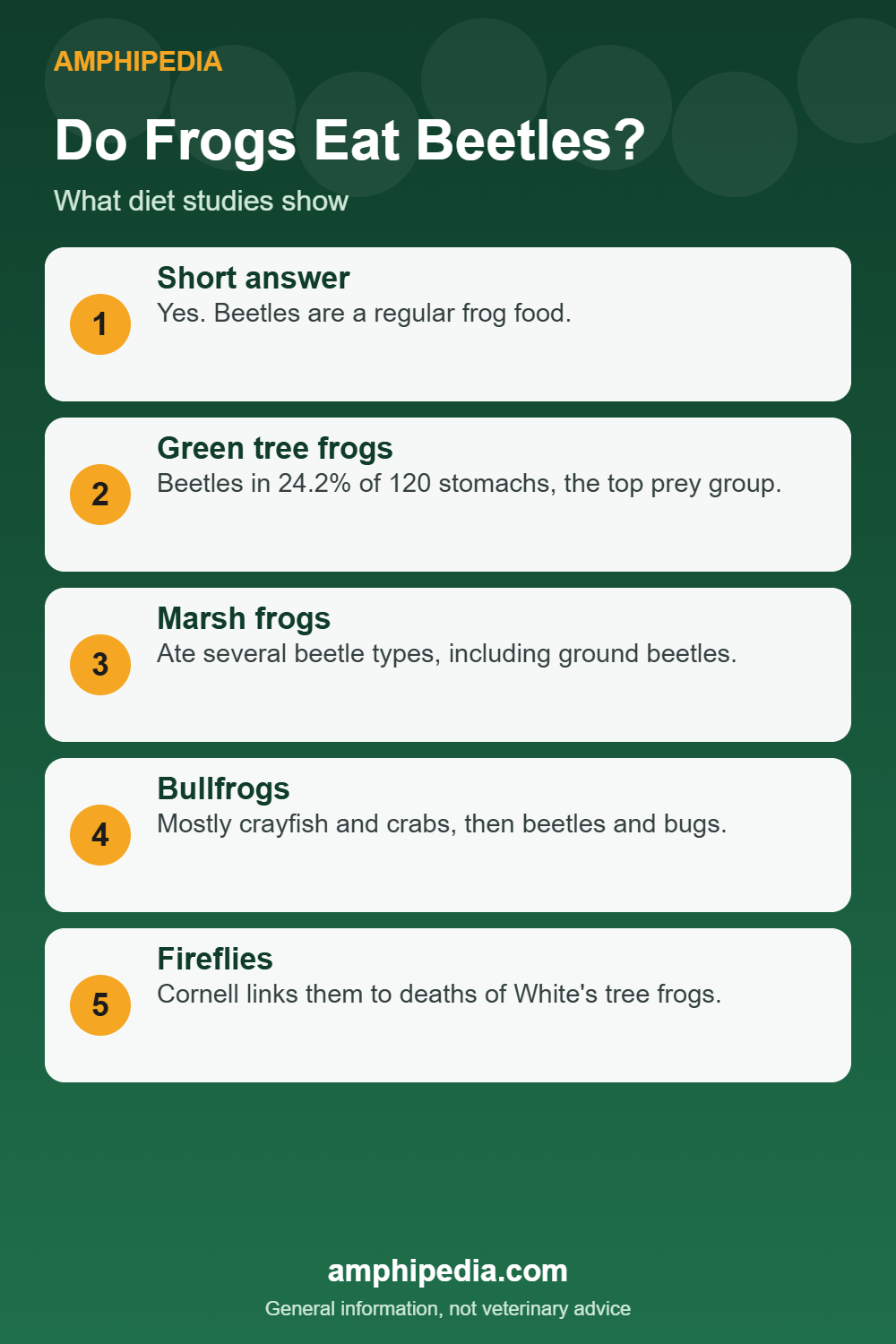
Yes. Beetles are a regular food for many frogs. In a study of 120 green tree frogs from Arkansas, 24.2% of stomachs held beetles, more than any other prey group. Marsh frogs in Romania and bullfrogs in Japan also ate them. The exception is fireflies, which are beetles too. A Cornell report links their toxins to deaths in pet reptiles and White’s tree frogs.
Frogs eat nearly any moving animal that fits in their mouths. Beetles are common, hard-shelled and plentiful on the ground and on plants, so they show up often.
Here is what published diet studies found, how frog size changes the picture, and the one beetle group that can be deadly.
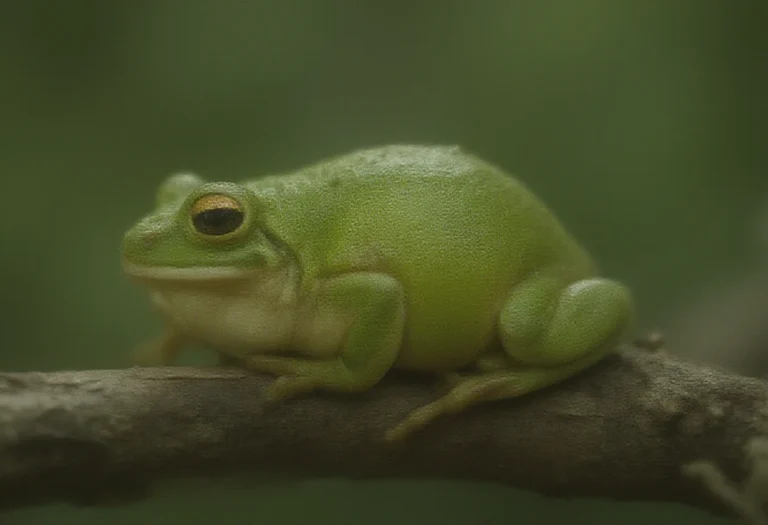
How this was made: prepared with AI assistance and checked against the sources listed at the end. Images are AI-generated illustrations, not photographs of real animals or products.
Key Takeaways
- Beetles were the most frequent prey group in green tree frogs from Arkansas.
- Marsh frogs in Romania ate several beetle types, including ground beetles.
- Bullfrogs in Kyoto ate mostly crayfish and crabs, with beetles making up much of the rest.
- Fireflies are beetles that contain lucibufagin toxins.
- White’s tree frogs died after eating fireflies, per Cornell.
- Studies show what wild frogs eat, not what is safe for a pet.
Pin this infographicShare on Facebook
Green tree frogs: beetles come first
A study of green tree frogs (Hyla cinerea) from Arkansas examined 120 stomachs from frogs collected between 1956 and 2014. Beetles were the most frequent prey. They appeared in 24.2% of stomachs, with 29 beetle items counted.
The authors reported frequency of occurrence, not the share of the total diet by volume. Frequency tells you how many frogs had a prey type, not how much they ate.
| Prey group | Stomachs with this prey | Items |
|---|---|---|
| Beetles | 24.2% | 29 |
| Spiders and relatives | 13.3% | 16 |
| Flies | 10.0% | 12 |
| True bugs | 9.2% | 11 |
| Grasshoppers and crickets | 7.5% | 9 |
| Moths and butterflies | 6.7% | 8 |
Marsh frogs in Romania
A study of 43 marsh frogs (Pelophylax ridibundus) in the Danube Delta in April 2007 counted 330 prey items. Beetles showed up in several forms. Undetermined beetles made up 9.68% of prey in females and 13.1% in juveniles. Ground beetles (Carabidae) were 6.67% of prey in males.
Beetles were not the top prey there. The authors name terrestrial isopods, spiders, aquatic snails and beetles as the most important groups. Small sample sizes mean the exact figures could change with more frogs or other seasons.
Bullfrogs in Japan
In the Kyoto area, American bullfrogs (Lithobates catesbeianus) ate mostly crayfish and crabs by volume. The study abstract says the rest was composed mainly of beetles, bugs and centipedes. Vertebrates were a very small part of the diet.
The study found that juvenile bullfrogs ate small crustaceans, while adults ate crayfish and crabs. Frog size shapes what is on the menu, so a small frog and a large frog will not eat the same beetles.
The exception: fireflies
Fireflies are beetles. Cornell researchers reported in 1999 that North American Photinus fireflies contain lucibufagins, steroid-like defensive toxins. Two bearded dragons at the Philadelphia Zoo died within hours of eating them.
The same report notes that White’s tree frogs died after an owner in Ohio fed them fireflies. Other reptiles died too. That is a report of deaths in captive animals, not a measure of what wild frogs do. Wild frogs may learn to avoid fireflies, but the Cornell report does not say so.
Never feed fireflies or wild-caught glowing beetles to a pet frog.
What this means for pet frogs
Studies of wild frogs show what they can eat. They do not prove that any beetle is a good feeder. Wild-caught insects can also be a poor choice, because the sources used here give no data on their pesticide or parasite load.
A review in Zoo Biology (Livingston and colleagues, 2014) found that common feeder insects are often low in calcium and vitamin A, and that gut-loading and dusting often fall short of target levels. Plan the whole diet with an exotics vet. The ARAV directory lists vets who treat amphibians.
For related questions, see do frogs eat rolly pollies and can frogs eat bread.
What the Arkansas stomach study can and cannot tell you
The green tree frog study examined 120 frogs from the Arkansas State University Museum of Zoology collection, taken between May 1956 and October 2014. These were preserved museum specimens, not a single season’s sample. The paper does not name collection sites and reports no breakdown by sex, size or season; the authors say future studies throughout the year may add insight.
Three details change how to read the beetle figure:
- 46 of the 120 stomachs (about 38%) held no identifiable food. 74 contained food: 60 had animal matter and 42 had vegetable matter.
- The paper lists 29 beetle items and a frequency of 0.242, which is 29 out of all 120 stomachs, empty ones included.
- Plant matter was mostly unidentifiable leaf, stem or flower pieces, plus three smartweed fruits. The authors suggest plant ingestion may be incidental, although it could supplement the diet when prey is scarce.
The authors name beetles and arachnids as the main prey, with flies and true bugs next, and say the diet resembles that of green tree frogs elsewhere. In other words, beetles are a staple in this sample, not an exclusive food.
How frogs choose prey: movement and size
Frogs are visual hunters. Animal Diversity Web (ADW) says adult green tree frogs eat flies, mosquitoes and other small insects, usually ones that are actively moving. The Virginia Herpetological Society says they are visual predators that respond to prey size, shape and speed. So a beetle that stays still may be ignored, while a moving one is a target.
Size sets a limit too. The Illinois Department of Natural Resources says the American bullfrog eats mostly crustaceans and insects, but will eat nearly any living creature it can catch and swallow. ADW describes the bullfrog’s strike: with a flash of the tongue, it grabs prey and brings it back into its mouth.
That is why the Kyoto bullfrogs ate crayfish and crabs, while the small Arkansas green tree frogs ate beetles and spiders. Habitat and body size decide what is available and what fits, so no single answer applies to every frog.
More about the firefly warning
The Cornell report adds detail on why fireflies are different. Lucibufagins are not the chemicals that make fireflies glow. They are steroidal pyrones, structurally similar to toxins in toads and certain plants. The report says birds that eat most other insects reject Photinus fireflies, and most North American animals seem to have an innate distaste for them.
The animals that died were captive and mostly exotic: two bearded dragons at the Philadelphia Zoo, White’s tree frogs fed by an owner in Ohio, a rock lizard fed one firefly on Long Island and a chameleon fed five or six fireflies in Illinois. The report says one firefly was enough to kill a lizard in at least one case.
It also describes a different beetle, a bombardier beetle that was spraying its irritant, eaten by bearded dragons in an experiment without reported harm. That result does not make the beetle safe for a frog. It shows only that the report found no harm in that test.
Feeder insects: what the nutrition review says
Livingston and colleagues (Zoo Biology, 2014) reviewed nutrient supplementation of feeder insects for amphibians. They say crickets commonly used as amphibian food have historically had low concentrations of calcium and vitamin A. Dusting with powder and gut-loading (feeding the insects a nutritious diet before they are offered) both raise these nutrients, but often fall short of target levels.
The authors suggest that better gut-loading diets and a standardized protocol may be the most effective approach. They conclude that, until breeders improve feeder insects, gut-loading and dusting appear necessary for amphibians and other insectivores in managed collections. The review is mostly about crickets and gives no beetle data, so it cannot say that beetles are a good feeder.
Common mistakes when thinking about frogs and beetles
- Treating a wild diet study as a feeding guide. The studies describe what frogs ate, not what is safe or nutritionally complete.
- Collecting beetles from the garden. The sources used here give no data on pesticide or parasite load in wild-caught insects.
- Offering glowing insects. Cornell’s reports involved fireflies fed to captive animals, and a firefly is a beetle.
- Assuming all frogs share a menu. Marsh frogs in Romania, bullfrogs in Kyoto and green tree frogs in Arkansas ate different mixes.
- Ignoring empty stomachs. A percentage out of all stomachs includes frogs that had nothing identifiable to eat when collected.
- Skipping the vet. An exotics vet can plan the whole diet, including calcium and vitamin A. The ARAV directory is at https://arav.org/professionals/.
Hygiene matters with any feeder. CDC says reptiles and amphibians often carry Salmonella, even when healthy, and advises washing hands with soap and running water after feeding a pet, handling its food or cleaning its tank. CDC also says children younger than 5 years old should not handle or touch reptiles or amphibians or their environments.
Frequently Asked Questions
Do all frogs eat beetles?
Most frogs eat insects, but beetles are not equally common in every frog’s diet. Habitat, season and frog size all matter.
Can frogs eat ladybugs?
The sources used here do not cover ladybugs and frogs, so this guide cannot say. Avoid feeding wild-caught insects to pet frogs.
Are fireflies poisonous to frogs?
Cornell reports White’s tree frogs died after eating fireflies, which contain lucibufagins.
What do green tree frogs eat most?
In the Arkansas study, beetles appeared in the most stomachs, followed by spiders and flies.
Do bullfrogs eat beetles?
Yes. In Kyoto, beetles were a main part of the diet beyond crayfish and crabs.
Do tadpoles eat beetles?
The studies used here covered adult and juvenile frogs, so this guide cannot say.
Can I feed my frog beetles from my garden?
The sources used here give no safety data. Ask an exotics vet before feeding wild-caught insects.
Bottom Line
Beetles are a regular food for many wild frogs, and the top prey group in the Arkansas green tree frogs. The big exception is the firefly.
If you keep frogs, build the diet with a vet and skip wild-caught insects.
Sources
- Diet of green treefrogs (Hyla cinerea) from Arkansas, 120 stomachs (open-access paper), accessed 31 October 2026
- David et al.: Diet of Pelophylax ridibundus, Danube Delta, Herpetologica Romanica, accessed 31 October 2026
- Current Herpetology: Diet of the American bullfrog in the Kyoto region, Japan, accessed 31 October 2026
- Cornell Chronicle (1999): Poisonous North American fireflies are killing exotic zoo and pet lizards, accessed 31 October 2026
- Livingston et al. (2014): Nutrient supplementation for amphibians, Zoo Biology, accessed 31 October 2026
- ARAV: Find an exotics veterinarian, accessed 31 October 2026
- CDC: Reptiles and Amphibians (Healthy Pets), accessed 13 November 2026
- Animal Diversity Web (University of Michigan): Lithobates catesbeianus, accessed 13 November 2026
- Illinois Department of Natural Resources: American bullfrog, accessed 13 November 2026
- Animal Diversity Web (University of Michigan): Hyla cinerea, accessed 13 November 2026
- Virginia Herpetological Society: Green Treefrog, accessed 13 November 2026
2 Comments