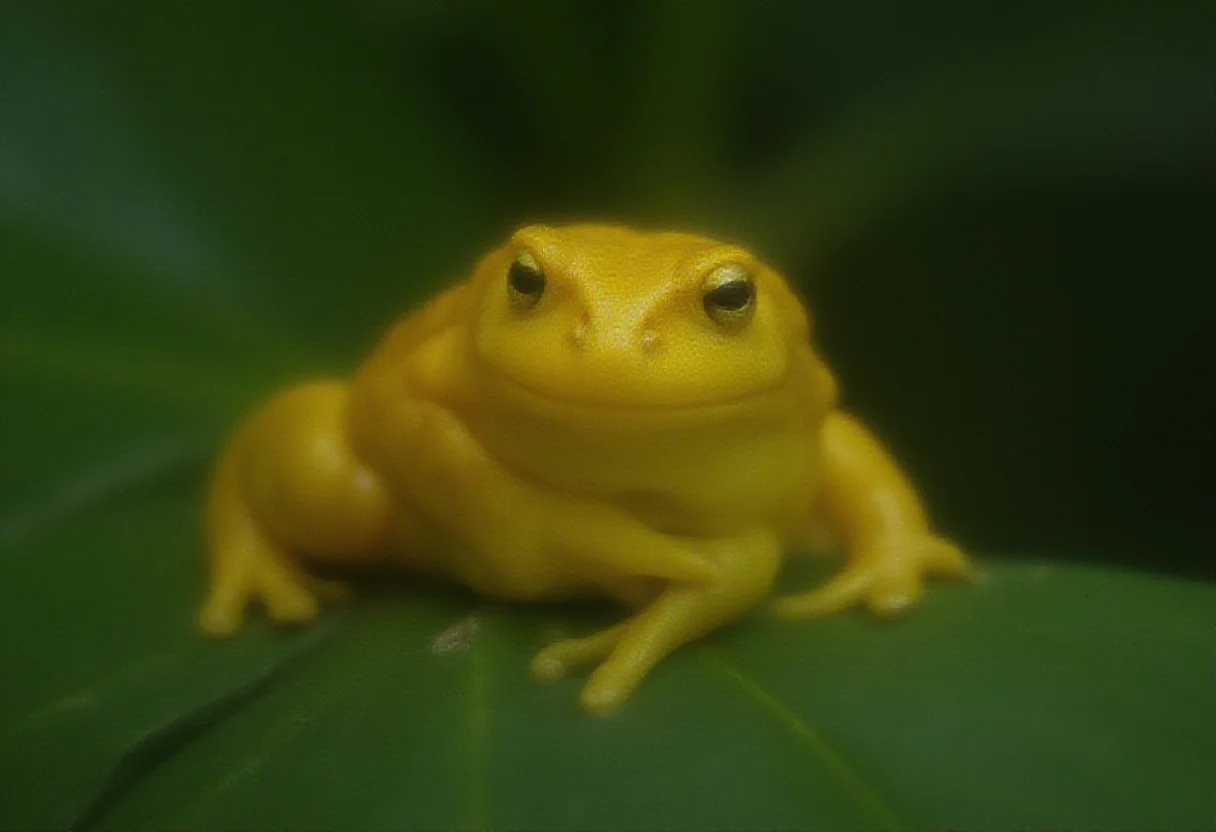
Golden Poison Dart Frog: Facts, Habitat and Toxin
The golden poison dart frog (Phyllobates terribilis) is a small, brightly colored frog from the Pacific coast of Colombia. It grows to about 5 cm, lives in wet lowland rainforest, and is listed as Endangered by the IUCN. Wild golden poison frogs carry batrachotoxin, a potent nerve and heart toxin they get from their diet. Captive-raised frogs do not have it.
The golden poison dart frog is often called the most poisonous animal on Earth. The claim is common, but the details are less well known: where the frog lives, what it eats, how it gets its toxin, and how few of them remain.
This article collects those facts from conservation groups, an aquarium and peer-reviewed research. Where sources disagree, both figures are shown.
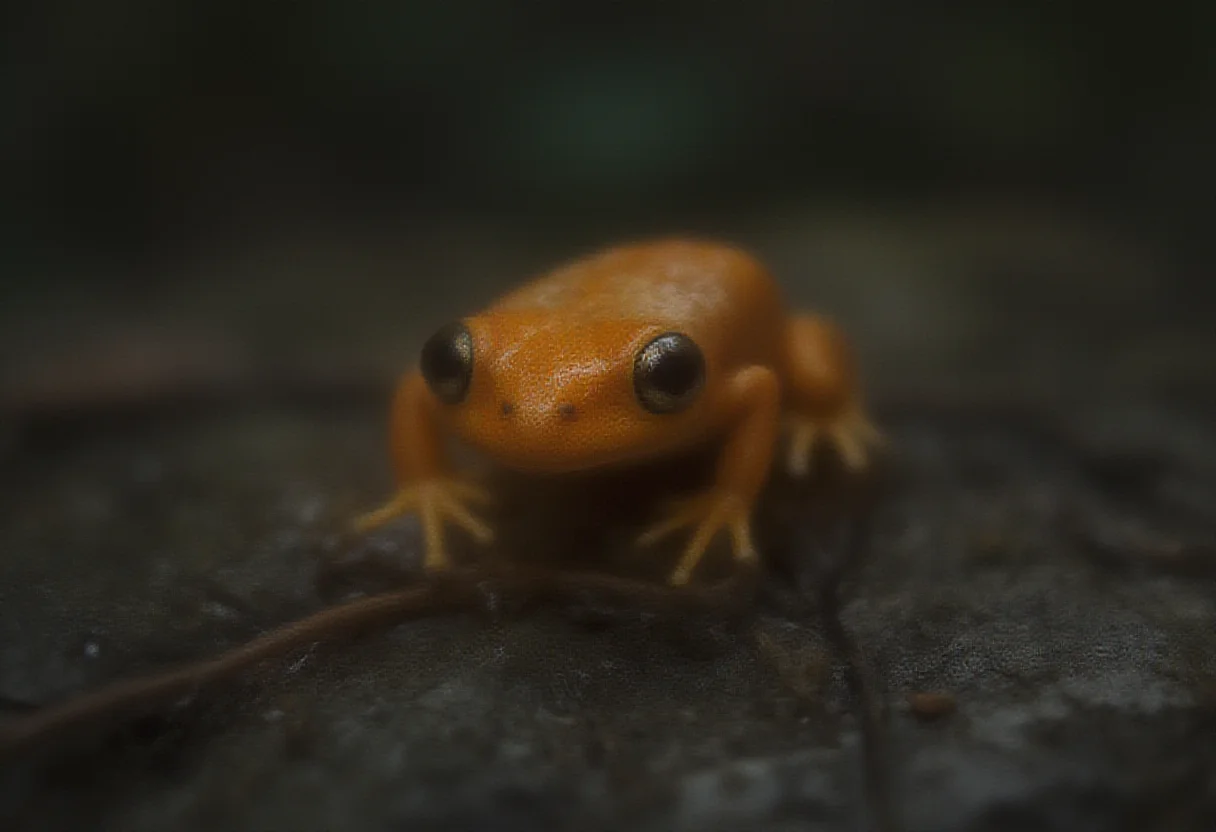
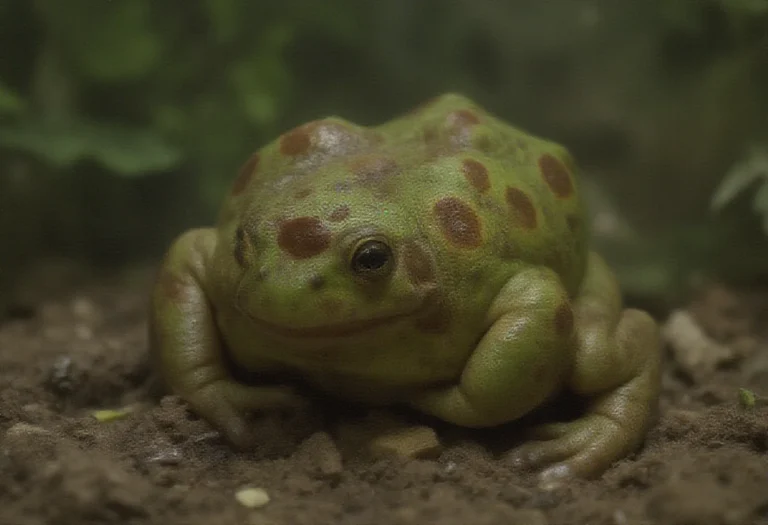
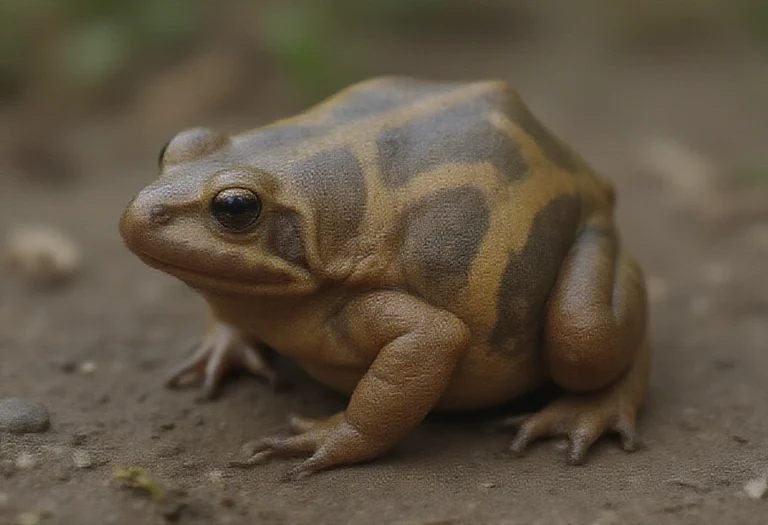
How this was made: prepared with AI assistance and checked against the sources listed at the end. Images are AI-generated illustrations, not photographs of real animals or products.
Key Takeaways
- Adults reach about 5 cm. Color ranges from golden-orange and golden-yellow to pale green.
- The species is found only in a small area of rainforest on Colombia’s Pacific coast.
- It is listed as Endangered by the IUCN.
- Wild frogs get batrachotoxin from their diet. Captive-raised frogs lack it.
- Wild lifespan is believed to be 6 to 10 years.
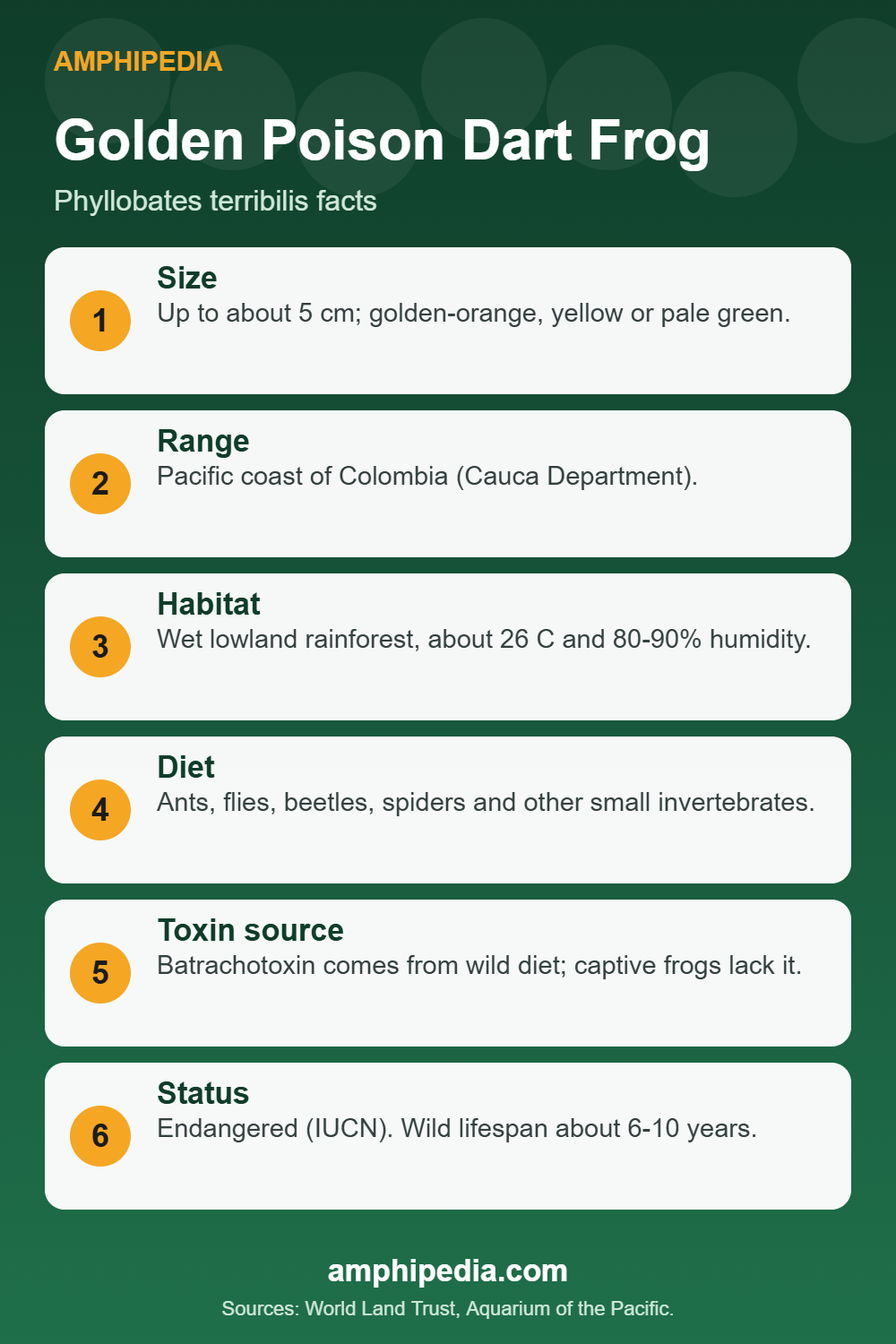
Pin this infographicShare on Facebook
Appearance and Size
The World Land Trust describes the golden poison frog as one of the largest poison dart frogs, up to about 5 cm long. Colors differ by location: golden-orange, golden-yellow or pale green.
The Aquarium of the Pacific gives a size range of 1.3 to 5.1 cm and notes that females are larger than males.
Bright color warns predators that the frog is dangerous. This is called warning coloration.
| Feature | Detail |
|---|---|
| Scientific name | Phyllobates terribilis |
| Length | Up to about 5 cm (1.3 to 5.1 cm range) |
| Color | Golden-orange, golden-yellow or pale green |
| Larger sex | Females |
| Wild lifespan | Believed to be 6 to 10 years |
| IUCN status | Endangered |
Range and Habitat
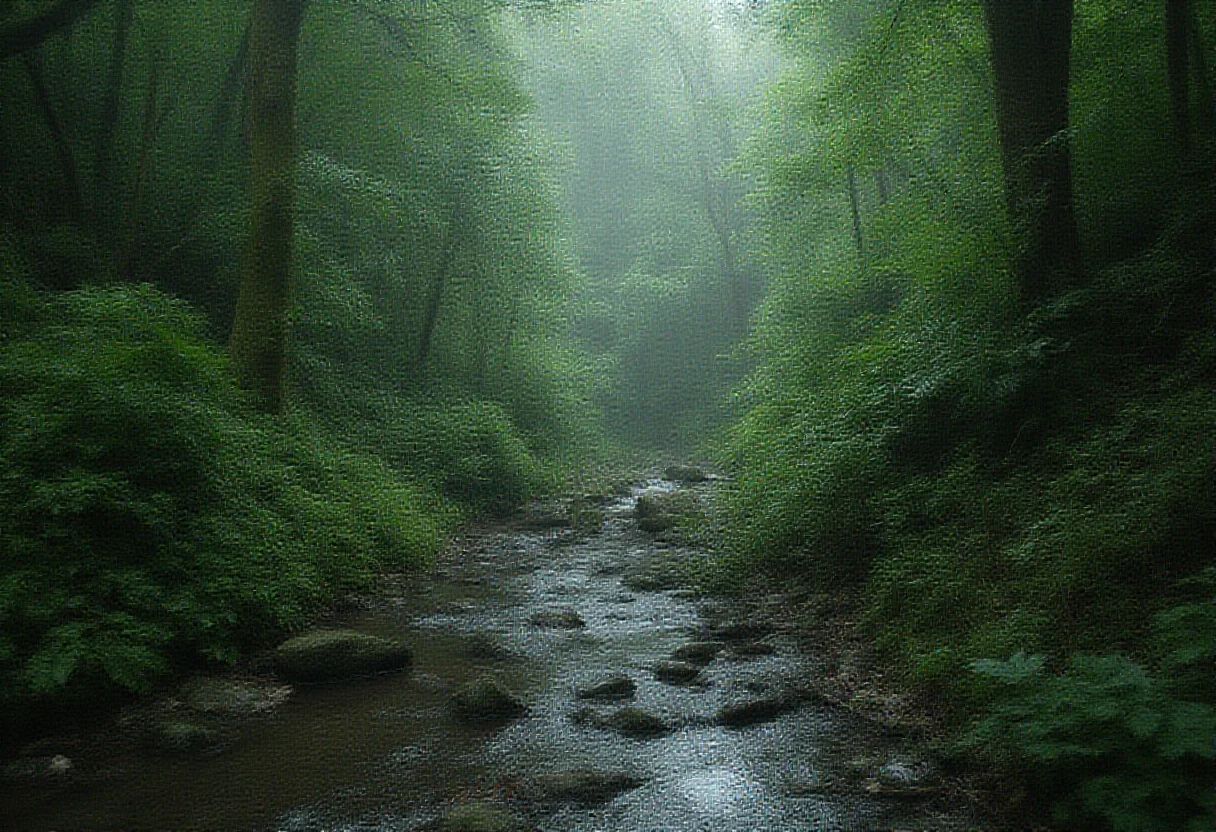
The species is endemic to a small area of westernmost Colombia, in the Cauca Department on the Pacific coast, according to the World Land Trust. Endemic means it lives nowhere else.
The Aquarium of the Pacific describes lowland rainforest at 100 to 200 m elevation with steep, rocky terrain and streams. The area gets about 5 m of rain per year, with temperatures near 26 C and 80 to 90 percent humidity.
The World Land Trust adds that this is one of the wettest tropical rainforests in the world, and that the habitat is small and shrinking.
Diet
Adults eat small invertebrates on the forest floor. The Aquarium of the Pacific lists flies, ants, beetles, spiders, mites, caterpillars and maggots. The World Land Trust also lists crickets and termites.
Tadpoles eat algae, microscopic plants, carrion and smaller tadpoles, according to the aquarium.
Diet matters for a bigger reason: it is the source of the frog’s toxin, as the next section explains.
Why the Frog Is Toxic
The golden poison frog carries batrachotoxin. A 2021 paper in the Journal of General Physiology states that the toxin is acquired in the wild from the frogs’ diet, so captivity-raised frogs lack it. A chemistry teaching page from Uppingham School says captive-born frogs have no batrachotoxin in their skin and that wild-caught frogs lose it over time.
The same teaching page says melyrid beetles that contain batrachotoxin may be part of the diet. It adds that it is not yet known whether the beetles make the toxin or get it from their own food.
Batrachotoxin affects sodium channels in nerve and muscle cells. The Uppingham page says the heart is especially sensitive. Different poison frogs carry different toxins. The 2021 paper notes more than 800 alkaloid toxins have been identified in the group.
Traditional Use of the Toxin
The Emberá people have used the toxin for hundreds of years to poison blowdart tips, according to the Uppingham page. The World Land Trust says the Chocó people rubbed darts on live frogs, which were released unharmed.
These accounts differ in the name of the people and the method. Both come from secondary sources, so treat the details with caution.
Conservation Status
The World Land Trust and the Aquarium of the Pacific both state that the IUCN lists the species as Endangered. The trust notes that the frog is at very high risk of extinction in the wild.
Threats named by the trust include logging, gold mining, agricultural clearing, illegal crop planting and pollution from crop spraying. Its very small range makes it more vulnerable.
The habitat had no protection until 2012, when the trust and Fundacion ProAves helped create the Rana Terribilis Amphibian Reserve.
Breeding and fatherhood
The Aquarium of the Pacific says breeding happens throughout the rainy season. The male sits on a leaf and calls with two trilling or buzzing calls that last about 6 to 7 seconds and 2 to 3 seconds. Only males call.
The pair moves to a moist spot such as leaf litter or the underside of a rock, where the female lays 8 to 28 gelatinous eggs. The male fertilizes them as she lays. The eggs are 0.8 to 1.1 cm long and hatch in about two weeks.
The male does all the parental care. He keeps the eggs moist, uses his hind legs to free the grey-brown tadpoles from the egg mass and carries them on his back to water. The aquarium lists groundwater, pools in bromeliad centers and low tree holes. The World Land Trust adds that males carry larvae to permanent pools.
From tadpole to adult
| Stage | What the Aquarium of the Pacific reports |
|---|---|
| Egg | 0.8 to 1.1 cm; hatches in about 2 weeks |
| Tadpole | Grey-brown; transforms in about 10 to 14 weeks |
| Froglet | 1.5 to 2.0 cm snout to vent |
| Juvenile | Black with a pair of gold stripes along the sides of the back |
| Adult | Usually uniform metallic golden yellow; can be deep orange or metallic silver-green depending on region |
| Maturity | Depends more on body size than age; males about 3.7 cm and females about 4.0 cm, reached at about 18 months |
Some adults keep black markings on the snout and toes, per the aquarium. The color shift from striped juvenile to golden adult is a reminder that a photo of one individual does not show the whole species.
Behavior: bold, territorial and on the ground
The aquarium says adults feed during the day, spend most of their time on the forest floor and rarely climb trees. Both sexes wrestle: females fight over males, and males fight over territories.
The World Land Trust describes the frog as territorial and terrestrial. It says the frog appears bold when threatened, hopping away rather than hiding. Its only defense is skin-secreted poison, because it has no teeth or spines.
How the frog survives its own poison
The Bristol Molecule of the Month page, written by Simon Cotton of Uppingham School, says the frogs are immune because they have a modified sodium channel protein that batrachotoxin cannot bind to. The Aquarium of the Pacific makes the same point.
Some predators cope too. The aquarium says a small frog-eating snake, Leimadophis epinephelus, hunts golden poison frogs in the same areas. It can eat juveniles without apparent harm and is somewhat affected by adult poison. The page says the snake is believed to detoxify the poison with a substance in its saliva. The Cotton page adds that some snakes are resistant, but not immune.
What batrachotoxin does
Cotton says batrachotoxin increases the permeability of nerve and muscle cell membranes to sodium ions. It stops sodium channels in muscle fibers from closing normally, so sodium floods in. The result is irreversible depolarization, which blocks the nerve signals that let a muscle relax. Heart cells are especially sensitive, which can cause arrhythmias, fibrillation and cardiac failure.
Sources give lethal amounts in grains of table salt: Cotton says about 136 micrograms is lethal for a 150-pound person, roughly two grains, and the aquarium says two to three grains. These are popular comparisons, not clinical data. The aquarium adds that the poison enters through cuts or abrasions or is ingested if the frog is eaten.
Is it really the most poisonous animal?
Cotton calls batrachotoxin one of the most toxic substances known, more toxic than curare or tetrodotoxin. The Aquarium of the Pacific says only three poison dart frog species have poison lethal to humans, that this frog is the most deadly of them and that its poison is reported to be 20 times more toxic than that of other dart frogs.
Those statements are about frogs and about one toxin. They do not rank every animal on Earth. A fair summary is that it is among the most toxic frogs, with a toxin that is among the most potent known.
Research interest
Cotton says researchers are studying batrachotoxin-related molecules for heart drugs and anaesthetics. This is early scientific interest, not a medicine, and nothing here suggests the toxin itself is safe to handle.
Protecting what remains
The World Land Trust says the species was discovered in 1973 and first described in 1978. Its habitat was unprotected until 2012, when the trust raised funds with a corporate supporter. The trust funds a wildlife ranger, and rangers funded through its Keepers of the Wild program patrol the reserve to prevent illegal logging and hunting.
The trust gives no population figures. The Aquarium of the Pacific says the exact range is unknown because surveying the area is risky, owing to drug cartel land ownership. That means the Endangered listing rests on limited field data.
Frequently Asked Questions
Is the golden poison dart frog the most poisonous animal?
The Aquarium of the Pacific calls it the most deadly of the three poison dart frogs with venom lethal to humans. Other animals are also very toxic, so rankings depend on how toxicity is measured.
Where does the golden poison frog live?
On the Pacific coast of Colombia, in the Cauca Department, according to the World Land Trust.
How big is a golden poison dart frog?
Up to about 5 cm, with a recorded range of 1.3 to 5.1 cm.
Do captive golden poison frogs have toxin?
No. Captive-raised poison frogs lack batrachotoxin because it comes from their wild diet.
Is the golden poison frog endangered?
Yes. Two sources state that the IUCN lists it as Endangered.
How long do they live?
The Aquarium of the Pacific says 6 to 10 years in the wild is believed. None of the sources reviewed gives a captive lifespan.
Bottom Line
The golden poison dart frog is small, rare and highly specialized. Its toxin comes from the wild food chain, and its home is one small patch of Colombian rainforest.
Related reading: are pet dart frogs poisonous and how fast can a golden poison dart frog kill you.
Sources
- World Land Trust – Golden Poison Frog, accessed 31 October 2026
- Aquarium of the Pacific – Golden Poison Dart Frog, accessed 31 October 2026
- Abderemane-Ali et al. 2021, Journal of General Physiology 153(9), doi:10.1085/jgp.202112872, accessed 31 October 2026
- Cotton, Batrachotoxin, Molecule of the Month (Uppingham School), accessed 31 October 2026
One Comment