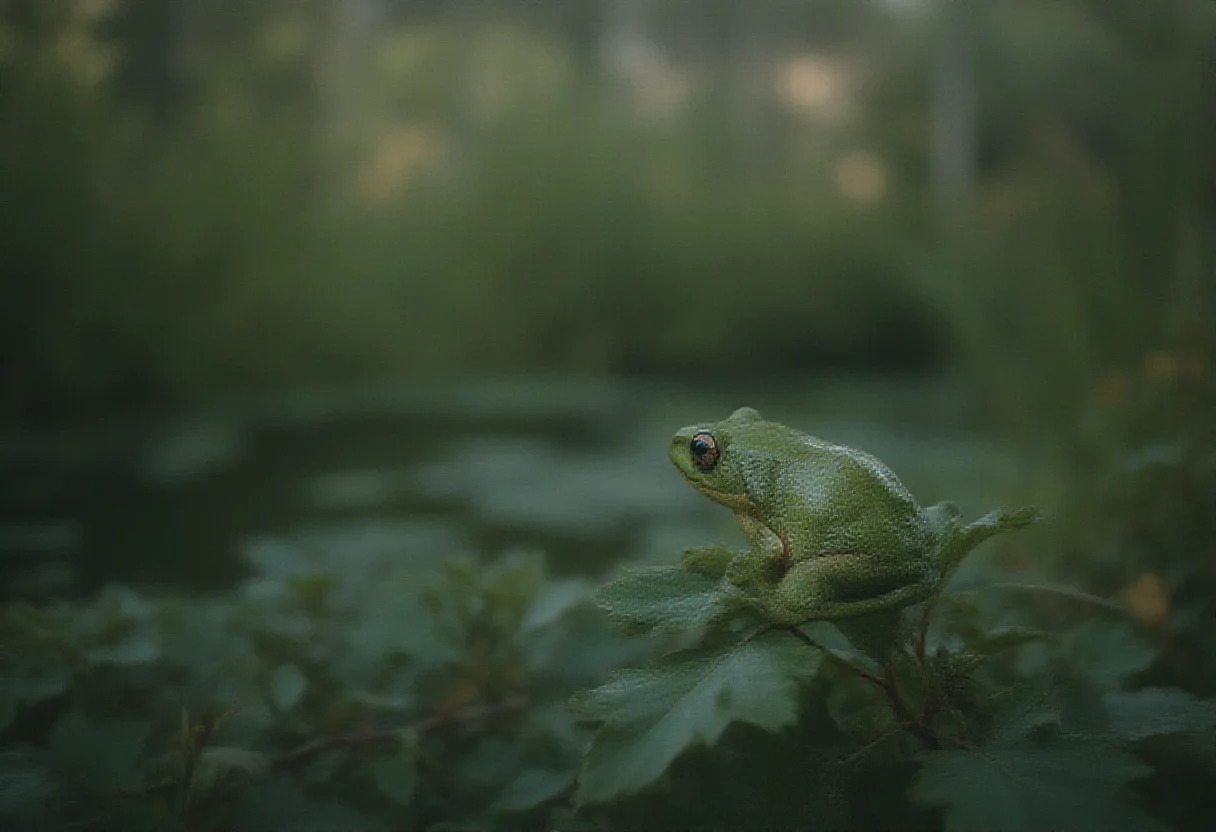
Green Tree Frog Range Limits: Expansion and Introductions
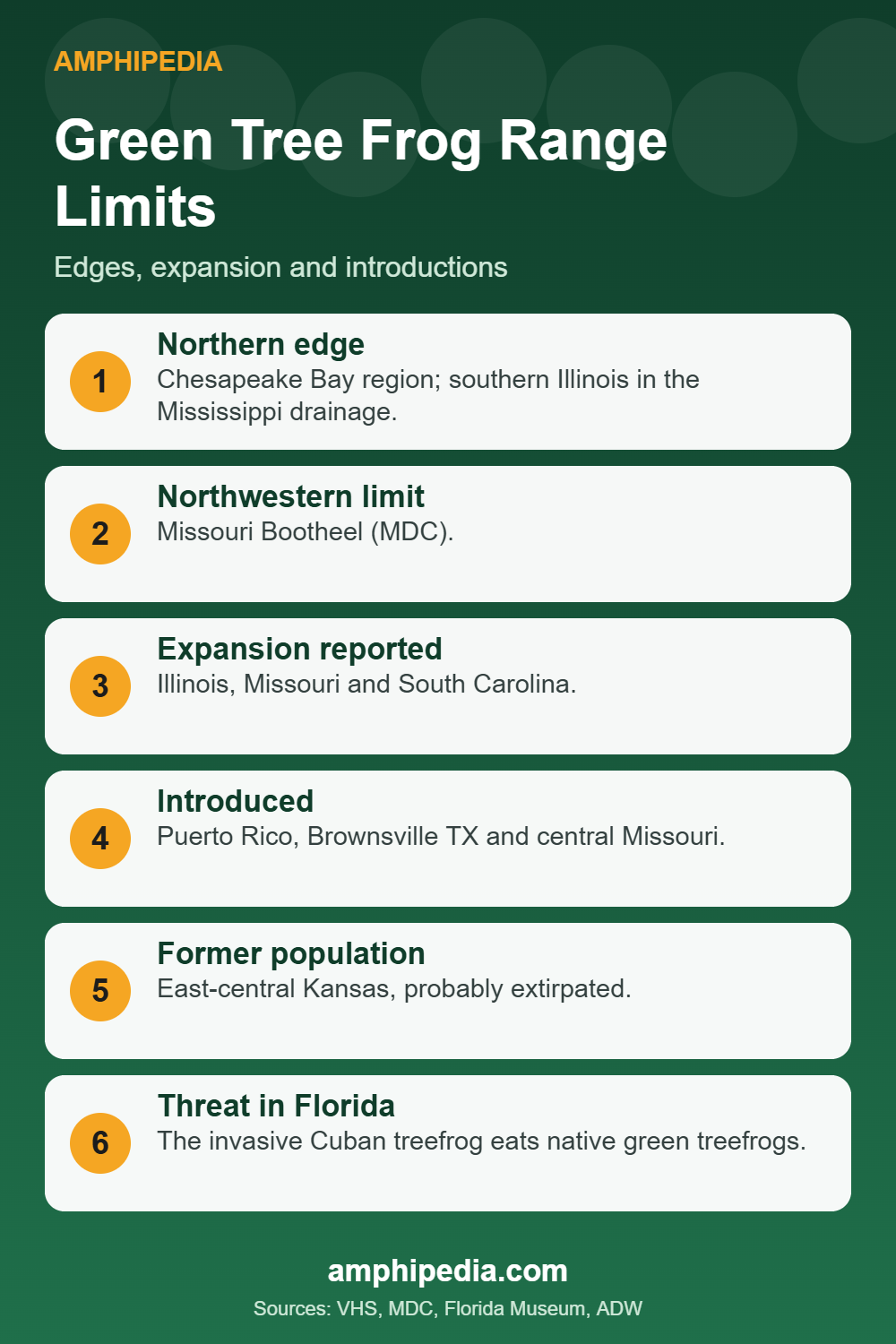
The American green treefrog reaches its edges around the Chesapeake Bay and the Mississippi River drainage of southern Illinois and southeastern Missouri. Recent range expansion has been reported in Illinois, Missouri and South Carolina. Introduced populations occur in Puerto Rico, Brownsville in Texas and central Missouri, and a former population in Kansas is probably gone.
Maps of the green treefrog show a neat range. Real frogs do not stay inside the lines. Edges shift, and people move frogs.
This guide covers the edges of the range, the expansion reports and the introductions. For the basic range, read the companion guide on where green tree frogs live in the US. Here, green tree frog means the American green treefrog.
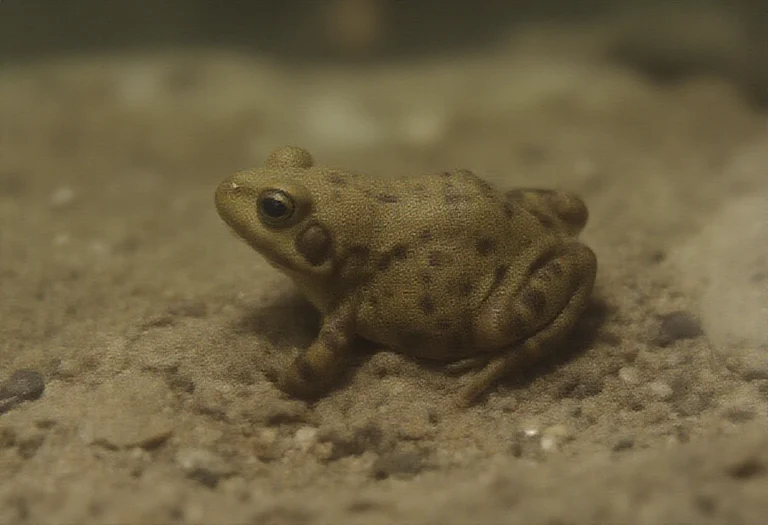
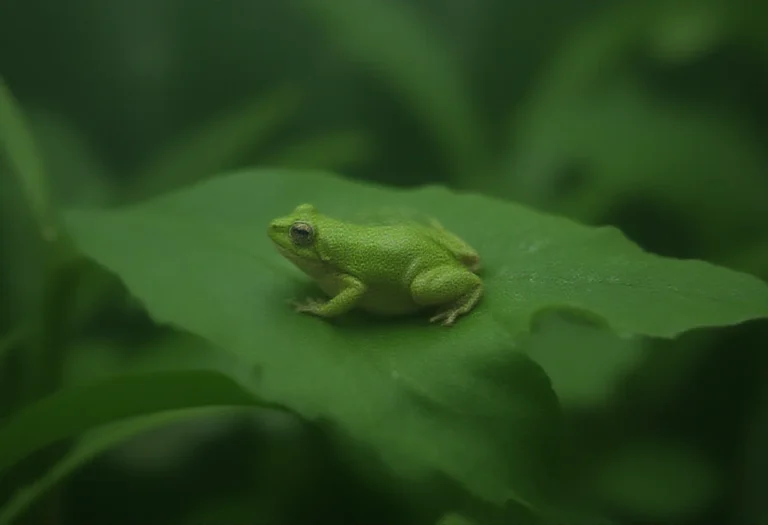
How this was made: prepared with AI assistance and checked against the sources listed at the end. Images are AI-generated illustrations, not photographs of real animals or products.
Key Takeaways
- The northwestern limit of the species is in Missouri’s Bootheel, according to Missouri Department of Conservation.
- Range expansion has been reported in Illinois, Missouri and South Carolina.
- Introduced populations occur in Puerto Rico, Brownsville (Texas) and central Missouri.
- A former population in east-central Kansas is probably extirpated.
- The invasive Cuban treefrog threatens native green treefrogs in Florida.
Pin this infographicShare on Facebook
Where the range ends
The Virginia Herpetological Society places the northern edge in the Chesapeake Bay region of Delaware, Maryland and Virginia. In the Mississippi drainage, the edge sits at southern Illinois and southeastern Missouri.
Missouri Department of Conservation says the Bootheel populations mark the northwestern limit of the whole range. Animal Diversity Web agrees on a northern limit at Maryland and Delaware.
Expansion reports
The Virginia Herpetological Society reports recent range expansion in Illinois, Missouri and South Carolina. Missouri Department of Conservation says the species appears to be expanding north and west.
These sources do not state the cause or a rate of spread. The sources do not say whether climate, habitat change or human movement drives the shift.
Introduced and former populations
People have moved green treefrogs outside their native range. Records of introduced and former populations are listed below.
| Place | Status | Source |
|---|---|---|
| Puerto Rico | Introduced population | Virginia Herpetological Society |
| Brownsville, Texas | Introduced population | Virginia Herpetological Society |
| Central Missouri | Introduced population | Virginia Herpetological Society |
| East-central Kansas | Former population, probably extirpated | Virginia Herpetological Society |
| Isolated Missouri counties (Greene, Taney, Jasper, Camden, Johnson) | Isolated populations, some likely from accidental or intentional introductions | Missouri Department of Conservation |
Pressures inside the range
Missouri Department of Conservation says much of the preferred habitat in southeastern Missouri was lost to swamp and marsh drainage and stream channelization. It recommends preserving large remaining swamps.
The Florida Museum warns that the Cuban treefrog, an invasive species, is larger and eats native green treefrogs. It also reports that the invasive frog’s similar call may confuse female green treefrogs.
The Virginia Herpetological Society reports one localized decline in Florida, while the species remains common across most of its range.
Variation across the range
Animal Diversity Web notes clinal variation in green treefrogs from Florida north along the Atlantic Coastal Plain. The authors suggest selection or drift may explain this, even though the species is considered a single form.
How to treat range maps
Range maps are summaries. The Virginia Herpetological Society notes that a missing record does not prove absence, only that no one has documented the frog there.
If you spot a green treefrog outside the known range, a local herpetological society or state wildlife agency can tell you whether to report it. Rules about moving wildlife vary by state.
Frequently Asked Questions
How far north do green tree frogs live?
The edge is the Chesapeake Bay region in Delaware, Maryland and Virginia, plus southern Illinois and southeastern Missouri in the Mississippi drainage.
Are green tree frogs expanding their range?
Yes. The Virginia Herpetological Society reports recent range expansion in Illinois, Missouri and South Carolina.
Where were green tree frogs introduced?
Puerto Rico, Brownsville in Texas and central Missouri, according to the Virginia Herpetological Society.
Are green tree frogs in Kansas?
A former population in east-central Kansas is probably extirpated, according to the Virginia Herpetological Society.
What threatens green treefrogs in Florida?
The Florida Museum names the invasive Cuban treefrog, which is larger and eats native green treefrogs.
Is a missing record proof the frog is absent?
No. The Virginia Herpetological Society says lack of a documented record does not mean the species is absent.
Bottom Line
Green treefrogs hold a large territory, but the edges move and people have carried the species beyond it. That makes local records more useful than a single map.
For the core range and habitat, read green tree frog range in the US. For lifespan questions about another tree frog, see how long gray tree frogs live.
One Comment