Red-Eyed Tree Frog Breeding: How It Works
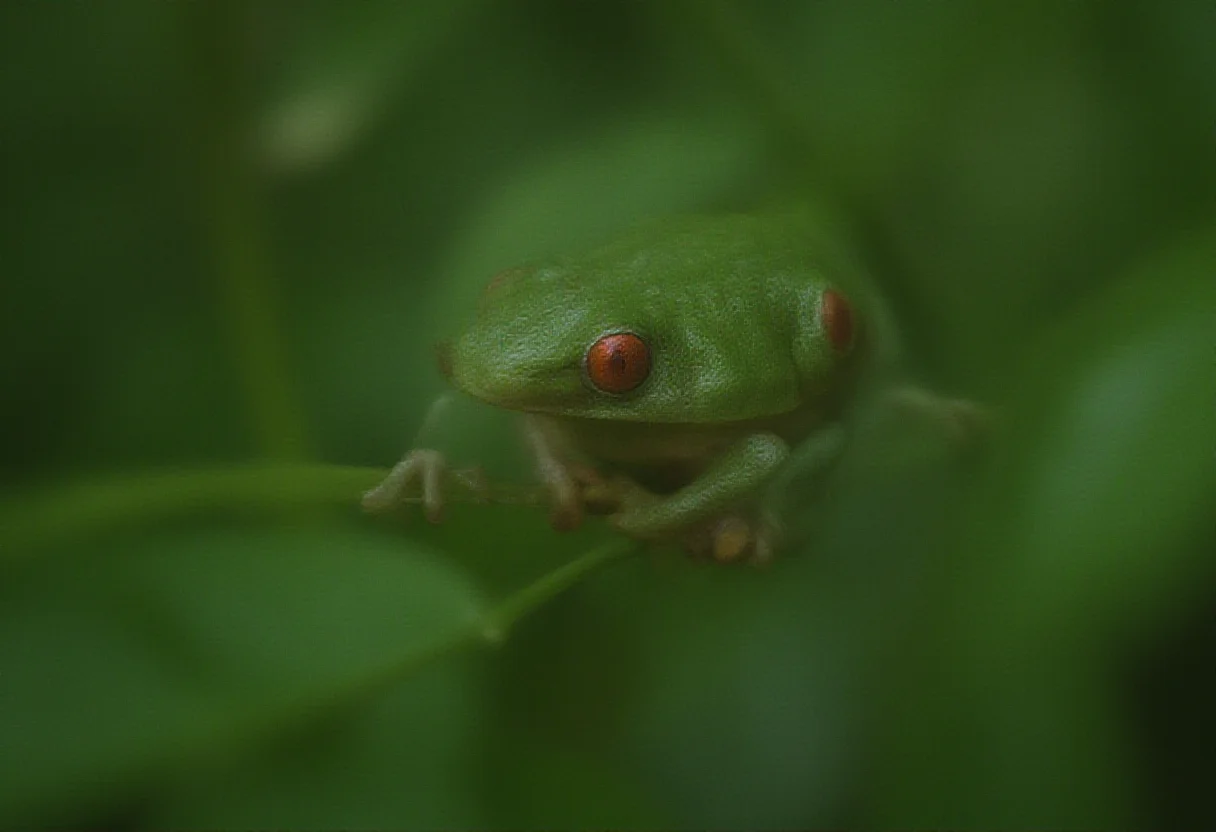
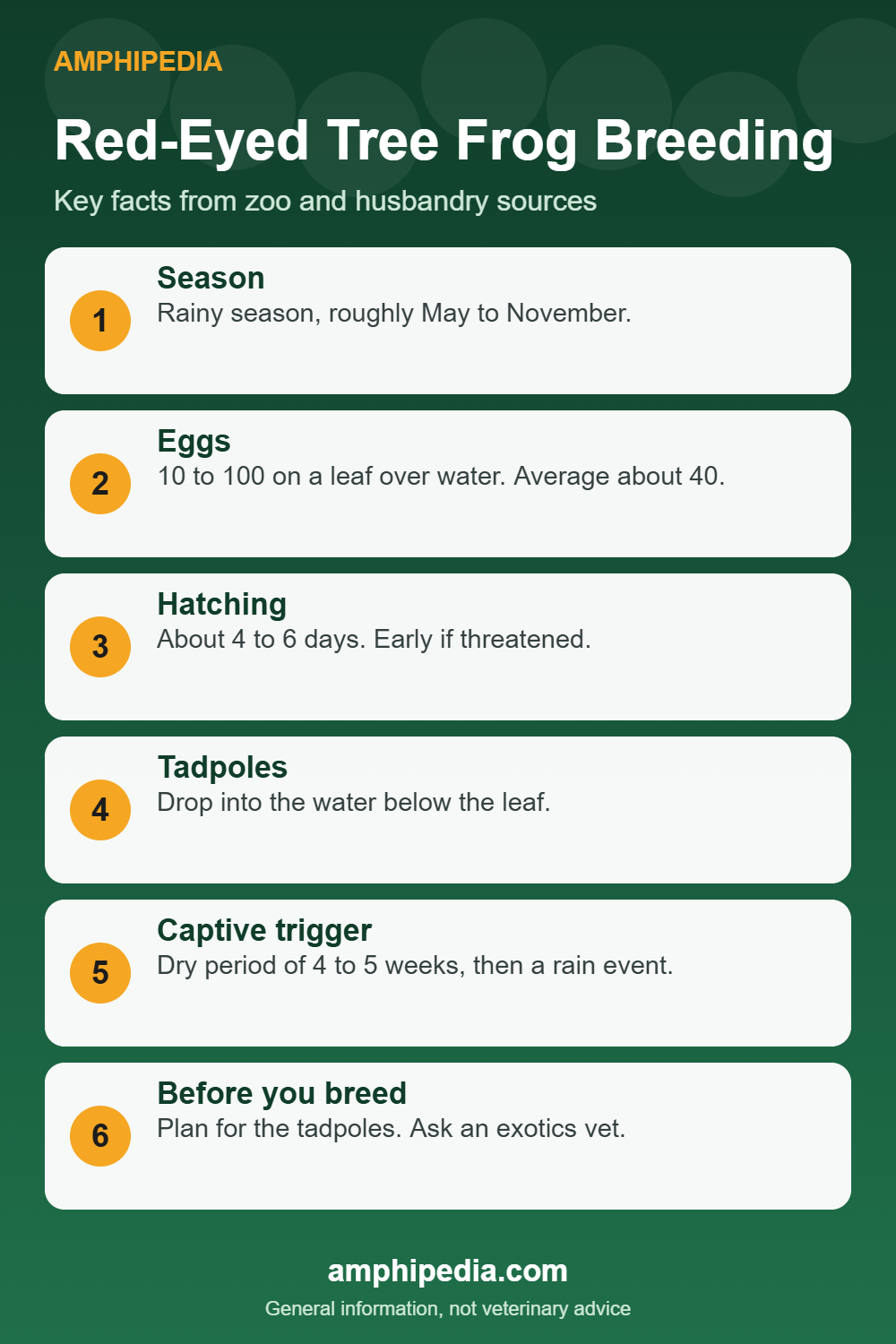
Red-eyed tree frogs (Agalychnis callidryas) breed in the rainy season. The male clasps the female on the underside of a leaf over water, and she lays about 10 to 100 eggs. The eggs hatch in roughly 4 to 6 days, and the tadpoles drop into the water below. In collections, Amphibian Ark advises a 4 to 5 week dry period followed by an abrupt rain event, such as a mist bar.
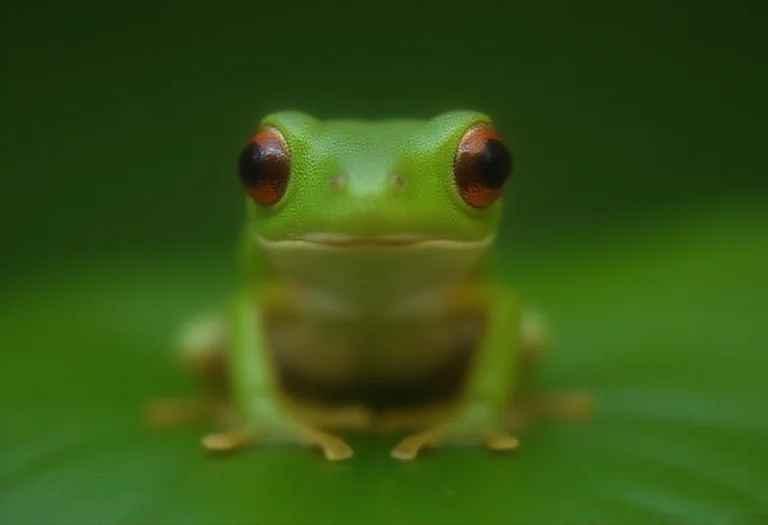
Red-eyed tree frogs are one of the most photographed amphibians, and their breeding habits are just as unusual. The eggs sit on leaves and the tadpoles fall into water when they hatch.
This guide covers wild breeding and the captive method described by Amphibian Ark. It is based on a small set of sources, so treat it as an overview, not a full manual.
How this was made: prepared with AI assistance and checked against the sources listed at the end. Images are AI-generated illustrations, not photographs of real animals or products.
Key Takeaways
- Wild breeding is tied to the rainy season, roughly May to November.
- Males call, and amplexus happens on the underside of a leaf over water.
- Clutches hold 10 to 100 eggs, with an average near 40.
- Eggs hatch in about 4 to 6 days and can hatch early when threatened.
- Captive breeding uses a dry period of 4 to 5 weeks, then a sudden rain event.
- Plan for the tadpoles before the eggs arrive. Ask an exotics vet for advice.
Pin this infographicShare on Facebook
Breeding in the wild
Animal Diversity Web (University of Michigan) says breeding is seasonal and tied to the rainy season, typically from May to November. Males attract females with a distinctive call and may fight each other for access. SF Zoo adds that males show a quivering display to claim territory.
During amplexus the male grips the female’s back. It happens on the underside of a leaf, usually over a pond or other water. Fertilization is external, as the male fertilizes the eggs while they are laid.

Eggs: number, timing and early hatching
Animal Diversity Web gives a clutch of 10 to 100 eggs, with an average of about 40, laid on the underside of a leaf. It reports hatching in about 4 to 6 days. Amphibian Ark gives a broader 5 to 14 days for leaf frogs in general, depending on species and temperature, so timing varies.
The eggs can react to danger. SF Zoo says they can tell harmless vibrations like rain from a predator’s vibrations, such as a snake, and hatch early when threatened. Animal Diversity Web says embryos facing more predators tend to hatch earlier.
There is no parental care after laying, per Animal Diversity Web. Adults do not return to the eggs.
| Stage | What sources report |
|---|---|
| Breeding season | Rainy season, roughly May to November |
| Eggs per clutch | 10 to 100, average about 40 |
| Egg site | Underside of a leaf over water |
| Hatching | About 4 to 6 days; faster if threatened |
| Tadpoles | Drop into the water below |
How captive breeders trigger breeding
The Amphibian Ark guide on leaf frogs says most phyllomedusines need a dry period of 4 to 5 weeks before males and females are introduced. After that comes a distinct, abrupt rain event, which a mist bar or other water source can simulate. It says red-eyed leaf frogs breed like clockwork in many collections.
The guide gives enclosure temperatures of 75 to 85 F, with a night drop of 5 to 15 F, and relative humidity of 50 to 75%. It notes automatic misting should run more at night so that enclosures dry somewhat during the day.
These numbers apply to leaf frogs in general and come from one 2009 guide. They are not a substitute for advice from an exotics vet or an experienced breeder.
- Dry period: 4 to 5 weeks, per Amphibian Ark
- Then an abrupt simulated rain event
- Temperature: 75 to 85 F, cooler at night
- Humidity: 50 to 75%
Raising the tadpoles
Amphibian Ark describes two ways to raise leaf frog tadpoles. In aquariums, a 10 to 20 gallon tank at about 75 F holds up to 30 tadpoles in 10 gallons, with 25 to 30% weekly water changes.
In tubs, 8 to 10 quart boxes filled about three quarters with filtered water hold a dozen or more tadpoles, with a 50% water change every other day.
The guide feeds a micron powder twice daily for about two weeks, then flake food. Freeze-dried tubifex worms are also accepted. Tadpoles begin metamorphosis at about 40 to 90 days, depending on species.
SF Zoo notes juveniles are brown and turn bright green as they mature.
Before you try to breed them
A single clutch can hold up to 100 eggs. Before breeding, ask where the froglets will go. Do not release captive animals into the wild. Chytrid fungus is a known threat to the species, per SF Zoo, and releases can spread disease.
Sources disagree on when the frogs mature. Animal Diversity Web gives an average age of 4.5 years but also says frogs mature at two years and may not mate for two more, so it is not consistent. Ask an experienced keeper.
Lifespan: Animal Diversity Web reports about 4.1 years on average in captivity, with some reports over 8 years, and about 5 years in the wild.
Common mistakes
These errors follow from what the sources describe.
- Skipping the dry period and expecting breeding to start.
- No plan for the tadpoles before the eggs appear.
- Releasing froglets into the wild.
- Using general numbers as if they were exact for every frog.
A breeding enclosure described by Amphibian Ark
The Amphibian Ark husbandry guide (Gagliardo, 2009) covers leaf frogs in general, including the red-eyed species. For breeding groups, the author prefers a semi-sterile glass terrarium. That limits nematode build-up in the substrate, which the guide treats as a real problem.
- A vertically oriented enclosure with many perches and basking spots.
- A floor drain and a false bottom of egg crate and screen.
- A water bowl and one or two potted plants.
- Broad-leaf tropical plants for cover, with Heliconia and Calathea recommended.
- Horizontal and vertical branches for perching.
The guide says automatic misting should run mostly at night, so the enclosure dries somewhat by day, and that direct misting of the frogs should be avoided. Water should be clean and filtered, in small bowls with smooth rocks so frogs cannot drown.
Handling the eggs once they are laid
The guide describes removing egg masses by taking off the leaf they are attached to. This is described for experienced keepers, so read it as a description, not a recipe.
- Take the leaf and egg mass out of the enclosure.
- Place it in a plastic container with a little water. The water should not fully submerge the eggs.
- If the stalk is attached, secure it to the lid or side so the mass hangs just above the water.
- Keep it at about 75 F under normal lighting.
The guide says eggs that slip into the water usually develop normally. It gives hatching as roughly 5 to 14 days depending on species and temperature, which is wider than the 4 to 6 days Animal Diversity Web gives for this species.
Froglets after metamorphosis
Once tadpoles have four limbs, the guide moves them to 32 ounce deli cups with vented lids. The cups hold about a quarter inch of water and a slanted, tall leaf for climbing out. After the tail is fully absorbed, froglets go to small enclosures with sphagnum moss or paper towel.
- First meals: 2 to 3 Drosophila hydei fruit flies. The guide warns against overfeeding flies, because neonates stress easily.
- Later food: small crickets of 1/8 to 1/4 inch after one to two weeks.
- Routine: mist daily and feed every other day.
- Space: a 3-gallon enclosure can hold 10 to 15 neonates for several weeks.
The guide advises moving juveniles in groups once they are eating well.
Health problems the guide flags
The guide lists several problems that matter when you raise a clutch. This is a list of what it reports, not treatment advice.
- Lungworm (Rhabdias) and other nematode infections.
- Cloacal prolapse, which can follow too many large food items.
- Rostral abrasions from snout rubbing or shipping.
It also reports that topical ivermectin was fatal to Agalychnis callidryas, and that one deworming product caused problems in some species. Never use a medicine made for another animal on a frog. Ask an exotics vet, and find one through the ARAV directory.
Predators at each stage
Animal Diversity Web lists different predators for each life stage, which helps explain why eggs hatch early when threatened.
- Embryos: polybid wasps and snakes.
- Tadpoles: shrimp and large fish.
- Froglets and adults: aquatic spiders, snakes, birds and bats.
Animal Diversity Web lists the species as Least Concern on the IUCN Red List and in CITES Appendix II, while saying populations are declining quickly, mainly due to deforestation. SF Zoo names habitat destruction, pollution, climate change and chytrid fungus as threats.
Reading the sources: known inconsistencies
The sources used here contain a few internal mismatches. Noting them is better than quoting only the tidy number.
- Animal Diversity Web gives age at maturity as 4.5 years in its infobox, but its text says the young mature in two years and do not start mating for another two.
- The same page mentions a gestation of about 45 days, which conflicts with eggs that hatch in 4 to 6 days.
- SF Zoo gives the IUCN status as Least Concern in one place and Least Vulnerable in another.
- Size also varies: SF Zoo gives about 2 inches for males and 3 inches for females, while Animal Diversity Web gives 4 to 7 cm overall, with females larger.
None of these changes the main points. They are reasons to avoid treating any single figure as exact.
Frequently Asked Questions
When do red-eyed tree frogs breed?
In the wild, during the rainy season, roughly May to November.
Where do they lay eggs?
On the underside of a leaf, usually over water.
How many eggs do they lay?
About 10 to 100, with an average near 40, per Animal Diversity Web.
How long do the eggs take to hatch?
About 4 to 6 days per Animal Diversity Web. Amphibian Ark gives 5 to 14 days for leaf frogs in general.
What happens when the eggs hatch?
The tadpoles drop into the water below the leaf.
Do the parents care for the eggs?
No. Adults do not return to the eggs.
How do keepers trigger breeding?
Amphibian Ark advises a dry period of 4 to 5 weeks, then an abrupt rain event such as a mist bar.
Bottom Line
Red-eyed tree frog breeding follows the rains: eggs on a leaf over water, a few days of development, then tadpoles that drop into the pond.
If you plan to breed them, plan for the tadpoles first and talk to an exotics vet.
Sources
- Animal Diversity Web (University of Michigan): Agalychnis callidryas, accessed 31 October 2026
- Amphibian Ark: Husbandry of Phyllomedusines (Gagliardo, 2009), accessed 31 October 2026
- San Francisco Zoo: Red-eyed tree frog, accessed 31 October 2026
- CDC: Reptiles and amphibians and Salmonella, accessed 31 October 2026
- ARAV: Find an exotics veterinarian, accessed 31 October 2026