Will a Frog Eat a Salamander?
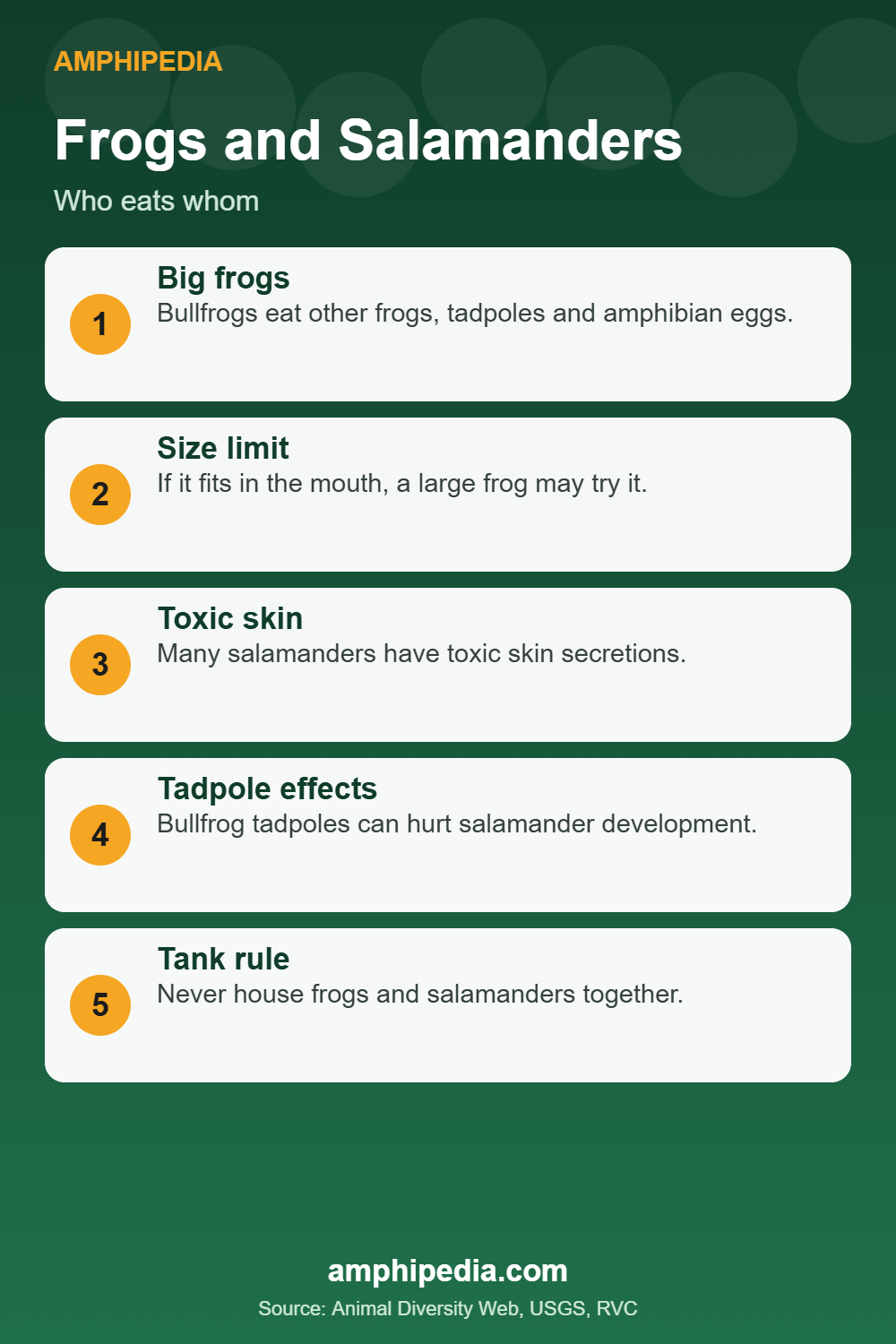
Yes, a large frog can eat a salamander if it fits in the mouth. Bullfrogs are the best documented case: they are cannibalistic generalists that eat other frogs, tadpoles and the eggs of salamanders. Many salamanders and newts have toxic skin, which deters most predators. In captivity, keep frogs and salamanders in separate enclosures.
Frogs are ambush predators with little ability to judge what they eat. If it moves and fits in the mouth, a big frog may try it.
That does not mean every frog hunts salamanders. This guide covers what the sources show, where the evidence is thin, and what it means for pet keepers.
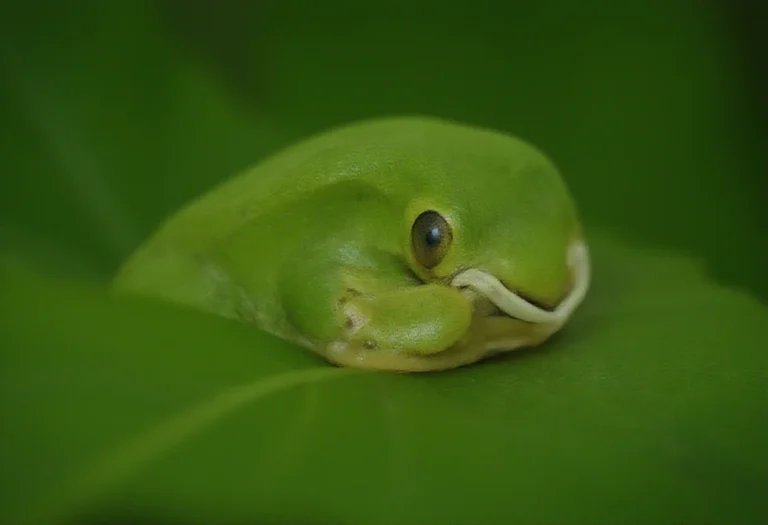
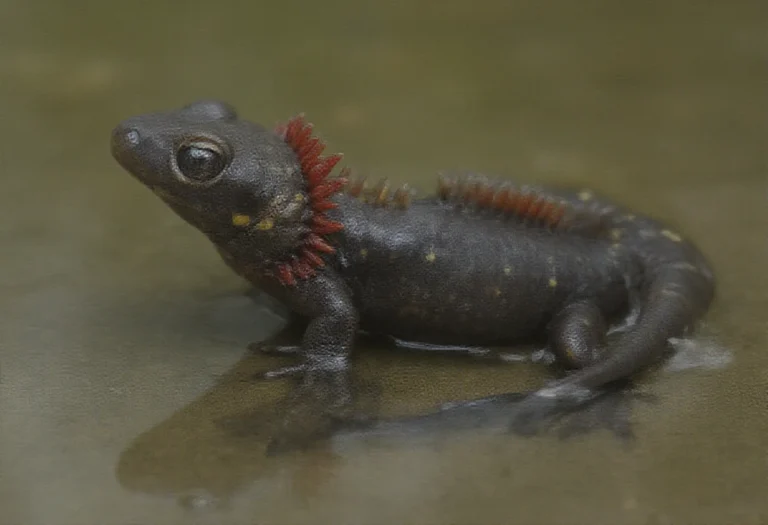
How this was made: prepared with AI assistance and checked against the sources listed at the end. Images are AI-generated illustrations, not photographs of real animals or products.
Key Takeaways
- Large frogs, especially bullfrogs, eat a very wide range of prey, including other frogs and amphibian eggs.
- Sources document salamander eggs in the bullfrog diet; evidence for adult salamanders is thinner.
- Some salamanders and newts have toxic skin that deters predators.
- Bullfrog tadpoles can also harm native salamander larvae by affecting how they develop.
- Never house frogs and salamanders together.
Pin this infographicShare on Facebook
What do frogs eat?
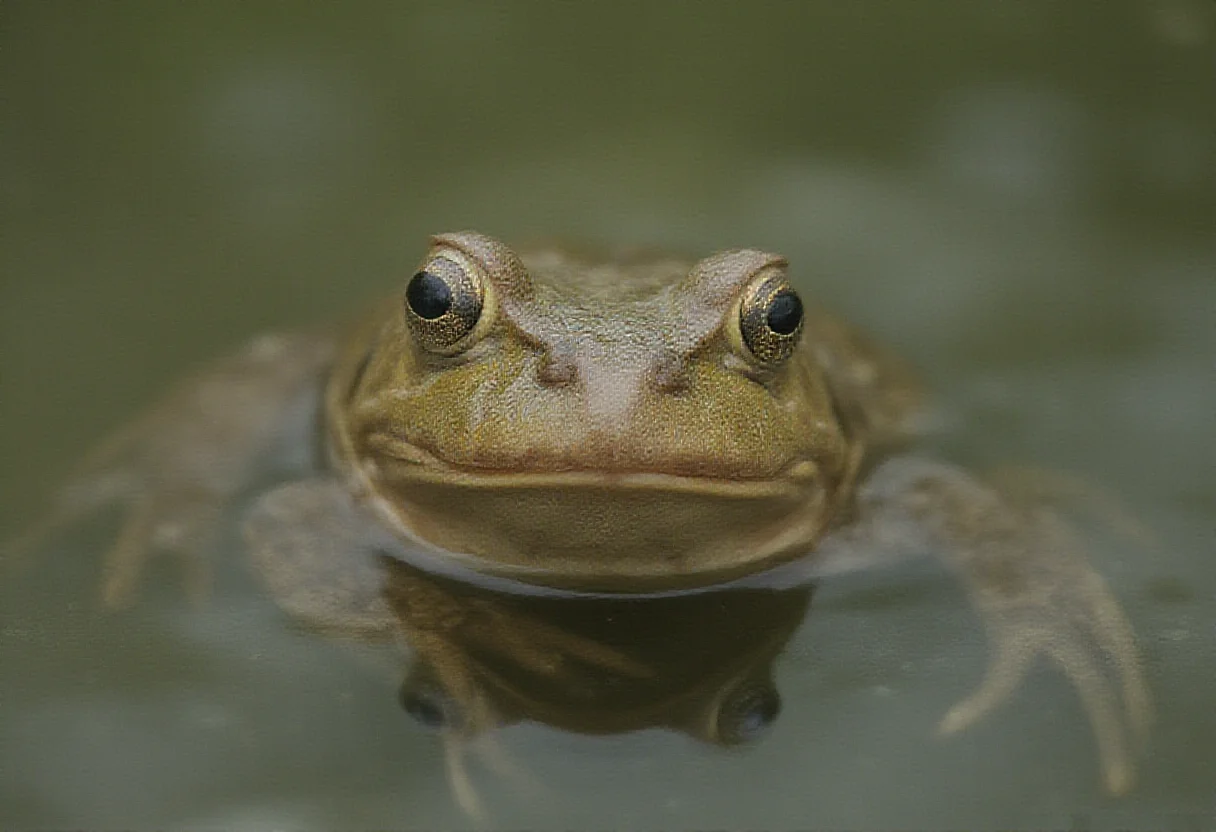
Most frogs are insect eaters. Adult American bullfrogs are far more varied. Animal Diversity Web lists snakes, worms, insects, crustaceans, other frogs, tadpoles and the aquatic eggs of fish, frogs, insects and salamanders. It also calls them cannibalistic.
They use a sit-and-wait strategy. They stay still until prey comes near, then grab it with a flash of the tongue.
Do frogs eat adult salamanders?
The sources we could open document salamander eggs as bullfrog prey. They do not give a clear, reliable record of adult salamanders being eaten, so we cannot say how often it happens.
What we can say is that size is the limit. A frog that can swallow a smaller frog can swallow other soft-bodied amphibians of similar size. Small frogs cannot do this.
Bullfrog tadpoles and native salamanders
A USGS-listed study of spotted salamander larvae found that larvae raised with overwintered bullfrog tadpoles had shorter larval periods and slightly smaller masses at metamorphosis.
The authors do not say whether predation or competition caused this. They conclude that overwintered bullfrog tadpoles can negatively affect the metamorphosis of native amphibians. American toads were not significantly affected.
Why many salamanders are hard to eat
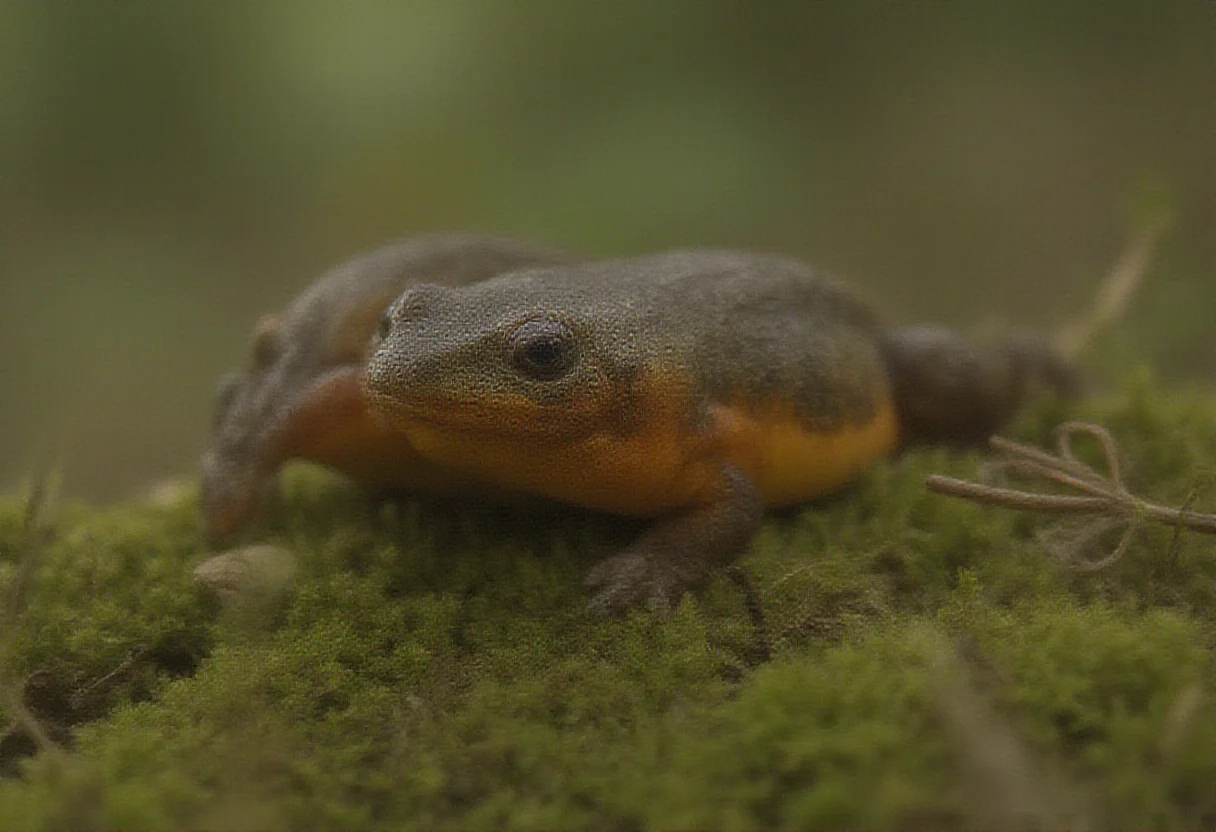
Many salamanders have toxic skin secretions, according to the Royal Veterinary College. The rough-skinned newt is the best known example. Animal Diversity Web says it makes tetrodotoxin in skin glands, and the level varies between regions.
Its bright belly warns predators, and the page says garter snakes are the only known predator because they appear to be immune. A frog that bites a toxic newt would be taking a risk.
Can frogs and salamanders live together?
No. Even setting hunting aside, the Royal Veterinary College notes that most salamanders are best kept alone because they are territorial, and that cannibalism is a risk when a larger animal is housed with a smaller one.
Skin secretions are another reason. Many salamanders have toxic secretions, which could harm a tankmate. A frog and a salamander also differ in temperature and humidity needs, so one will often be wrong for the other.
What the evidence cannot tell us
Field records of what frogs eat come from stomach contents and observation, so rare meals are easy to miss. An absence of adult salamanders in a source does not prove it never happens.
Pet frogs add another gap. Most care guides cover insects and pellets and do not test what a frog does with a salamander. The safe rule is to separate them, not to wait for a case report.
Why food size matters in a pet tank
PetMD stresses that prey must suit the frog. Fruit flies are too small for a White’s tree frog, and a frozen mouse is too large for even the biggest dart frogs.
The same logic applies to tankmates. A large frog sees a smaller animal as a possible meal, and a smaller frog may be seen the same way by its larger neighbour. This is the reason size-matching and separate housing are standard advice.
Quick reference
This table sums up the findings.
| Question | What the sources say |
|---|---|
| Do bullfrogs eat salamander eggs? | Yes, listed by Animal Diversity Web |
| Do bullfrogs eat other frogs? | Yes, they are cannibalistic |
| Are adult salamanders documented as bullfrog prey? | Not clearly in the sources we could open |
| Are many salamanders toxic? | Many have toxic secretions (RVC); rough-skinned newts make tetrodotoxin (ADW) |
What to do if you keep both
Use separate enclosures with their own tools and water. Wash your hands between tanks. Quarantine new animals before adding them to a collection. The Merck Veterinary Manual says a period of 6 to 8 weeks is typically adequate and should be based on a risk assessment.
Use separate cleaning tools for quarantined and established animals, as Merck advises. If an animal is injured or sick, call an exotics vet.
How big does a frog need to be?
Animal Diversity Web (ADW) calls the American bullfrog the largest true frog in North America. Typical length is 90 to 152 mm, and the largest reach about 203 mm and 0.5 kg.
Size is the practical limit on prey. A bullfrog that long has a mouth able to take frogs, snakes and other large items, according to the diet list. A small tree frog or dart frog has no such range, so the risk depends on species and size, not on the word “frog.”
Bullfrog tadpoles can stay in the water for years
ADW says bullfrog tadpoles may remain in the tadpole stage for almost 3 years, and that transformation can take 1 to 3 years. That long larval period helps explain why researchers study overwintered bullfrog tadpoles, as in the USGS work cited above.
ADW describes tadpoles as mostly grazers on aquatic plants and algae, so the study’s effect on salamander larvae is not a simple case of tadpoles eating them. The authors themselves did not decide between predation and competition.
Most fish avoid bullfrog tadpoles because of their unpleasant taste, ADW adds, which may help them survive in ponds with fish.
Bullfrogs outside their home range
ADW gives the native range of the bullfrog as eastern and central North America, from Nova Scotia to central Florida and west across the Great Plains. It lists introductions in the western US, including California and Colorado, in the early 1900s, and in southern Europe, South America and Asia.
The account says bullfrogs may drive native frogs to extinction in some areas. In California, it says they are efficient predators of native frogs and tadpoles. In Colorado, they have caused problems for native frogs and may have spread through trout stocking operations.
Salamanders are not named in that passage, so the impact on salamanders comes from the egg records and the USGS larval study above.
The rough-skinned newt as a case study
ADW describes the rough-skinned newt (Taricha granulosa) as a salamander of the Pacific coast, from Santa Cruz County, California, to Juneau, Alaska. Adults measure about 12.7 to 21.6 cm in total length and spend most of their time on land, usually under rotting wood in forests.
When provoked, the newt performs the unken reflex. It bends its head back and curls its tail to show a bright orange-to-yellow belly. ADW calls this a warning display.
Common garter snakes are its only known predator, and they appear resistant to tetrodotoxin. ADW thinks the two species are in an evolutionary arms race.
Safety for people and other pets
ADW reports no known harmful effects of the rough-skinned newt on humans unless it is ingested, and warns that it holds enough toxin to kill several humans. The page gives no handling instructions.
The RVC salamander care sheet adds that many species have toxic secretions. It advises avoiding direct handling because oils on human skin can damage the animal’s mucus layer, and says moistened, powder-free latex gloves should be used if handling is necessary.
Keep young children and other pets away from any salamander or newt enclosure, and wash your hands after touching a tank or its contents.
Because ADW ties the danger to ingestion, treat any case where a child or pet has put a newt in the mouth as an emergency. Call a doctor, poison line or exotics vet at once, and do not wait for signs. Do not try home treatment.
What a correct salamander set-up looks like
Separate housing needs more than a second tank. The RVC gives these numbers for adults, and says to check requirements for your specific species.
| Item | RVC care sheet |
|---|---|
| Minimum enclosure for one salamander | 90 x 45 x 45 cm |
| Substrate | 5 cm of pea gravel or worn slate topped with 7 to 10 cm of burrowing substrate |
| Pool | 2 to 5 cm deep, with a ramp |
| Daytime temperature | About 18 to 24 C |
| Night temperature | About 10 to 15 C |
| Humidity | At least 70 percent |
| Feeding | As much as they will eat in one sitting, every other day |
The sheet also notes that most species are highly territorial and best kept individually, and that pairs are kept together only around mating time. It gives no information on housing salamanders with other species.
Mistakes that cause losses
- Putting a small frog and a larger frog in the same tank because both are called “frogs.”
- Assuming a toxic newt is safe to house with a hungry frog.
- Moving bullfrog tadpoles or other animals between ponds.
- Skipping quarantine for new animals when you keep several species.
- Handling salamanders bare-handed, when oils on the skin can damage their mucus layer.
Each of these is avoidable with separate tanks, correct sizing and careful hygiene.
Frequently Asked Questions
Will a bullfrog eat a salamander?
Salamander eggs are listed in the bullfrog diet. Adult salamanders are possible if they fit, but our sources do not document it clearly.
Will a pet frog eat a salamander in the same tank?
It may try, and cannibalism and toxin risks make mixing unsafe. Keep them separate.
Are salamanders poisonous to frogs?
Many have toxic skin secretions. Rough-skinned newts make tetrodotoxin.
Do salamanders eat frogs?
This guide focuses on frogs as predators. Our sources do not cover salamanders eating frogs, so we leave that question open.
Do frogs eat each other?
Bullfrogs do. Animal Diversity Web calls them cannibalistic.
Can frogs and newts share a tank?
Not safely. Newts often have toxic skin and different water needs.
Bottom Line
Frogs are opportunists, so size decides most outcomes. Salamanders add toxic skin to the mix.
Related reading: what frogs eat in the wild and the frog food chain.
Sources
- Animal Diversity Web: Lithobates catesbeianus (American bullfrog), accessed 31 October 2026
- Animal Diversity Web: Taricha granulosa (rough-skinned newt), accessed 31 October 2026
- USGS: Overwintered bullfrog tadpoles negatively affect salamanders and native anurans, accessed 31 October 2026
- Royal Veterinary College: Salamander care sheet, accessed 31 October 2026
- Merck Veterinary Manual: Environment and Husbandry for Amphibians, accessed 31 October 2026
- CDC: Reptiles and Amphibians, accessed 31 October 2026
- PetMD: What to Feed Your Frog. Used for: prey size matching