How Does Algae Help the Salamander? The Green Egg Mystery
The algae in question is Oophila amblystomatis, which lives inside spotted salamander egg masses. It gives the eggs their green color. Researchers report that it raises oxygen levels around the developing embryos, and one study found it passes some of the carbon it fixes to the embryos late in development. In return, embryo waste supplies nitrogen the alga can use. The relationship appears helpful to the salamander, though some benefits are still being studied.
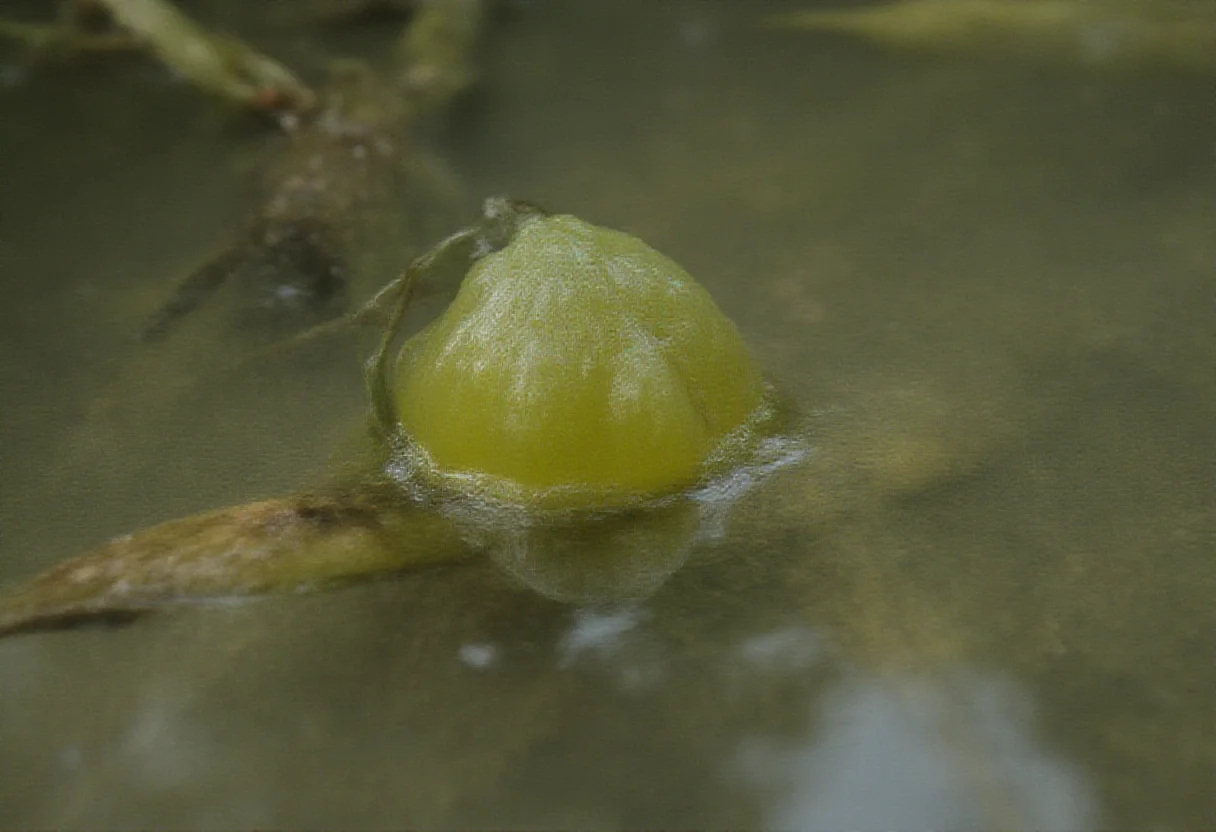
Open a pond in spring and some salamander egg masses are bright green. The color comes from algae living inside the eggs.
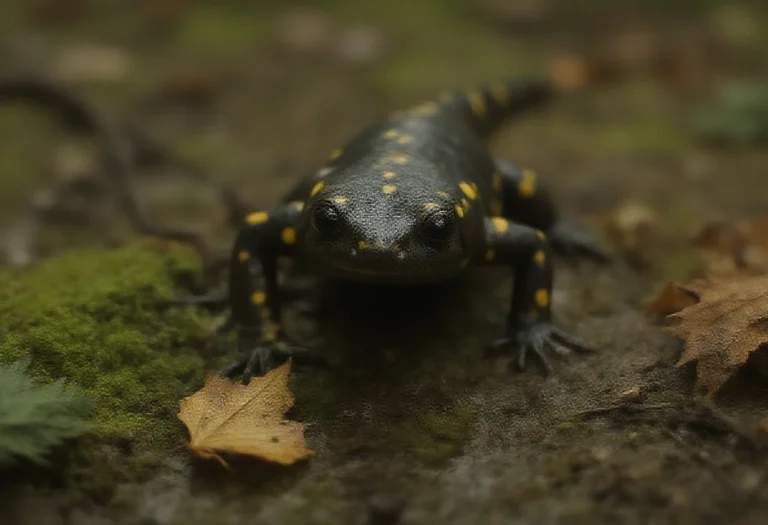
This post is about the spotted salamander (Ambystoma maculatum), the species where this partnership is best studied. The title does not name a species, so we assume that one. The science is still unfolding, so we mark what is confirmed and what is not.
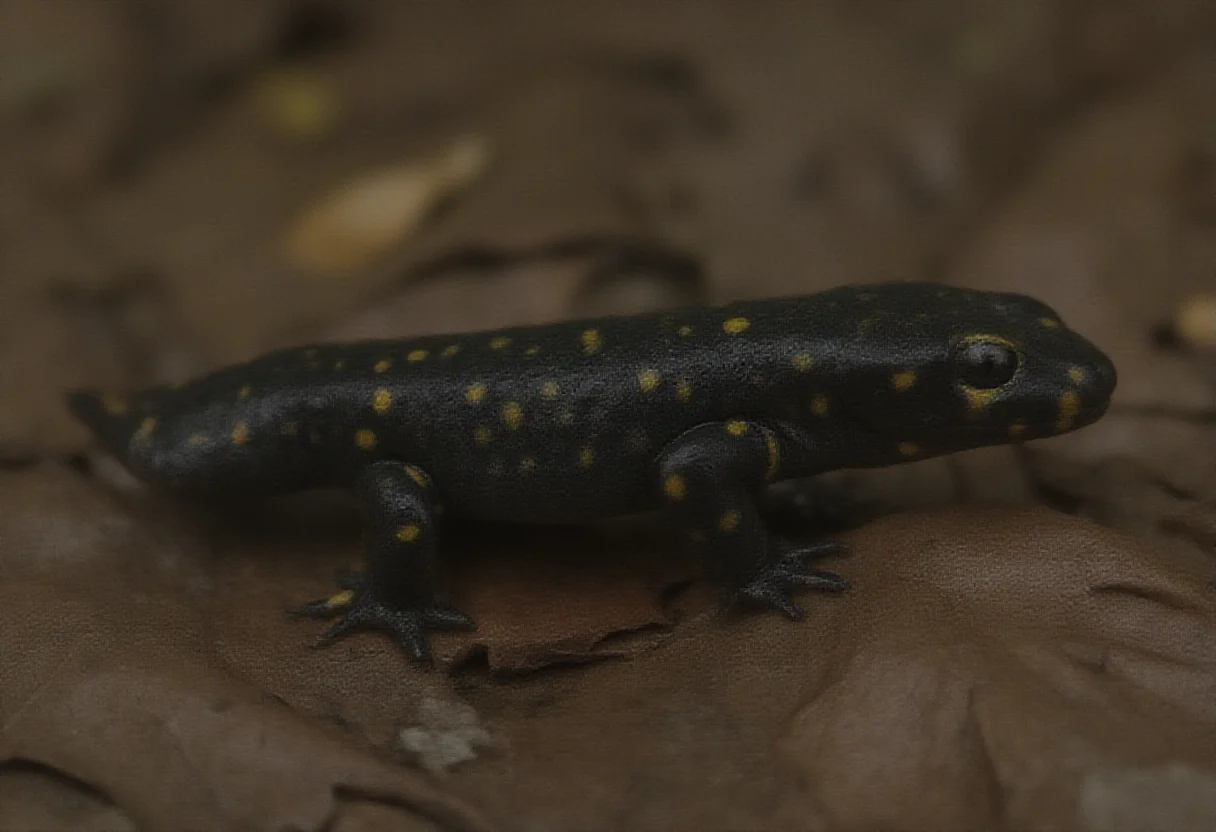
How this was made: prepared with AI assistance and checked against the sources listed at the end. Images are AI-generated illustrations, not photographs of real animals or products.
Key Takeaways
- The alga is Oophila amblystomatis, found in spotted salamander eggs.
- It tints the egg masses green over several weeks.
- Researchers report it raises oxygen around the embryos.
- One 2014 study found carbon passing to the embryo, peaking late in development.
- Embryo waste gives the alga nitrogen.
- Researchers describe it as the only known case of an alga living inside cells of a vertebrate.
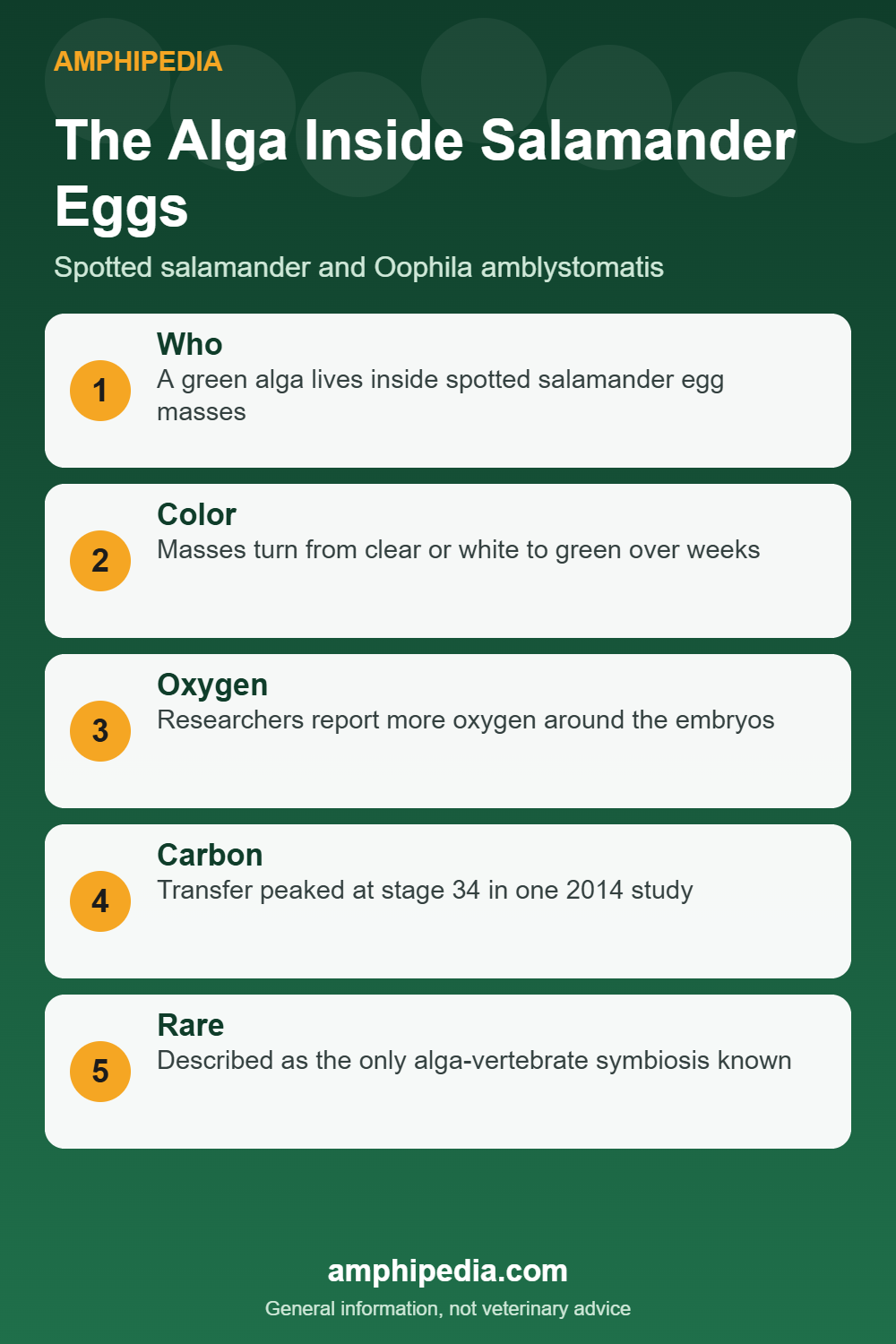
Pin this infographicShare on Facebook
What the alga is and where it lives
The alga is a single-celled green alga named Oophila amblystomatis. Vernalpool.org describes it as a symbiotic green alga that grows within the eggs and the egg mass, turning masses from clear or white to green over several weeks.
A 2020 Journal of Herpetology study tested 149 spotted salamander egg masses from six ponds in northeast Alabama. It found algal DNA in egg capsules at every stage.
The chance an egg contained algal DNA rose with the age of the mass, and the amount of algal DNA seemed to rise as embryos developed. The authors say the relationship appears to be mutualistic.
Oxygen: the best-supported benefit
Embryos need oxygen. In sunlight, the algae photosynthesize and release oxygen into the fluid around them.
A 2017 eLife study, by researchers at the American Museum of Natural History and Gettysburg College, reports that the algae increase oxygen in the fluid around developing embryos.
A 2014 paper in BMC Research Notes notes earlier work reporting that extra oxygen speeds embryo growth, synchronizes hatching and lowers embryo death. That 2014 study did not test those outcomes itself, so treat them as earlier findings.
Carbon transfer late in development
The 2014 study, by Graham, McKie-Krisberg and Sanders, measured whether carbon fixed by the alga reaches the embryo. Eggs came from Pennsylvania and were kept at 8 degrees C.
They found no transfer in early tailbud embryos. Transfer peaked at stage 34, when 87 percent of eggs showed it, at about 6.5 percent of the carbon the algae fixed on average. Transfer dropped by stage 36 and was not significantly different from zero just before hatching.
The authors suggest the timing follows the alga losing motility and settling against the inner egg envelope near the embryo. The decline near hatching may follow the envelope breaking and releasing the algae.
| Stage | Eggs with carbon transfer | Mean share of fixed carbon |
|---|---|---|
| Stage 25 (early tailbud) | None detected | Not applicable |
| Stage 28 | 20% | Not reported here |
| Stage 30 | 14% | Not reported here |
| Stage 34 (peak) | 87% | 6.5% |
| Stage 36 | 67% | 1.4% |
| Stage 39 (before hatching) | 25% | Not different from zero |
What the alga gets in return
The eLife study reports embryos produce nitrogen-rich waste that the algae can use. It also says it is still unclear whether the alga gains from living inside salamander cells, since the algae look stressed and change how they make energy.
An alga inside a vertebrate
The researchers behind the eLife work describe this as the only known symbiosis between an alga and a vertebrate. They report that algae were found inside cells throughout the salamander body, a cell-within-a-cell arrangement.
They also report that the salamander cells showed no signs of stress and that the salamanders overexpress genes that may suppress immune responses. That suggests the relationship is neutral or beneficial for the host. It is still an active research topic.
- Confirmed: the alga lives in egg masses and turns them green.
- Reported: extra oxygen in the egg fluid.
- Measured in one study: carbon transfer that peaks late in development.
- Unclear: how much the alga benefits from living inside cells.
Does this happen in all salamanders?
The sources we used focus on the spotted salamander. We found no source in our research showing the same partnership in other species, so we do not claim it. For how spotted salamander egg masses look and how they differ from other species, see our guide to what salamander eggs look like and our overview of salamander reproduction.
Frequently Asked Questions
What algae lives in salamander eggs?
Oophila amblystomatis, a green alga found in spotted salamander egg masses.
Why are some salamander eggs green?
The alga grows in the eggs and the egg mass and tints them green over several weeks.
How does the algae help the salamander?
Researchers report it adds oxygen around the embryos, and one study found it passes some carbon to them late in development.
What does the alga get?
Embryo waste supplies nitrogen the alga can use, according to the eLife summary.
Is it the only partnership of its kind?
The researchers describe it as the only known alga-vertebrate symbiosis.
Are green egg masses dangerous?
The sources we used do not describe the green color as harmful. It is a normal part of the egg masses.
Does the alga live in every salamander species?
The sources we found describe it in spotted salamanders. We did not find evidence for other species.
Bottom Line
The green in a spotted salamander egg mass is a living partnership. Researchers report oxygen from the alga, some carbon transfer and an unusual life inside the embryo cells.
Much is still being studied, so expect the details to be refined.
Sources
- Phys.org: Green alga makes salamanders stressful hosts (eLife 2017 summary), accessed 31 October 2026
- BMC Research Notes 2014: Photosynthetic carbon transfer to salamander embryos, accessed 31 October 2026
- Journal of Herpetology 2020: Algae in spotted salamander egg masses, accessed 31 October 2026
- Vernalpool.org: Spotted salamander, accessed 31 October 2026