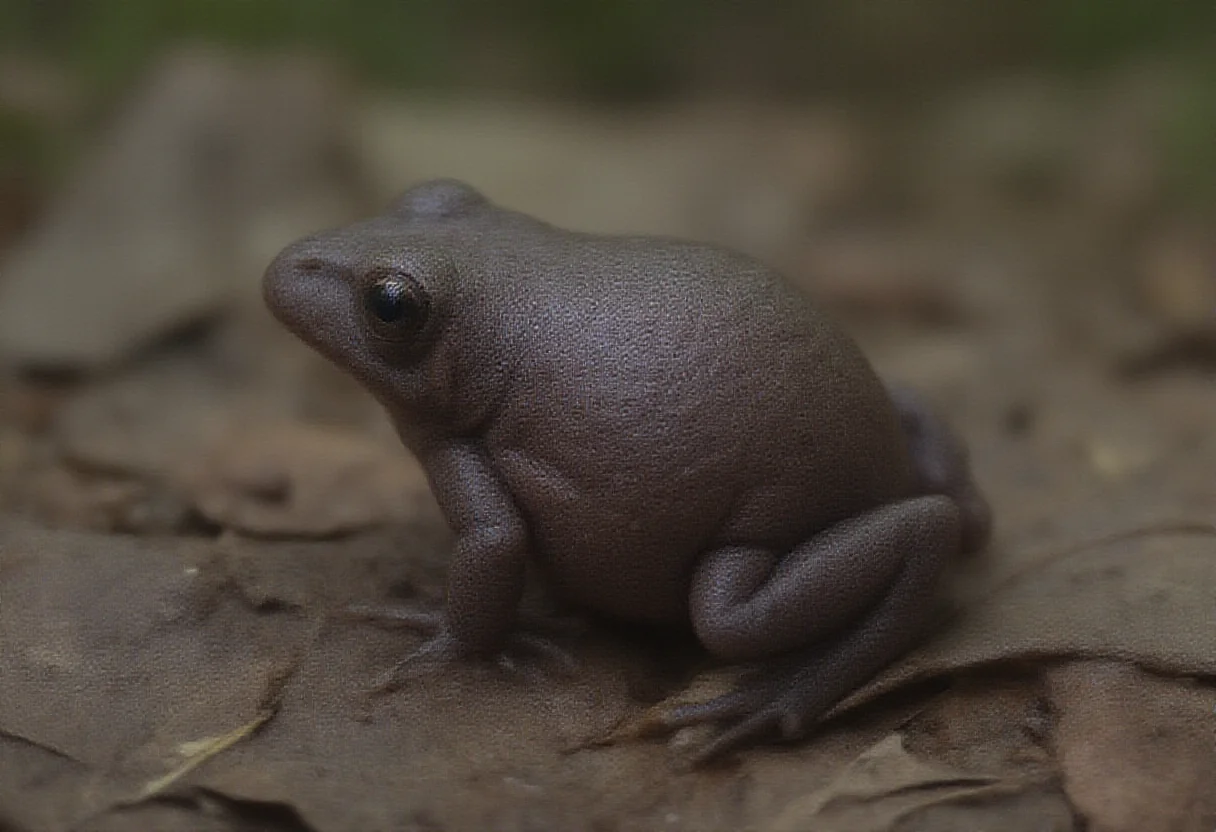
Are Purple Frogs Endangered? Status, Threats and Numbers
Yes. The Indian purple frog (Nasikabatrachus sahyadrensis) is listed as Endangered on the IUCN Red List, based on a 2004 assessment cited by EDGE of Existence. The main threats are road kills and habitat loss. There is no overall population estimate, and the trend is reported as decreasing. A reassessment is being evaluated, so the category may change.
The purple frog lives only in the Western Ghats of Kerala and Tamil Nadu in India. It spends most of the year underground, which makes it very hard to count.
This guide gives the official status, the known numbers and the main threats, and it flags where sources disagree.
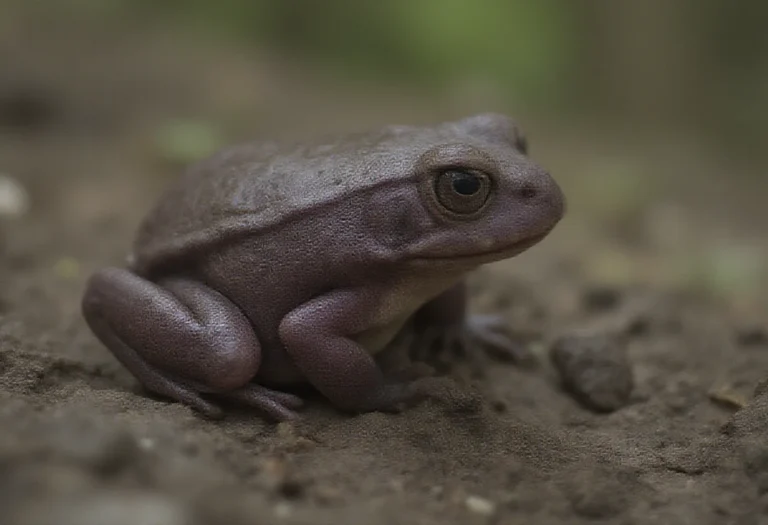
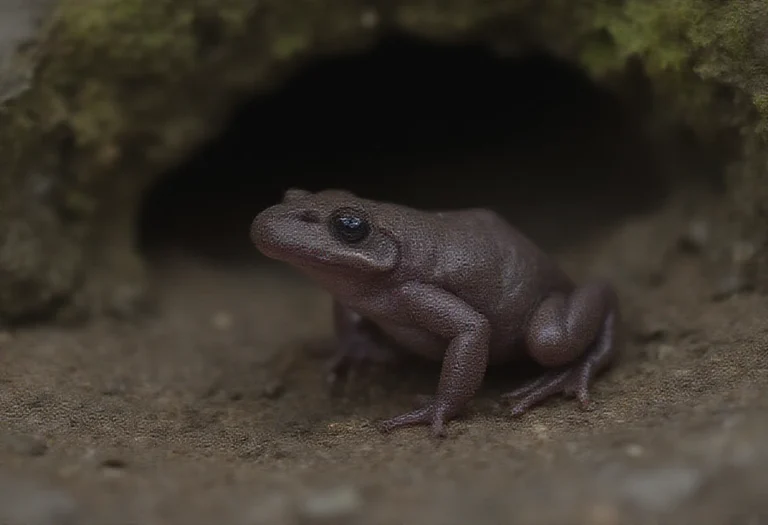
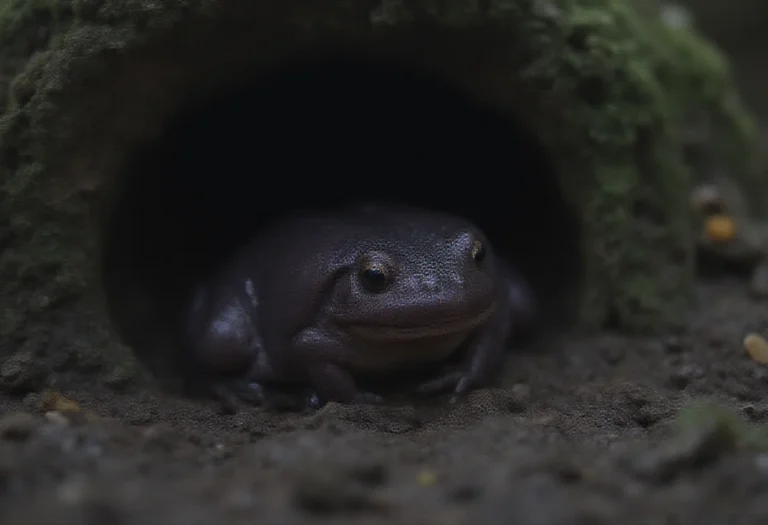
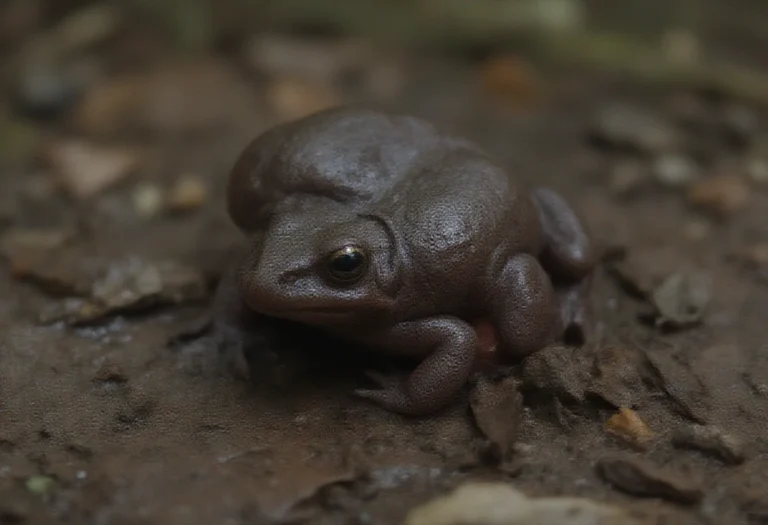
How this was made: prepared with AI assistance and checked against the sources listed at the end. Images are AI-generated illustrations, not photographs of real animals or products.
Key Takeaways
- The IUCN lists the species as Endangered (2004 assessment).
- There is no overall population estimate; the trend is decreasing.
- Road kills and habitat loss are rated as high threats in the 2019 EDGE action plan.
- Check dams, tadpole consumption and pesticides are lower or unknown threats.
- About half of known breeding habitat lies inside protected areas.
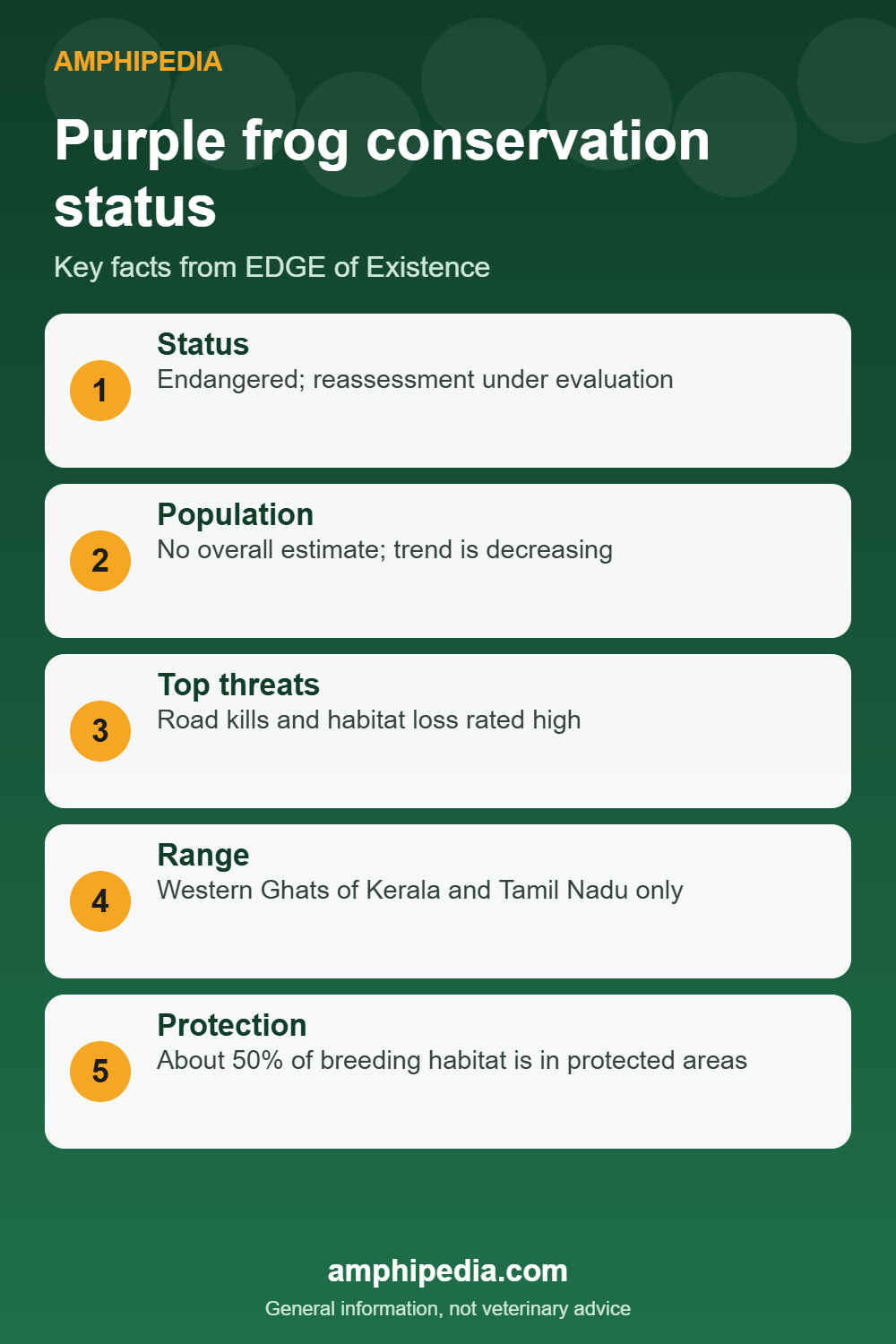
Pin this infographicShare on Facebook
What is the official status?
EDGE of Existence, the Zoological Society of London programme, lists the purple frog as Endangered. Its 2019 survival blueprint credits the Endangered listing to a 2004 assessment.
Reverse the Red says the 2004 assessment was based on limited data and that a reassessment is under evaluation. It expects the status to change after the new assessment.
One secondary website shows a Near Threatened category in a species box. The IUCN page itself could not be opened to verify that, so check the Red List directly for the current category.
How many purple frogs are left?
Nobody knows. EDGE of Existence says the population size is unknown and that the trend is decreasing. The frog is hard to count because it lives underground and surfaces only briefly.
The available numbers come from partial surveys, so they show how little was known rather than the total population.
| Year | What was recorded |
|---|---|
| 2004 | 135 individuals found, only 3 of them female (Idukki district) |
| 2017 to 2019 | 131 breeding sites recorded by the EDGE project |
| 2018 | 180 breeding pairs at a single egg-laying site |
Where does it live?
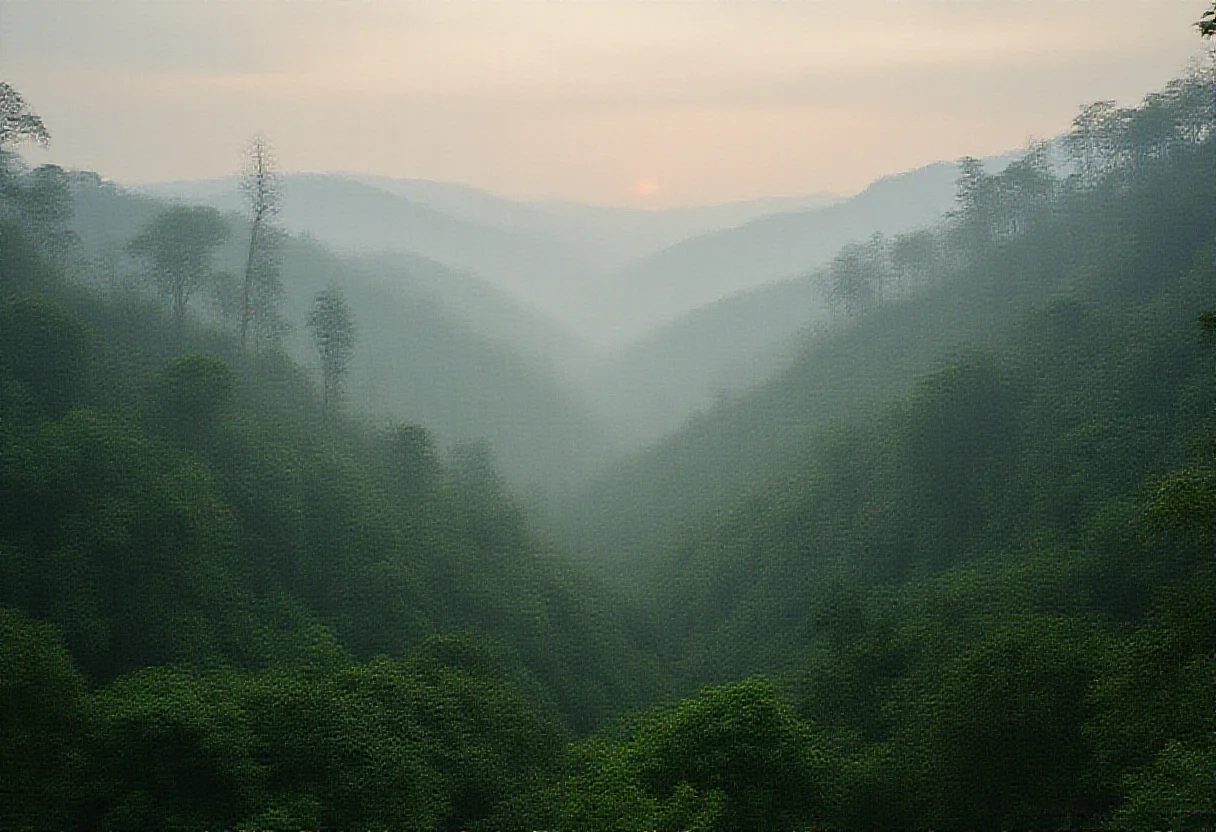
The species is found only in the Western Ghats of Kerala and Tamil Nadu. Breeding populations range from Cardamom Hill to the Camel Hump Mountains, with the northernmost known limit at the Periya Ghats in Kerala.
Elevation figures differ by source. EDGE of Existence says the frog lives below about 1,000 metres. The 2019 blueprint gives a range of 20 to 1,400 metres.
What are the main threats?
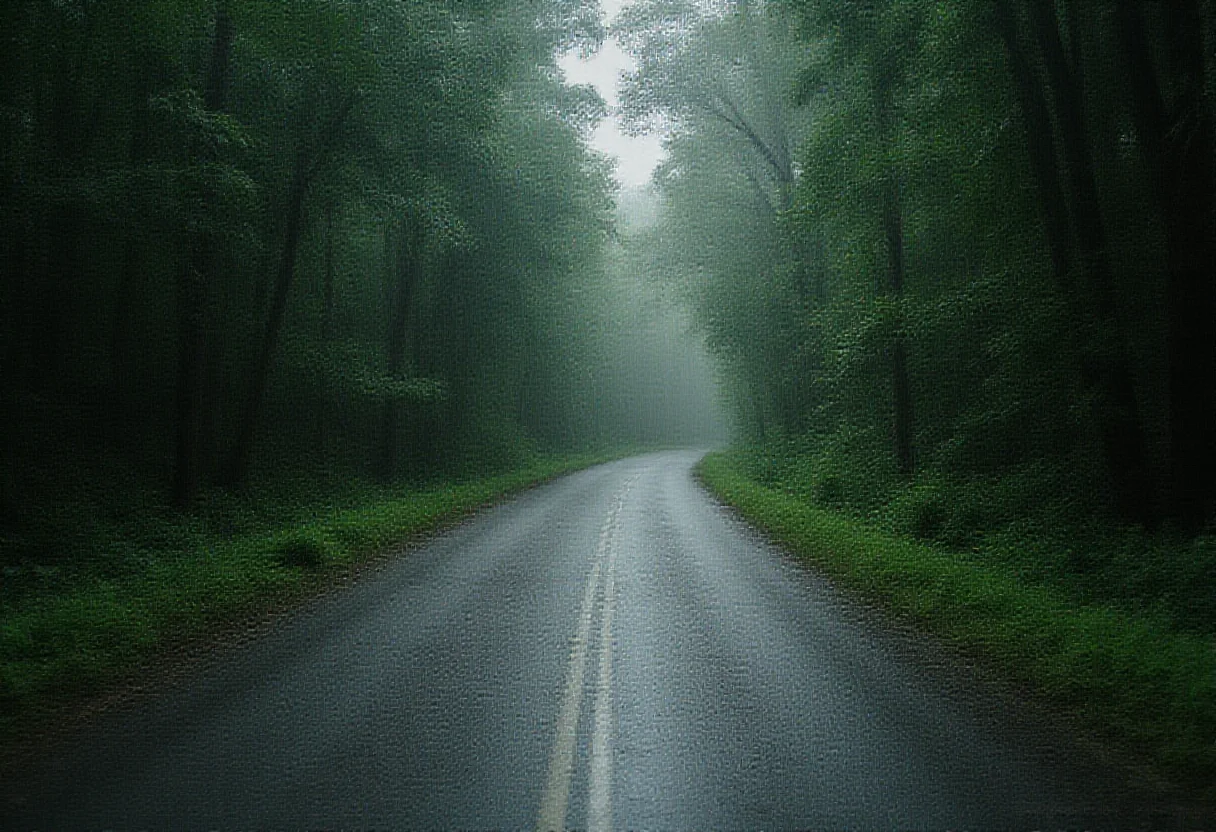
The 2019 EDGE action plan rates each threat. Road kills and habitat loss are both rated high. Adults cross roads to reach breeding sites during the monsoon, and vehicles kill them.
Habitat loss comes from development, mining and degradation on private land. Floods and landslides add to the pressure.
- Road kills: high
- Habitat loss: high
- Check dams that submerge egg-laying sites: low
- Consumption of tadpoles and adults for use as a respiratory remedy: low
- Pesticides near plantations: unknown, suspected high
Does tea farming threaten the frog?
EDGE of Existence warns that tea gardens could replace forest in parts of the frog’s range. Many plantations are recent, at no more than 50 to 70 years old, and sit beside forest.
The 2019 blueprint does not list tea as a separate threat, but it does flag pesticides on plantations beside breeding habitat as a suspected risk.
Why is such a hidden frog so vulnerable?
The frog depends on a few narrow conditions. The 2019 blueprint says adults emerge with the early rains and breed in crevices along fast-flowing seasonal streams, and that breeding takes only a couple of days.
If a road, a dam or a clearing blocks that short window, a whole year of breeding can be lost. A research paper titled “Tadpole consumption is a direct threat to the endangered purple frog” also exists, although the blueprint rates consumption as a low threat overall.
What is being done to protect it?
Conservation work covers surveys, clean-ups and awareness. Reverse the Red reports EDGE surveys since 2017 and a roadkill survey since 2020. Volunteers clean breeding sites, and the Kerala Forest Department has restricted tourist access to some sites.
The 2019 blueprint proposes a night traffic ban, signboards and speed bumps on key roads, plus screening for the chytrid fungus. A proposal to declare the frog Kerala’s state frog was also reported.
About 50 percent of breeding habitat lies inside protected areas, and about 30 percent lies outside, including private land and plantations.
Is it related to purple toads?
No. The purple frog is a frog in its own family, Nasikabatrachidae. It is not a toad. See are purple toads real for the toad question.
To learn more about the animal, read how purple frogs reproduce and how big purple frogs get.
Tadpole harvesting: what a five-year study found
A 2015 Mongabay report describes a survey in Idukki, Kerala, that ran from 2008 to 2013. It studied tribal communities of 100 to 150 households beside the Idukki Wildlife Sanctuary, where purple frog tadpoles are eaten.
- An average household of four ate about 1,500 tadpoles, roughly 3 kg, per season.
- The practice at that site had lasted about 40 years, since the communities settled there.
- Some people also ate adult frogs, which are above ground for only about two weeks.
- Most harvesters were young people aged 20 to 40.
- Five families stopped harvesting during the survey after learning about the consequences.
The authors warned that local populations could disappear if harvesting continued. They also cautioned that five years may not capture normal population swings and called for long-term monitoring.
Why two sources rate consumption differently
The 2019 EDGE blueprint rates consumption of tadpoles and adults as a low threat overall. The Mongabay study treats it as a direct local threat. Both statements can be true because they describe different scales.
Reverse the Red notes that human consumption is not considered a major threat across the range, since good populations persist where it occurs. The Idukki study covers one area with two key sites.
| Source | Scale | View on consumption |
|---|---|---|
| EDGE survival blueprint (2019) | Whole range | Low threat |
| Reverse the Red | Whole range | Not considered a major threat |
| Mongabay report on the 2008 to 2013 survey | Idukki study area | Could cause local extinction if it continues |
When you cite this frog’s threats, name the area as well as the source.
Other pressures from the same study
The Mongabay report adds several habitat points. Forest is converted for crops such as coffee, cardamom and ginger. Global Forest Watch data showed that the two key sites lost 4 percent of tree cover from 2001 to 2014.
Weather also mattered. Erratic pre-monsoon rain in 2011 and 2012 dried streams and some egg clutches. The authors suggest this, combined with harvesting, may explain the tadpole decline they saw.
Local people told the researchers that populations were much higher 10 to 15 years earlier. That is testimony, not a count, so treat it as a lead for further study.
A frog that surfaces for only about two weeks
The Mongabay study says adults stay in burrows for most of the year and emerge for about two weeks in the pre-monsoon season to breed and lay eggs. The EDGE blueprint also describes a short breeding window.
This pattern is why counts are unreliable. A survey that misses the window sees almost nothing, and a survey that hits it may see only part of the population.
The 2004 count of 135 frogs with only 3 females, in the table above, shows the problem. Lead author Ashish Thomas said amphibian sex ratios are often highly skewed, around 10 males to 1 female, so a skewed ratio in one count is not unexpected.
Who is monitoring the frog
Reverse the Red reports that the Zoological Society of London’s EDGE of Existence programme ran a project survey from 2017 to 2020 and has added sites since 2020 to fill data gaps. A roadkill survey began in 2020.
Partners include the Kerala Forest Research Institute, Aranyakam Nature Foundation and On the Edge, with help from the Kerala Forest Department, the Malabar Natural History Society, the Koodu Nature Society and Nature Guards of India.
Forest Department staff have been trained, including in identifying tadpoles, according to the same report.
The second purple frog species
Reverse the Red states that a related species, Nasikabatrachus bhupathi, was discovered in 2017 and has not yet been assessed for the Red List. An assessment record on the Conservation Needs site lists it as Not Evaluated, and says mouth abnormalities have been recorded in N. sahyadrensis, which could indicate the chytrid fungus Batrachochytrium dendrobatidis.
The cause of those abnormalities is unconfirmed. The 2019 blueprint separately proposes screening for the chytrid fungus.
Amphibian Species of the World adds that a 2017 study compared the two species in morphology, call and genetic markers, and an earlier paper suggested the name may cover unnamed species. Status claims therefore apply to N. sahyadrensis only.
Naming and culture
Biju and Bossuyt described the species in Nature in 2003, from a disturbed secondary forest near a cardamom plantation at Kattappana, Idukki district, at about 900 m. Local communities knew the frog long before that.
Reverse the Red says its popularity has grown through the King Mahabali story linked to the Onam festival, and that a proposal to name it Kerala’s State Frog has had wide media coverage. Government approval would bring more conservation attention, according to that source.
Frequently Asked Questions
Are purple frogs endangered?
Yes. EDGE of Existence and its 2019 blueprint list the species as Endangered, based on a 2004 IUCN assessment.
How many purple frogs are there?
No overall estimate exists. The population trend is reported as decreasing.
What threatens purple frogs most?
Road kills and habitat loss, both rated high in the 2019 EDGE action plan.
Are purple frogs eaten?
In a few locations, tadpoles and adults are used by indigenous communities as a respiratory remedy. The blueprint rates this as a low threat.
Where do purple frogs live?
Only in the Western Ghats of Kerala and Tamil Nadu in India.
Can the status change?
Yes. Reverse the Red says a reassessment is under evaluation and the status is expected to change.
Bottom Line
The purple frog is Endangered, scarce and hard to monitor. Its biggest known risks are roads and habitat loss.
Check the sources below for the latest details, and confirm the current Red List category before relying on it.
Sources
- EDGE of Existence: Purple frog. Used for: Status, population trend and threats.
- EDGE of Existence: Purple frog survival blueprint 2019. Used for: Threat ratings, numbers, range and conservation actions.
- Reverse the Red: Holistic approaches to conserving the purple frog. Used for: Reassessment, surveys and community work.
- EDGE of Existence: Tea plantations threaten amazing purple frog. Used for: Tea gardens and road risks.
- Amphibian Species of the World: Nasikabatrachus sahyadrensis. Used for: Distribution and year of description.
- Mongabay: Eaten to extinction? India’s purple frog faces another threat (2015). Used for: tadpole harvesting study, habitat and weather notes
- Conservation Needs: Nasikabatrachus bhupathi assessment record. Used for: sister species status and the mouth abnormality note
4 Comments