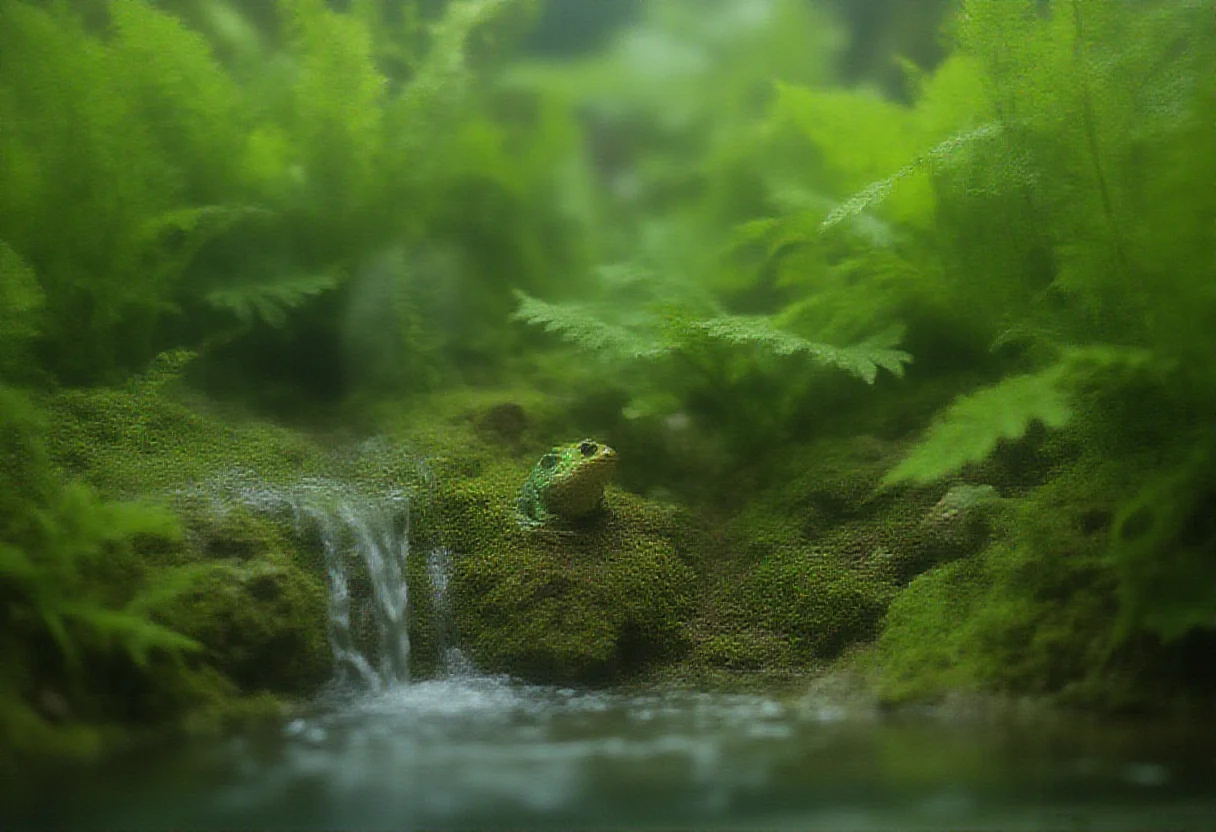
Amphibian Drip Waterfall Kit: Setup, Water and Safety
This post contains affiliate links. As an Amazon Associate I earn from qualifying purchases. Prices and availability are shown by Amazon and can change.
A drip waterfall kit uses a small pump to recirculate water over a rock or background so it trickles down into a pool. The MSD Veterinary Manual lists small streams and waterfalls as ways to keep moisture up in an amphibian enclosure. Choose a gentle, adjustable pump, make sure water stays clean and free of chlorine, protect electrical parts from splashes, and ensure no animal can be trapped behind the feature.
A trickling waterfall looks great and can help with humidity. But a moving-water feature adds a pump, a cable and a pool of standing water to a small enclosure. For amphibians, with their permeable skin and sensitivity to water quality, the details matter.
This guide explains how a drip waterfall works, what to check when choosing a kit, how to set it up, and how to keep it clean and safe. It is general guidance for frogs, newts and salamanders that live in humid setups.
How this was made: prepared with AI assistance and checked against the sources listed at the end. Images are AI-generated illustrations, not photographs of real animals or products.
Key Takeaways
- Streams and waterfalls are one way to keep moisture in an enclosure (MSD Veterinary Manual).
- Water must be free of chlorine, ammonia, nitrite, pesticides and heavy metals (MSD).
- Keep flow gentle and make sure animals cannot be trapped, pinned or drowned.
- Pools of standing water need regular cleaning and partial changes.
- Protect the pump and cable from splashes, and use a drip loop.
- A waterfall alone does not set humidity. Measure with a gauge.
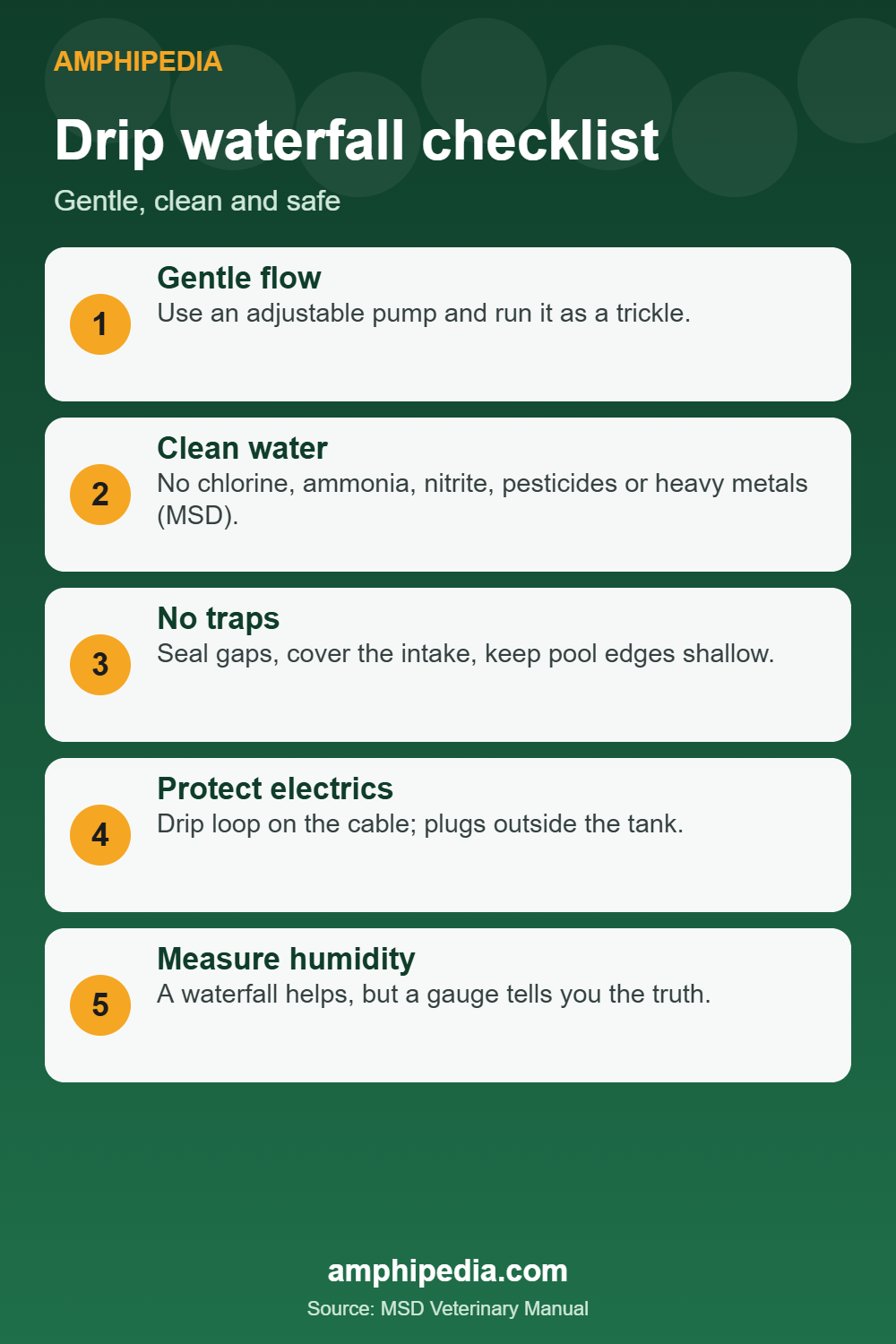
Pin this infographicShare on Facebook
Small pumps and filters for a trickling water feature
A waterfall needs a gentle, adjustable pump. These small units suit a trickle in a small enclosure. Cover the intake and keep cables above the water line.


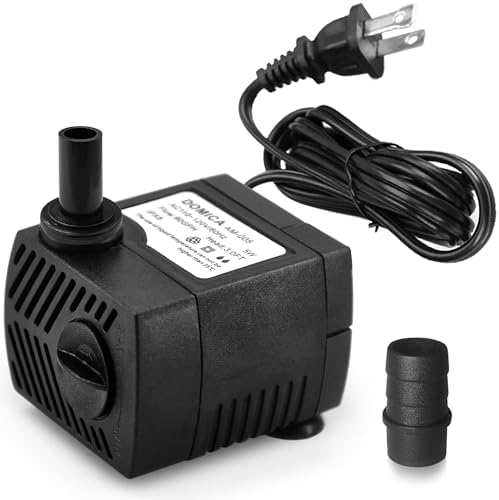


Product titles, prices and ratings are provided by Amazon and are accurate only at the time they are displayed.
How a drip waterfall works
A small submersible pump lifts water from a pool at the bottom, sends it up a tube, and releases it at the top. The water runs or drips down a rock face, a background panel or a chain of ledges, then returns to the pool.
The movement adds humidity to the air around it, gives animals a place to drink or soak, and creates a point of interest. It does not replace misting or ventilation planning.
What the evidence says about moving water
The MSD Veterinary Manual lists small streams, waterfalls, ultrasonic humidifiers and frequent misting as ways to maintain moisture in an amphibian enclosure. It also says some aquatic species need gentle filtration that keeps water clean without strong currents.
We did not find a vet or university source that tests specific waterfall flow rates for pet amphibians. So there is no sourced “correct” flow, only the principle: gentle, clean and safe.
What to look for in a kit
Look for features that make the feature safe and easy to maintain.
- An adjustable pump, so you can reduce flow to a trickle.
- A pump with a protected intake that small animals cannot enter.
- A smooth waterfall surface without sharp edges or deep gaps.
- Enough pool depth for the pump, but shallow edges animals can climb out of.
- Parts that can be taken apart and rinsed.
- A cable long enough to route outside the tank with a drip loop.
Setup step by step
Plan the feature before you add substrate and plants.
- Decide where the pool will sit and keep it at the lowest point.
- Check that the pump fits and the intake is covered.
- Build the rock or background so there are no gaps where animals could become trapped.
- Fill with clean, treated water.
- Run the pump with the tank empty of animals for a day and check for leaks.
- Adjust the flow to a trickle, then add animals.
Water quality in the pool
The MSD manual says water must be free of chlorine, ammonia, nitrite, pesticides and heavy metals. Treat tap water before it goes in the pool, and use a specific dechlorinating agent if your supply contains chloramines.
The manual says distilled water should not be used in enclosures. Our guide to dechlorinators for amphibian water explains the choices.
Small pools foul quickly. Remove debris, change part of the water often, and clean the pump and tubing. The MSD manual recommends at least 10% weekly water changes in established aquatic tanks, a useful guide for a large pool.
Safety checks
Moving water and electricity need respect.
- Use a drip loop on the cable so water cannot run into the socket.
- Keep plugs and controllers outside the tank and out of reach of splashes.
- Make sure the pump cannot be blocked by moss or substrate.
- Check for sharp edges around the waterfall.
- Keep lids closed so animals cannot reach cables.
- Switch off and unplug before reaching into the tank.
Hygiene
Reptiles and amphibians often carry Salmonella, and the CDC says you can become sick from tank water and equipment even without touching the animal. Clean pumps and tubing outside the kitchen, then wash your hands with soap and running water.
Pour old pool water down the toilet rather than a sink, as the CDC advises.
How much flow is too much? What vets say about currents
The earlier section noted that no source gives a correct waterfall flow rate. Two veterinary care sheets for axolotls, a fully aquatic salamander, do speak about currents, and the warning is clear.
- The Royal Veterinary College (RVC) axolotl sheet says it is essential that filters do not cause strong water flow, because this can cause severe stress. It adds that over-filtration is a potential cause of stress and must be controlled.
- Lafeber’s axolotl sheet says axolotls prefer stagnant to slow-moving water and that strong currents can cause stress. It suggests a spray bar to dissipate flow across the surface.
These sheets are about axolotls, not frogs or newts, so they do not set a flow for every species. They do show what to watch for: if an animal avoids the stream, the flow may be too strong. Turn the pump down, aim it at a rock face and recheck.
Water changes: the sources give three numbers
A recirculating pool is a small closed system, so water change advice matters. The sources differ on how much, and on what to measure.
- MSD Veterinary Manual: at least 10 percent of the water weekly in established aquatic tanks.
- RVC axolotl sheet: 10 to 20 percent weekly, adjusted for the filter system and water quality testing.
- Lafeber axolotl sheet: ideally 30 percent weekly, with more frequent or larger changes if nitrate keeps rising.
Lafeber also says filtration is an aid and should never replace regular water changes. A waterfall pump moves water. It does not remove dissolved waste. For a small pool, the larger figure is the cautious choice, and testing should settle the question.
Test the pool before animals use it
The MSD pet owner page says regular water testing is essential and suggests testing weekly for water temperature, pH, hardness, ammonia, nitrite and nitrate. It also says pet owners should read bottled water labels carefully and test water when unsure.
Lafeber’s axolotl sheet gives sample targets of 0 ppm for ammonia and nitrite and nitrate below 10 ppm, and says not to add animals to a new aquarium until water parameters have stabilised. These are axolotl targets, so confirm the targets for your species. The principle still applies to any waterfall pool.
- Fill and run the system without animals.
- Test ammonia, nitrite and nitrate at the start and again after several days.
- Do not add animals until the readings are stable.
- Record the readings weekly and adjust water changes to what the tests show.
Watch the pool temperature
Cool-water species have a firm ceiling. The RVC says the optimum temperature for axolotls is 16 to 18 C and should never exceed 24 C. Lafeber gives 15.6 to 17.8 C (60 to 64 F) and says axolotls exposed to water above 24 C (75 F) have a high probability of becoming ill. The two sources agree on 24 C as the upper limit.
A pump runs inside the pool, and a small volume of water is quick to change temperature. If you keep a cool-water species, put a thermometer in the pool and check it daily, especially in warm weather.
Where to clean the pump and tubing
Pumps and tubing are tank equipment, so the CDC rules apply. The CDC says to clean supplies outside if possible, away from gardens and other food or water sources. If that is not possible, use a laundry sink or bathtub and thoroughly clean and disinfect the area before others use it.
It says never to use food preparation areas for habitat equipment, and to pour tank water down the toilet, not a sink or drain. If soap and water are not available, use a hand sanitiser with at least 60 percent alcohol. The CDC lists children under 5, adults 65 and older, people with weakened immune systems and pregnant women as higher risk.
Common mistakes
These problems are easy to avoid.
- Flow set too high, which splashes water out of the tank.
- No humidity gauge, so you cannot tell if the feature helps.
- Letting the pool run low and the pump run dry.
- Using untreated tap water.
- Leaving gaps where a small animal can get trapped behind the rock.
Related guides
For more on water movement, see our guides to a water pump or filter for a frog tank, a pond pump for a paludarium and a compact mist generator.
Frequently Asked Questions
Does a waterfall raise humidity?
It can help. The MSD manual lists waterfalls and streams as ways to maintain moisture, but you still need a humidity gauge.
What flow rate is right?
We found no sourced figure. Keep flow gentle and adjustable, and watch your animals.
Can any tap water go in the pool?
No. Chlorine must be removed, and chloramines need a specific dechlorinating agent, according to the MSD manual.
How often should I change the water?
The MSD manual says at least 10% weekly in established aquatic tanks. Small pools may need more frequent care.
Is a waterfall safe for all amphibians?
Not always. Some aquatic species need gentle filtration without strong currents. Check your species.
How do I stop animals getting trapped?
Seal gaps behind rocks, cover the intake and keep pool edges shallow.
Do I still need misting?
Possibly. A waterfall is one tool, not a complete humidity plan.
Bottom Line
A drip waterfall kit can add humidity and interest, but only if the pump is gentle, the water is clean and the build is safe. Plan the layout first, protect the electrics and keep up with water changes.
Measure humidity rather than assuming, and check your species needs. If you are unsure, ask an exotics vet.
Sources
- MSD Veterinary Manual: Housing for Amphibians (pet owner version), accessed 12 November 2026. Used for: moisture from streams and waterfalls, water quality, weekly testing, filtration, water changes.
- MSD Veterinary Manual: Environment and Husbandry for Amphibians (professional version), accessed 12 November 2026. Used for: chloramine and water quality background.
- Royal Veterinary College: Axolotl care sheet (2024), accessed 12 November 2026. Used for: filtration and flow, temperature, water changes.
- Lafeber Veterinary: Axolotl Care (PDF, March 2021), accessed 12 November 2026. Used for: flow, spray bar, water changes, water targets, temperature.
- CDC: Reptiles and Amphibians (Healthy Pets, Healthy People), accessed 12 November 2026. Used for: Salmonella risk, handwashing, where to clean equipment, tank water disposal, higher-risk groups.
One Comment