Best Gloves for Handling Amphibians: What Is Safe
This post contains affiliate links. As an Amazon Associate I earn from qualifying purchases. Prices and availability are shown by Amazon and can change.
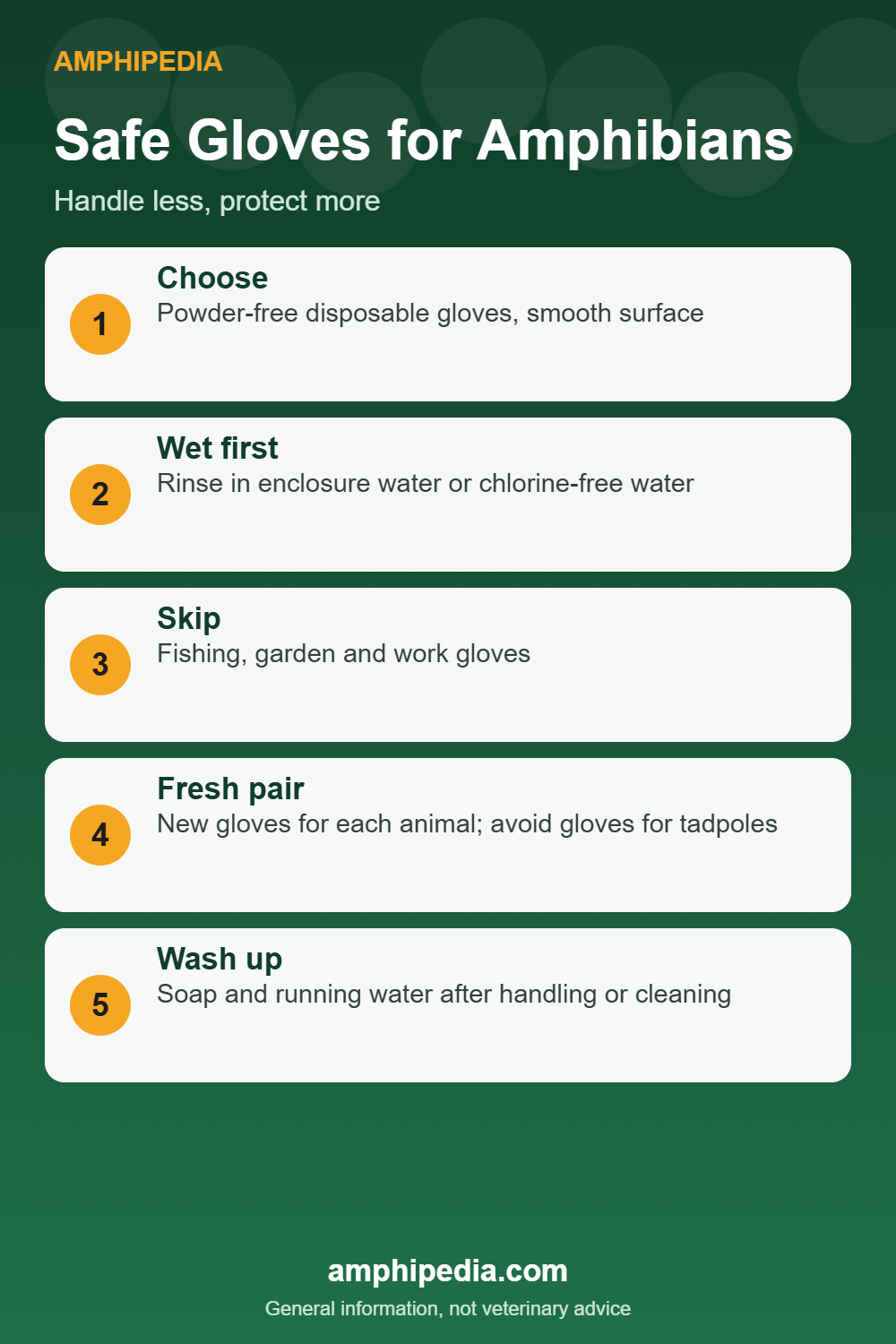
The best gloves for handling amphibians are powder-free disposable gloves, rinsed in dechlorinated water before use. The MSD Veterinary Manual advises wetting them with enclosure water or chlorine-free water. Fishing and work gloves are not suitable. Handle your animal as little as possible, use a fresh pair for each animal, and skip gloves entirely for tadpoles, since research found some glove types can be lethal to larvae.
Amphibian skin is thin, moist and easily damaged. Dry hands, soap residue, lotion and rough gloves can all harm it. Gloves protect the animal, and they also protect you from skin secretions and germs.
Many older posts recommend fishing or grip gloves. Those are made for fish scales and wet rope, not delicate skin. This guide explains what to use instead, how to use gloves correctly, and when it is better not to handle at all.
How this was made: prepared with AI assistance and checked against the sources listed at the end. Images are AI-generated illustrations, not photographs of real animals or products.
Key Takeaways
- Handle amphibians as little as possible. Most are display animals, not pets to hold.
- Use powder-free disposable gloves, moistened with enclosure water or chlorine-free water.
- Do not use fishing, gardening or work gloves, which are textured and may carry residue.
- Use a new pair for each animal. Research found some glove types can be lethal to tadpoles.
- Wash your hands with soap and running water after handling animals or cleaning tanks.
Pin this infographicShare on Facebook
Disposable gloves worth a look
The table is ordered from the highest price to the lowest. Prices, images and buy buttons come straight from Amazon and are not edited by us.


Product titles, prices and ratings are provided by Amazon and are accurate only at the time they are displayed.
Why gloves are needed at all
The MSD Veterinary Manual states that amphibian skin is delicate and that adults breathe partly through it, so it must stay moist. A slime layer protects the skin. Dry hands can strip this layer away.
Some species also release irritating toxins from skin or glands. Gloves protect you from that. They do not make handling safe for every species, so research your animal before you pick it up.
Fishing gloves are the wrong tool
Fish-handling gloves have a textured or coated grip to hold slippery fish. That grip can abrade a frog or salamander and may carry fish slime, residue or cleaning chemicals. They are not designed to be rinsed clean for a different animal.
Choose smooth, disposable gloves that you throw away after use. The MSD Veterinary Manual asks for powder-free disposable gloves, so powder from standard gloves is avoided.
What to look for
Look for simple, plain gloves. You do not need extra features.
- Labelled powder-free and disposable
- A snug fit that does not slip off the fingers
- Smooth surface, not textured
- Thin enough to keep a light touch
- Sizes that suit your hands, so you do not tear the glove
- A material you are not allergic to, such as latex-free options
A caution about tadpoles and glove types
A 2009 paper in Herpetological Review by Greer and colleagues reports that latex, vinyl and nitrile gloves have been lethal to some tadpole species, even after short exposure. The authors recommend a new pair for each animal and a glove type tested as safe for the species.
They also note that rinsing gloves in fresh water reduced toxicity, and that washed bare hands may sometimes be better than reusing the same gloves. If you keep larvae, ask your vet or breeder and avoid handling them.
How to use gloves step by step
Prepare everything before you touch the animal.
- Wash your hands with soap and running water, then rinse well.
- Put on a fresh pair of powder-free disposable gloves.
- Rinse the gloves in enclosure water or chlorine-free water. The MSD housing page says distilled water should not be used when handling amphibians.
- Scoop the animal gently from below. Do not squeeze or pinch.
- Keep the session short, and hold the animal over a soft, wet surface.
- Return the animal, then remove and throw away the gloves.
- Wash your hands again.
When it is better not to handle
Moving an animal with a clean container is often safer than any glove. Petco advises moving salamanders and newts into a secure container before tank cleaning. A small tub with some enclosure water, or a damp cup, lets the animal walk in on its own.
Skip handling for sick animals, shedding animals, tadpoles and species known for strong skin secretions. If a transfer is essential, ask an exotics vet to show you the safest method for that species.
Quick comparison of options
Each method has trade-offs. Pick the one that causes the least contact.
| Method | Good for | Watch out for |
|---|---|---|
| Clean container, no touching | Moving most animals during cleaning | Needs patience and a calm animal |
| Powder-free disposable gloves, rinsed | Short handling of adults, cleaning tasks | Fresh pair every time; may harm larvae |
| Washed bare hands, rinsed well | Species where gloves are not advised | Soap or lotion residue can hurt skin |
| Fishing or work gloves | Not suitable | Rough grip and residue |
Handling children and visitors
The CDC says people at higher risk, including children under 5, should consider a different pet. Adults over 65 and people with weakened immune systems are also at higher risk. Do not let visitors pick up animals, even with gloves.
Keep gloves, containers and cleaning supplies out of kitchens and out of reach of children. Teach everyone in the house to wash hands after any contact with the tank.
Cleaning tasks need gloves too
The MSD Veterinary Manual also advises disposable gloves when cleaning enclosures. Tank water and equipment can carry Salmonella, which the CDC says amphibians often carry without signs of illness.
The CDC advises cleaning tanks and supplies outside the home if you can, not in the kitchen sink, and pouring wastewater down a toilet. Households with children under 5 should read the CDC advice on higher-risk groups before keeping amphibians.
Common mistakes
Most harm comes from rushing or reusing gear.
- Handling with dry gloves or dry hands
- Reusing the same pair on several animals
- Handling right after using hand sanitiser, lotion or insect repellent
- Picking up an animal for photos or to show others
- Using gloves that smell of rubber or powder
- Forgetting to wash hands afterwards
Gloves, disease and why a new pair matters
Skin protection is one reason to wear gloves. Greer and colleagues give another: gloves help stop pathogens such as the chytrid fungus Batrachochytrium dendrobatidis (Bd) and ranaviruses spreading between individuals, populations and habitats. The authors warn that dropping glove use may unnecessarily increase the spread of harmful pathogens.
That is why the advice is a new pair for each animal. Reusing a pair carries whatever the first animal left on it to the second. This matters most if you keep several animals, handle wild-caught animals or help with a rescue.
What researchers recommend for testing a glove
The Greer paper describes how researchers screen glove types. It cites work in which gloves that were toxic affected up to 40% of the tadpoles tested, and notes that some gloves were lethal even after short exposure. Its test method is built for labs.
- Test each species with each glove type and brand, or batch, before routine use.
- Watch the handled animals for 24 hours.
- Include control animals handled with clean bare hands or with gloves already shown to be safe.
- Retest new batches from time to time.
- If gloves have been used on a species for 24 hours without problems, the authors say use can continue, with a watch for unusual deaths.
The paper suggests a sample of 29 animals for a reliable test, which is far beyond a pet keeper. For a hobbyist, the useful lesson is simple: never trial an untested glove on a valued animal, and avoid gloves for larvae unless a vet or breeder confirms a safe type.
Storing gloves so they stay clean
The same paper advises storing gloves away from disinfectants, insecticides and laboratory chemicals, and checking whether plastic containers leach contaminants. At home, translate that into habits.
- Keep the glove box in a drawer or cupboard away from cleaning sprays, pest products and hand sanitiser.
- Do not keep gloves in the same cabinet as fertiliser or garden chemicals.
- Pull gloves from the box with clean, dry hands, not wet or soapy ones.
- Discard any gloves that smell strongly of chemicals.
- Close the box after each use.
Greer and colleagues also say to rinse gloves in fresh water before handling, because this reduced the toxicity of vinyl gloves, and to discard the rinse water on land rather than into the tank.
Choosing a method by situation
- Moving a healthy adult: coax it into a damp container if you can. If you must hold it, use rinsed, powder-free gloves, as the MSD Veterinary Manual advises.
- Cleaning the tank: MSD advises gloves dampened with enclosure or chlorine-free water. Move the animal into a secure container first.
- A wild animal in your yard: avoid touching it. If you have to move it, wear fresh gloves and wash up after.
- Tadpoles: avoid gloves and handling altogether unless a vet or breeder confirms a safe type.
- A sick or injured animal: MSD says prompt veterinary care is essential and that drugs should never be given without asking a vet first.
Greer and colleagues note that another study found washed bare hands may sometimes be preferable to reusing the same gloves repeatedly. That does not make bare hands better than a fresh pair, but it shows that careless glove use has costs.
Throwing gloves away properly
- Peel the first glove off by the cuff so it turns inside out.
- Hold it in the other gloved hand and peel that glove over it.
- Drop both in a bin, not in the tank, sink or toilet.
- Wash your hands with soap and running water, as the CDC advises.
- Wipe the surface where you worked, away from food areas.
Frequently Asked Questions
Do I need gloves to handle a frog?
Wet, clean hands or moistened powder-free gloves are advised. Handling should be minimal either way.
Are nitrile gloves safe for amphibians?
They are common, but research found nitrile can harm some tadpole species. Rinse them, use a fresh pair for each animal and avoid gloves for larvae.
Can I use latex gloves?
Powder-free disposable gloves are advised. Latex has also been reported harmful to tadpoles, and some people are allergic, so latex-free options are simpler.
Can I wear gloves to clean the tank?
Yes. The MSD Veterinary Manual advises disposable gloves for cleaning, and the CDC says to wash hands afterwards.
Why not use fishing gloves?
Their textured grip can scratch thin skin and may carry fish slime or residue. Use smooth disposable gloves instead.
Bottom Line
The best amphibian gloves are the plainest ones. Choose powder-free, disposable and smooth, rinse them in safe water, and change them between animals.
Better still, handle less. Watching a healthy frog from outside the glass is safer for both of you.
Sources
- MSD Veterinary Manual: Special Considerations for Amphibians, accessed 31 October 2026
- Greer et al. 2009, Guidelines for the Safe Use of Disposable Gloves with Amphibian Larvae, Herpetological Review 40(2), accessed 31 October 2026
- MSD Veterinary Manual: Housing for Amphibians, accessed 31 October 2026
- CDC: Reptiles and Amphibians, Healthy Pets, accessed 31 October 2026

One Comment