Best Compact Fogger for a Vivarium: Size, Setup and Safety
This post contains affiliate links. As an Amazon Associate I earn from qualifying purchases. Prices and availability are shown by Amazon and can change.
A compact fogger for a vivarium is a small ultrasonic unit that adds cool fog to raise humidity in a small to mid-size amphibian tank. Pick a unit with low or adjustable output, a hose or outlet you can aim away from the animal, and a reservoir you can clean easily. Use it on a timer, check humidity with a gauge, and disinfect it weekly, as the MSD Veterinary Manual advises for humidifiers.
Small vivariums lose and gain humidity quickly. A compact fogger is a handy tool, but too much fog turns a planted tank into a swamp, and a dirty reservoir can spread bacteria.
This guide focuses on size, placement and routine for small setups. For safety questions about the “reptile safe” label, see our companion article on the reptile safe fogging humidifier.
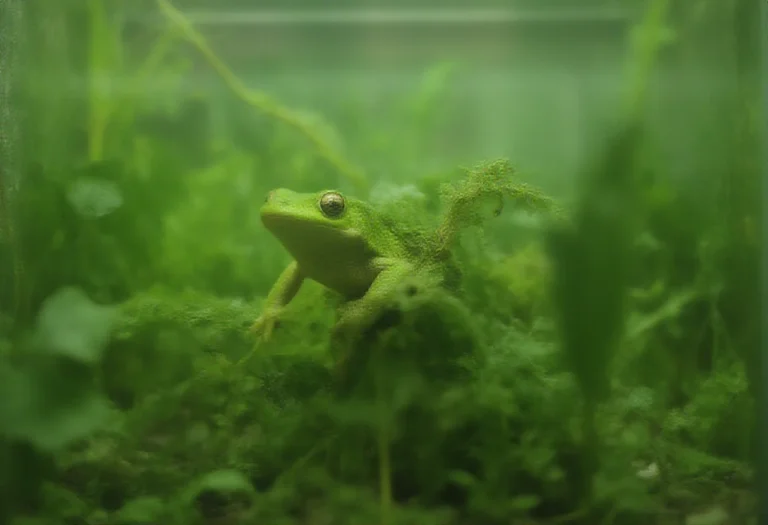
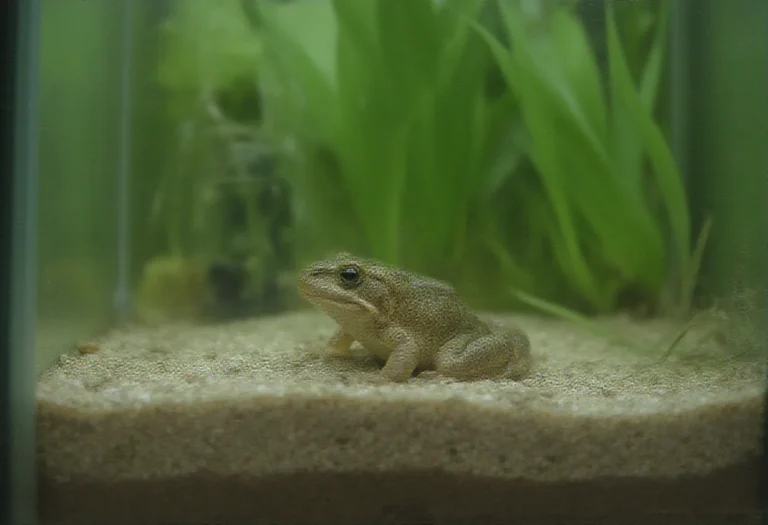
How this was made: prepared with AI assistance and checked against the sources listed at the end. Images are AI-generated illustrations, not photographs of real animals or products.
Key Takeaways
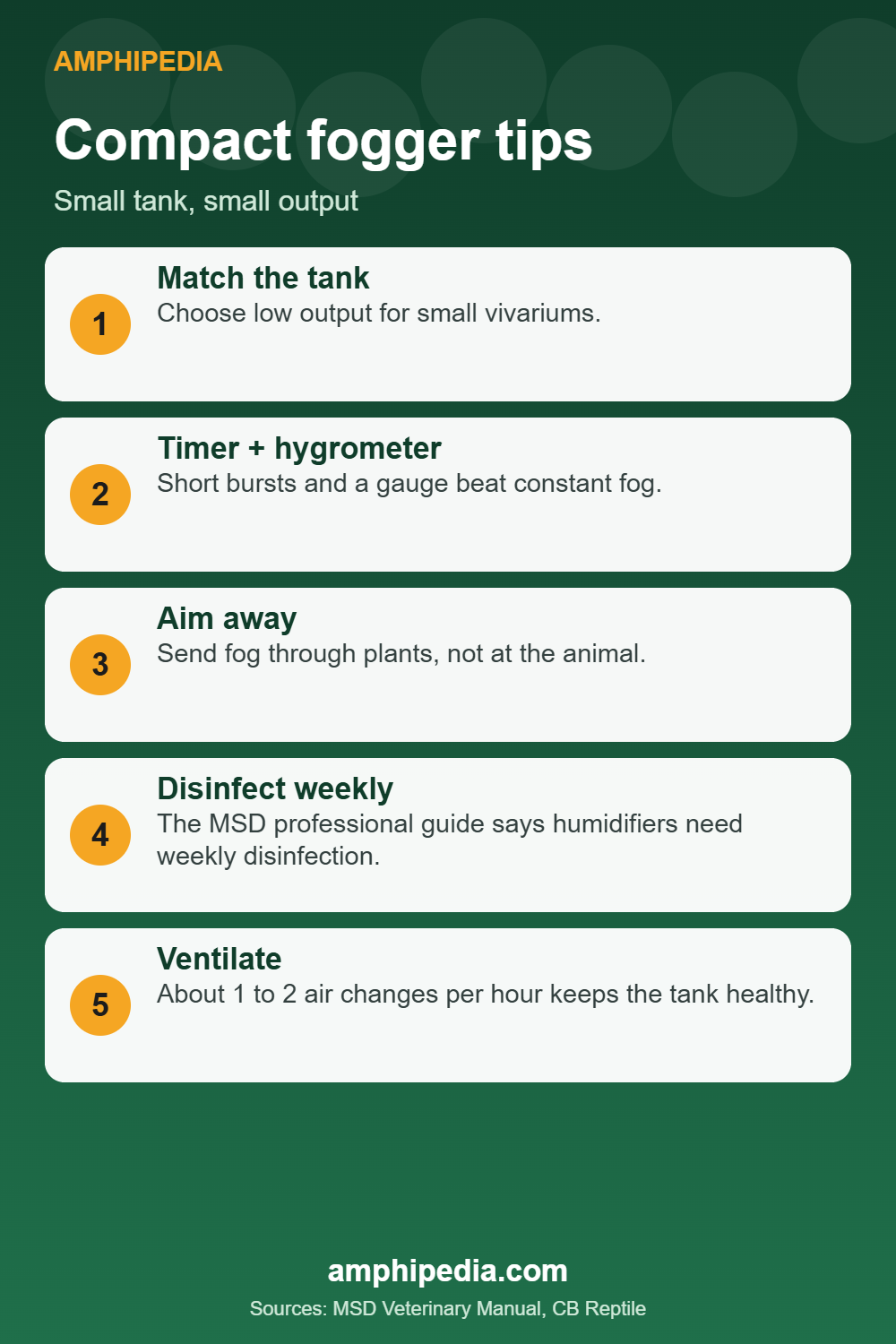
- Choose a unit that matches the tank. Small tanks need low output, not maximum fog.
- Most amphibians do well at 75 to 80% humidity; tropical species may need 85 to 90% (MSD Veterinary Manual).
- Disinfect humidifiers weekly (MSD professional guide).
- Use a timer and a hygrometer so humidity cycles instead of staying saturated.
- Keep ventilation of about 1 to 2 air changes per hour.
- Fog should drift through plants, never blast at an animal.
Pin this infographicShare on Facebook
Compact Reptile Foggers to Compare
These reptile foggers come from Amazon listings and are sorted by price from high to low. We have not tested them or checked them for amphibians. Check tank size, water type and cleaning needs against the guide below.
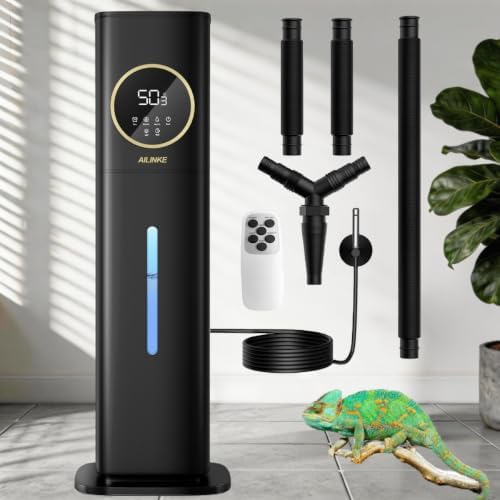


Product titles, prices and ratings are provided by Amazon and are accurate only at the time they are displayed.
What compact means in practice
A compact fogger has a small water reservoir and a small output, so it suits a modest vivarium. That is good news for control. A large fogger in a small tank pushes humidity to saturation within minutes.
Check how much volume the maker says the unit is meant for, and choose the lower end of the range. You can always run it longer, but you cannot take fog back out of the tank.
Features worth paying attention to
Compare these features before you decide.
- Adjustable fog output or a simple low/high switch.
- An outlet or hose you can aim and secure.
- A reservoir with a wide mouth for easy rinsing.
- A built-in or external timer connection.
- A float or auto shut-off that stops the unit when the water runs out.
- Parts that can be taken apart and dried completely.
Humidity targets to aim for
The MSD Veterinary Manual says most amphibians do well at 75 to 80% humidity, and tropical species may need 85 to 90%. It also advises at least one thermometer in every enclosure, and a hygrometer does the same job for humidity.
A CB Reptile dart frog guide suggests about 70 to 100% humidity with daily cycling. This matches a common routine: wetter after misting or fogging, drier later in the day.
Cooler-climate species may need much less. Do not push every tank to 90% simply because a fogger can.
Placing and running it
Where you put the fogger matters more than the model. Keep the unit outside the tank if you can, run a short hose in through a vent, and point the fog toward plants.
Avoid aiming at a hide or at the spot where an animal rests. Constant drenching is not the same as healthy humidity.
- Fill the reservoir with treated, clean water.
- Set the lowest output and run for 5 to 10 minutes.
- Check the hygrometer and the floor.
- Add a timer for short daily bursts.
- Adjust over several days, not several minutes.
Water and cleaning
The MSD manual says water must be free of chlorine, ammonia, nitrite, pesticides and heavy metals, and that distilled water should not be used in enclosures. CB Reptile suggests distilled or RO water for fogging. Because these two sources disagree, follow your fogger manual and ask a vet about your local water.
The MSD professional guide says humidifiers and spray bottles must be disinfected weekly. Rinse well afterwards and let parts dry.
The CDC advises cleaning habitat equipment outside the home when possible and away from kitchens. Wash your hands afterwards.
A simple weekly routine
Small tanks stay healthy when the routine is short and regular. A fogger adds one more item to it, so write the steps down.
Check the reservoir level, rinse it and let it dry between uses. Wipe the outlet and any hose, because film builds up where warm water sits. Look at the plants and substrate for mould before you refill.
- Empty and rinse the reservoir.
- Disinfect the unit and let it dry, as the MSD professional guide advises weekly.
- Refill with treated water.
- Check the hygrometer at the same time each day.
- Note any change in appetite or activity and ask a vet if something looks wrong.
Signs the fogger is overdoing it
Watch the tank for early warning signs.
- Water pooling on the substrate or glass all day.
- Mould or fuzz on wood or soil.
- A musty smell.
- Animals sitting at the top of the tank, away from the wet floor.
- Plants turning slimy.
- Humidity stuck at the top of the gauge range.
Alternatives and add-ons
A fogger is not the only route. The MSD manual lists small streams, waterfalls, ultrasonic humidifiers and frequent misting as ways to keep moisture in the tank. Our guides to auto mist systems and the compact mist generator explain other options.
For a water-and-land setup, see the fogger for a paludarium and the fog machine for a newt tank.
Home humidifier rules versus amphibian rules
A compact fogger is a small ultrasonic humidifier, so general humidifier guidance applies. The US EPA’s page on home humidifiers says to use water with low mineral content, such as distilled water, because minerals can be released into the air as white dust and tap water minerals build up as scale. Scale can harbour microorganisms. The EPA adds that reverse-osmosis and deionized water usually retain more minerals than distilled water.
On cleaning, the EPA says to empty, dry and refill a portable humidifier daily and to clean it every third day. The MSD Veterinary Manual asks for weekly disinfection of humidifiers and spray bottles. These are different standards. A keeper who empties and dries the tank daily and cleans every few days is following the stricter of the two.
The water advice also conflicts. The MSD pet owner page says distilled water should not be used in amphibian enclosures or when handling amphibians, while CB Reptile and the EPA favour distilled or low-mineral water for the machine. A fogger that fills the tank with fog sits between those uses. Ask an exotics vet which applies to your species, and follow the fogger maker’s directions.
Reading a humidity cycle
CB Reptile’s dart frog guide recommends roughly 70 to 100 percent humidity with daily cycling. It says the enclosure should be slightly drier after the lights come on and wetter after misting. Use that rhythm to judge your fogger, not a single reading.
- Place a hygrometer at the level where the animals sit, not near the fog outlet.
- Write down the reading at the same two times each day for a week.
- Note when the fogger ran and for how long.
- Look for a daily rise and fall. A flat line at the top of the gauge means the tank is staying saturated.
- Shorten the run time or lower the output until the pattern looks like a cycle.
Match the target to the species
There is no single humidity number. The sources used here give different targets for different animals.
- Most amphibians: 75 to 80 percent, and tropical species 85 to 90 percent (MSD Veterinary Manual, pet owner version).
- Dart frogs: 80 to 95 percent (DartFrog.pet) and 80 to 100 percent (Lafeber). CB Reptile gives a wider 70 to 100 percent with daily cycling.
- Temperate species: MSD says most amphibians do well at 60 to 70 F (16 to 21 C) and tropical species may need 75 to 80 F (24 to 27 C), so a cool-climate animal may need a drier, cooler tank than a fogger could produce.
Always confirm the range for your own species before you size or run a fogger.
Fog and temperature
CB Reptile warns that sustained heat above the high 70s to low 80s F can stress amphibians. Lafeber’s dart frog sheet says not to use radiant heat sources because they tend to dry amphibian environments. A fogger that sits in a warm spot, or that is paired with a hot lamp, works against its own purpose.
Check temperature with a probe at mid-tank height, as CB Reptile suggests, whenever you change the fogger’s position or run time.
Frequently Asked Questions
What size fogger do I need?
Choose one that the maker rates for your tank volume, and lean toward the lower end. Small tanks saturate quickly.
How long should it run?
Start with 5 to 10 minutes and check the hygrometer. Many keepers use short bursts on a timer. Adjust slowly.
What humidity should I aim for?
The MSD manual says 75 to 80% for most amphibians and 85 to 90% for tropical species.
Do I need to clean it?
Yes. The MSD professional guide says humidifiers must be disinfected weekly.
Can I use tap water?
Water must be free of chlorine, per the MSD manual. Chloramine needs a specific agent. Check your fogger manual too.
Is fog bad for amphibians?
Not by itself. Problems come from constant saturation, dirty reservoirs and fog aimed at the animal.
Should I use it with misting?
CB Reptile suggests pairing fogging with regular misting or an automated misting system.
Bottom Line
The best compact fogger is the one you can control. Look for low output, easy cleaning and a way to aim the fog away from the animal.
Keep humidity cycling, ventilate the tank, disinfect weekly and measure before you adjust. When in doubt, ask an exotics vet.
Sources
- MSD Veterinary Manual: Housing for Amphibians (pet owner version), accessed 12 November 2026. Used for: temperature, humidity, water quality, distilled water, cleaning.
- MSD Veterinary Manual: Environment and Husbandry for Amphibians (professional version), accessed 12 November 2026. Used for: weekly disinfection of humidifiers, ventilation, chloramine and water quality.
- CB Reptile: Dart frog care guide, accessed 12 November 2026. Used for: dart frog humidity, misting, fogger water, temperature, photoperiod.
- US EPA: Use and Care of Home Humidifiers, accessed 12 November 2026. Used for: low-mineral water, scale, daily emptying, cleaning every third day.
- DartFrog.pet: Dart Frog information library, accessed 12 November 2026. Used for: dart frog humidity range.
- Lafeber Veterinary: Basic Information Sheet, Poison Dart Frog, accessed 12 November 2026. Used for: dart frog humidity, radiant heat.
- CDC: Reptiles and Amphibians (Healthy Pets, Healthy People). Used for: Salmonella risk, handwashing and where to clean habitat equipment.

7 Comments