Best Humidity Controller for Amphibians: What to Look For
This post contains affiliate links. As an Amazon Associate I earn from qualifying purchases. Prices and availability are shown by Amazon and can change.
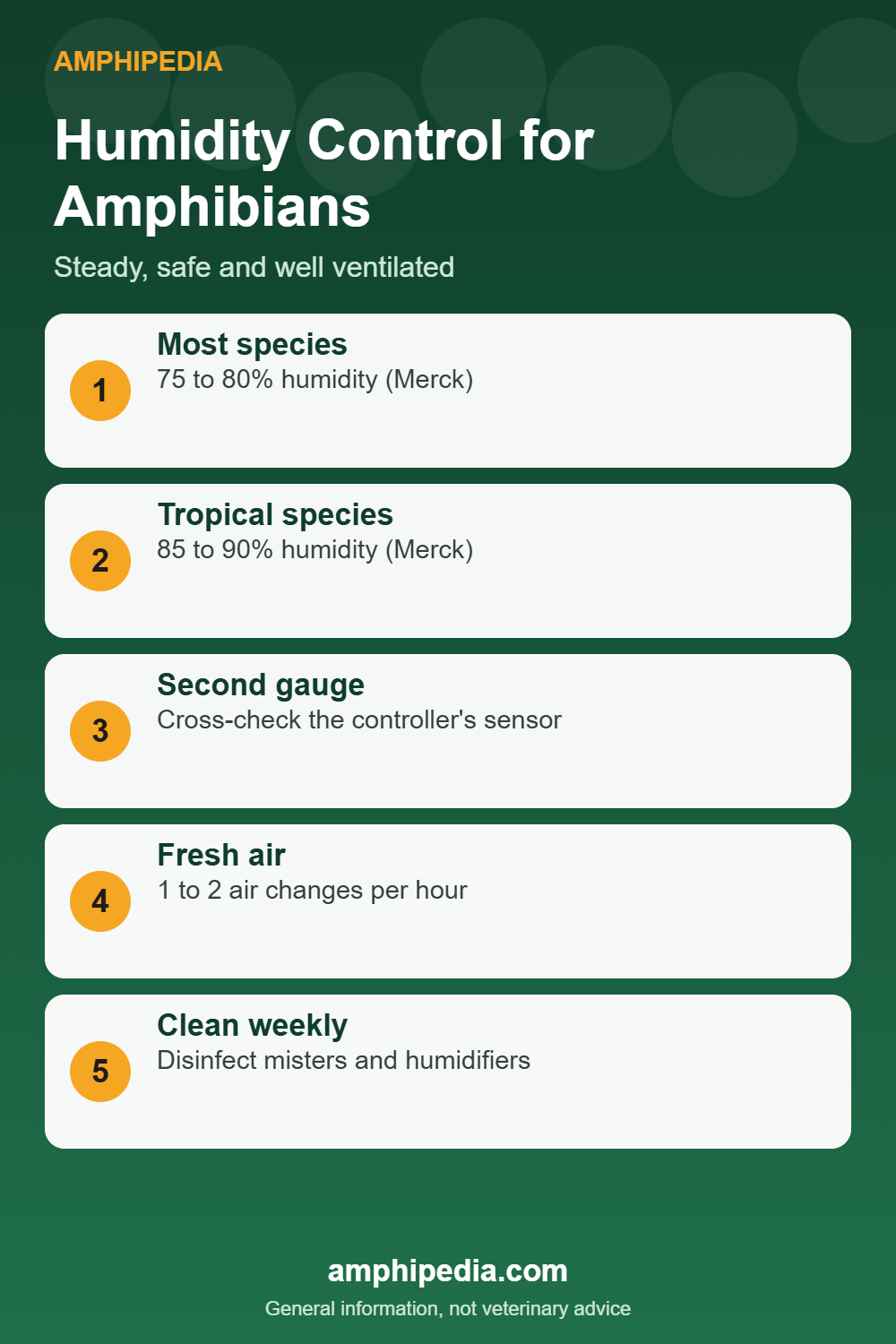
The best humidity controller for amphibians pairs a reliable sensor with a mister or humidifier and lets you set safe limits. The Merck Veterinary Manual says most amphibians do well at 75 to 80% humidity and tropical species may need 85 to 90%. Always check the reading with a separate gauge and keep the tank ventilated.
Amphibians lose and absorb water through their skin. Humidity that swings too low or stays too high can cause real problems. A controller can help by switching a mister or humidifier on and off for you.
This guide explains what a controller does, which numbers to aim for and how to avoid common mistakes. For related gear, see our humidity stabilizer guide.
How this was made: prepared with AI assistance and checked against the sources listed at the end. Images are AI-generated illustrations, not photographs of real animals or products.
Key Takeaways
- A controller reads humidity and switches a mister or humidifier on and off.
- Merck gives 75 to 80% for most amphibians and 85 to 90% for tropical species.
- Always check readings with a second gauge in the enclosure.
- Controllers do not replace ventilation, which Merck sets at 1 to 2 air changes per hour.
- Disinfect misters, humidifiers and spray bottles weekly.
Pin this infographicShare on Facebook
Humidity controllers to compare
The table is ordered from the highest price to the lowest. Prices, images and buy buttons come straight from Amazon and are not edited by us.


Product titles, prices and ratings are provided by Amazon and are accurate only at the time they are displayed.
What a humidity controller does
A humidity controller is a device that reads humidity with a sensor and turns a connected mister, fogger or humidifier on and off. You set the target, and the controller keeps the tank near it. It does not make water on its own.
The Merck professional manual lists ultrasonic humidifiers, streams, waterfalls and frequent misting among ways to keep humidity up. A controller automates one of those methods.
Which humidity levels to aim for
Species differ, so check yours first. Use these ranges as a starting point and not as a rule.
| Group | Humidity target | Source |
|---|---|---|
| Most amphibians | 75 to 80% | Merck Veterinary Manual |
| Tropical species | 85 to 90% | Merck Veterinary Manual |
| Dart frogs | 80% or higher most of the time; about 70% only for short periods | Josh’s Frogs |
| Dart frogs (care blog) | 80 to 100% | Reptile Advisor |
Choosing a controller
Many controllers exist for reptile keepers. Not all suit a frog tank. Use this checklist.
- A sensor you can place in the enclosure, away from direct spray.
- An adjustable target, with an adjustable range so the device does not cycle too often.
- A way to connect your mister or humidifier, such as a plug-in outlet.
- A display or app that shows the current reading.
- Clear instructions and a safe power setup for damp rooms.
- Easy-to-clean parts and a sensor that tolerates moisture.
Why a second gauge still matters
Merck says every enclosure should have a humidity gauge. Sensors can drift or sit in a spot that does not match the rest of the tank. Place a separate gauge at the animal’s level and compare the readings every week.
If the two disagree, move them or replace the weaker unit. Do not trust one device alone.

Ventilation and air flow
High humidity is not the only goal. Merck says that 1 to 2 fresh air changes per hour are needed to prevent disease. Josh’s Frogs notes that a full glass top restricts airflow and holds in moisture. Reptile Advisor also prefers low ventilation for dart frogs.
These sources point to a balance. A controller keeps humidity up. Ventilation keeps air fresh. If you see constant condensation, mould or a sour smell, ask a vet or experienced keeper about the balance.
Hygiene and safety
Merck advises disinfecting humidifiers and spray bottles weekly. Water must be free of chlorine, ammonia, nitrite, pesticides and heavy metals, and distilled water should not be used in amphibian enclosures.
Keep electrical parts away from standing water and follow the maker’s safety instructions.
Common mistakes
A controller helps only when it is set up correctly.
- Placing the sensor in the direct path of a mister.
- Setting the target too high for a species that needs less.
- Relying on one device and never cross-checking.
- Forgetting to refill the water reservoir.
- Ignoring ventilation, which leads to stale air.
- Skipping the weekly cleaning of the mister or humidifier.
Dart frogs: where the humidity numbers disagree
The humidity table above shows that sources do not give one number. For dart frogs the spread is wide, and it matters when you set a controller.
- Bowling Green State University herpetarium lists about 95% for its dart frog tanks, with a preferred range of 75 to 84 F.
- Merck lists 85 to 90% for tropical species in general.
- Josh’s Frogs, a retailer, gives 80% or higher most of the time. Reptile Advisor, a care blog, gives 80 to 100%.
The two blog and retailer sources are less authoritative than a university or vet manual. Treat them as support, not proof. A sensible plan is to pick a target inside the overlap, watch the frogs and the plants, and adjust slowly. Confirm the target for your exact species before you rely on a number.
The BGSU tank uses a hinged glass lid with a plastic strip drilled with about six small holes, so air exchange is limited but not zero. Humidity that high depends on that balance.
Run a trial week before you trust the controller
UC Davis Office of the Attending Veterinarian asks laboratory staff to record minimum and maximum humidity and temperature daily. It also says the humidity range for frogs is species and life stage dependent. A home keeper can borrow that habit when testing a new controller.
- Set up the controller with the enclosure empty or with robust plants only.
- Place the controller sensor and a separate gauge at the same height, away from direct spray.
- Choose a target inside your species range.
- Each day, write down the lowest and highest reading on both devices.
- After 7 days, compare the two sets of readings and look for drift or big swings.
- Only then add animals, or move them over if you were testing in a spare tank.
If the lows and highs are far apart, narrow the controller range or move the mister. Large swings can stress animals even when the average looks right.
Questions to ask before you buy
Product pages vary in detail. Look for answers to these questions in the description, the manual download or the seller Q and A.
- What range of target humidity can you set, and can you set a gap between on and off?
- Does the sensor probe come on a cable, and is it replaceable?
- What is the maximum load of the outlet, and does it suit your mister or humidifier?
- What happens after a power cut: does it restart with your settings?
- Is the sensor rated for damp conditions?
- Does the manual say how to calibrate or check the sensor?
If a listing cannot answer these, expect to test the device yourself during the trial week. Do not assume that any accuracy figure on a page matches what your tank sees.
Plan for the day it fails
No source reviewed gives failure rates for humidity controllers, so this is risk planning rather than data. Two failures are worth thinking about: the mister never turns on, and the mister never turns off.
- If the mister never turns on, humidity falls. Merck says amphibians need moisture to prevent drying out, and recommends checking enclosures daily.
- If it never turns off, the tank floods or stays soggy. Poor airflow adds to the problem.
- A cheap plug-in timer set to cap the maximum run time can limit the damage. Check that the timer is rated for the load.
- Keep a spray bottle and a spare gauge on hand for manual backup.
Never leave on a long trip without testing the full set-up for a week first, and ask a reliable person to check the tank.
Air movement, drafts and condensation
UC Davis says direct exposure of animals to air moving at high velocity should be avoided, especially for semi-aquatic amphibians, which can dry out. So keep a fan or vent from blowing across the tank, even when you want less condensation.
Merck notes live plants add humidity, and hides that limit water loss help maintain humidity in small areas. A well-planted tank often holds humidity better than a bare one, so the controller may need to run less.
Look at the room as well
A controller only manages the enclosure. The room matters too. If the room air is very damp, you may need to dry the room while keeping the tank humid. See our guide to a compact dehumidifier for an amphibian room, which explains EPA and ENERGY STAR humidity guidance for the room itself.
For passive options that hold humidity steady inside the tank, read our guide to a humidity stabilizer for frog tanks.
Frequently Asked Questions
What humidity do most amphibians need?
Merck says most do well at 75 to 80%, and tropical species may need 85 to 90%. Check your species.
Do I still need a hygrometer with a controller?
Yes. Merck says every enclosure should have a humidity gauge. A second reading helps you spot sensor errors.
Can a controller replace daily misting?
It can automate part of it. You still need to check the enclosure daily.
Is high humidity always good?
No. Too much moisture with poor airflow can cause mould and stale air. Merck calls for 1 to 2 air changes per hour.
What water should I use?
Water free of chlorine and other toxins. Merck says not to use distilled water.
How often should I clean the humidifier?
Merck says to disinfect humidifiers and spray bottles weekly.
Bottom Line
A humidity controller is a convenient tool, but it works best with a second gauge, good ventilation and regular cleaning.
Compare the options below using this checklist, and check your species’ needs with an exotics vet.
Sources
- MSD Veterinary Manual (pet owner version, the same manual Merck publishes in the US): Housing for Amphibians (temperature, humidity, ventilation, cleaning), accessed 12 November 2026
- Merck Veterinary Manual: Environment and Husbandry for Amphibians (professional version) (humidity methods, ventilation, hygiene), accessed 12 November 2026
- Josh’s Frogs: Low dart frog humidity (dart frog humidity and misting; retailer guide), accessed 12 November 2026
- Reptile Advisor: Poison dart frog care (dart frog humidity, ventilation and water; care blog), accessed 12 November 2026
- CDC: Reptiles and Amphibians (Salmonella and hygiene), accessed 12 November 2026
- BGSU Herpetarium: Poison Dart Frogs, General Care (humidity, temperature, lid ventilation), accessed 12 November 2026
- UC Davis Office of the Attending Veterinarian: SC-35-100 Husbandry Care of Frogs (2025) (daily records, drafts), accessed 12 November 2026


4 Comments