Best Pond Liners for a Frog Pond: Choosing and Installing
Pond Liners to Consider
This post contains affiliate links. As an Amazon Associate I earn from qualifying purchases. Prices and availability are shown by Amazon and can change.
These options come from Amazon listings and are sorted by price from high to low. We have not tested them. Check the details against the buying guide below.


Product titles, prices and ratings are provided by Amazon and are accurate only at the time they are displayed.
The best pond liner for a frog pond is a flexible, durable sheet sized to cover the whole pond plus an overlap of about one foot on each side, according to Maryland DNR. Butyl is described by the RHS as the easiest way to make a natural-shaped pond. Build gradual slopes or shallow shelves so frogs can enter and leave, and keep fish out, because fish eat amphibian eggs and larvae.
A frog pond is mostly a shape and a liner. Frogs need a place to lay eggs, hide and climb out again. A good liner holds water, but the design around it decides whether frogs actually use the pond.
This guide covers sizing, shapes, slopes and installation. The products above come from live Amazon listings.
How this was made: prepared with AI assistance and checked against the sources listed at the end. Images are AI-generated illustrations, not photographs of real animals or products.
Key Takeaways
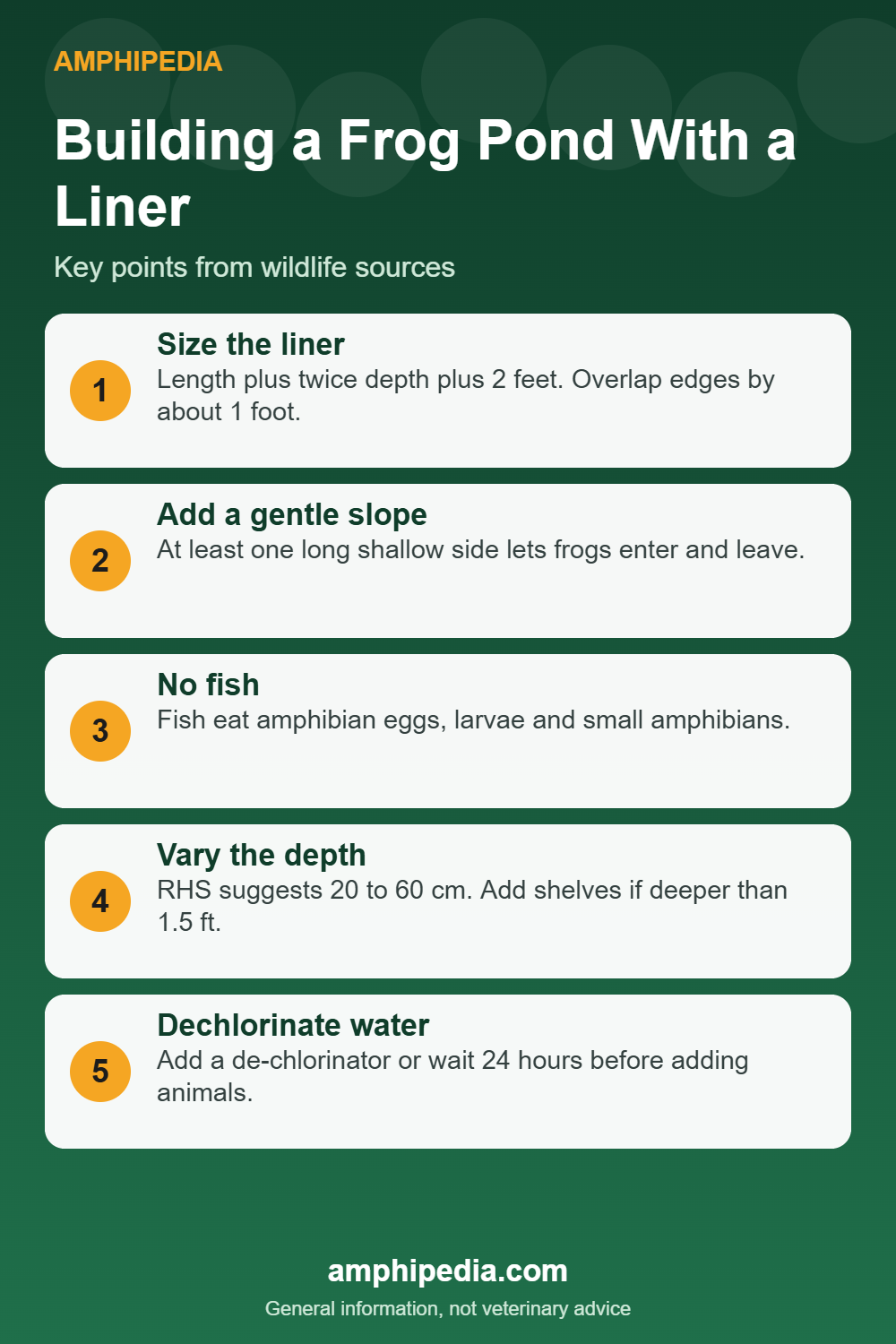
- Size the liner to the pond length plus twice the depth plus 2 feet, per Maryland DNR.
- Make at least one long, gentle slope so frogs can get in and out.
- Skip fish. They eat amphibian eggs, larvae and even small amphibians.
- Choose a flexible liner that you can shape into shelves and ledges, and check the maker’s guidance on use with wildlife.
- Wash your hands after working in the pond. Amphibians can carry Salmonella.
Pin this infographicShare on Facebook
What a frog pond needs from its liner
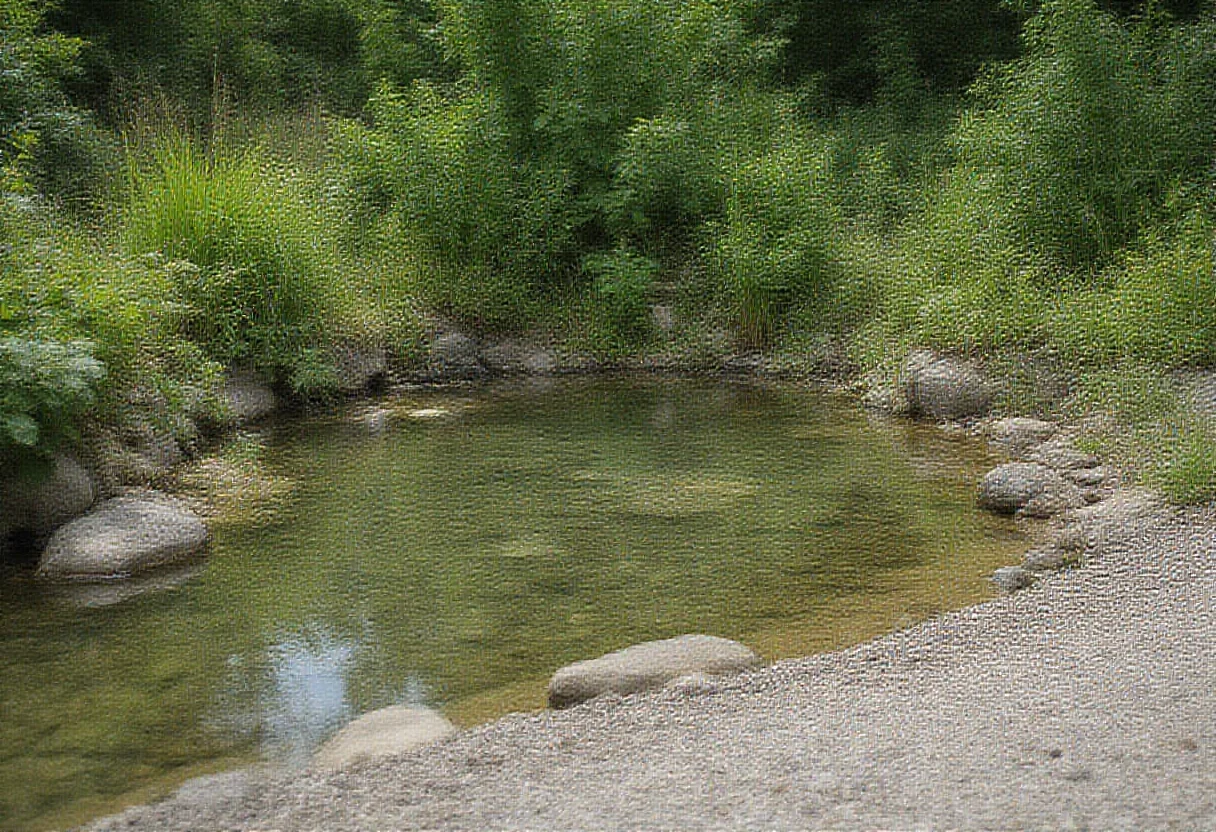
The liner holds the water, but frogs need more than water. Maryland DNR says gradual depth lets amphibians reach the water easily. The RHS also recommends at least one long, shallow slope to give wildlife easy access.
Flexible liners suit this because you can shape slopes, shelves and ledges. Rigid pre-formed ponds usually lack a shallow slope, according to the RHS, so they need an added ramp.
Liner types and what the sources say
The two sources we checked do not give exact thickness or a ranking of materials. The RHS says butyl liners are the easiest way to make a natural-shaped pond. Maryland DNR lists flexible liners, pre-formed ponds and recycled tubs as options.
| Option | What the sources say |
|---|---|
| Flexible liner (such as butyl) | Easiest for natural shapes, per the RHS. |
| Pre-formed pond | Usually lacks a shallow slope, so add a ramp. |
| Recycled tub or barrel | Listed by Maryland DNR as an option. |
| Clay or bentonite | Suggested by the RHS for larger natural ponds. |
| No liner | Not needed where the water table is high, per Maryland DNR. |
How to size the liner
Maryland DNR gives a simple formula. Liner length equals pond length plus twice the depth plus 2 feet. Liner width equals pond width plus twice the depth plus 2 feet.
The liner should overlap the pond edges by about one foot. For a plastic sheet, fill the pond to about 3 inches from the top, wait about a week, then trim the excess to about 6 inches past the edge.
Design slopes and shelves for frogs
Frogs get in easily and often struggle to get out. The RHS notes that many animals remain trapped in ponds, and it recommends leaving edge vegetation for cover and escape.
Maryland DNR suggests shallow shelves up to 3 inches deep for ponds deeper than 1.5 feet. It also says partly submerged logs or rocks can replace shelves for certain animals.
- Dig at least one long, gentle slope.
- Add stones, gravel or a log along the shallow side.
- Let grass or plants grow along one edge for cover.
- Keep part of the pond sunny for warmth and part shaded to limit algae.
- Aim for varied depth. The RHS suggests 20 to 60 cm (8 inches to 2 feet).
Why fish do not belong
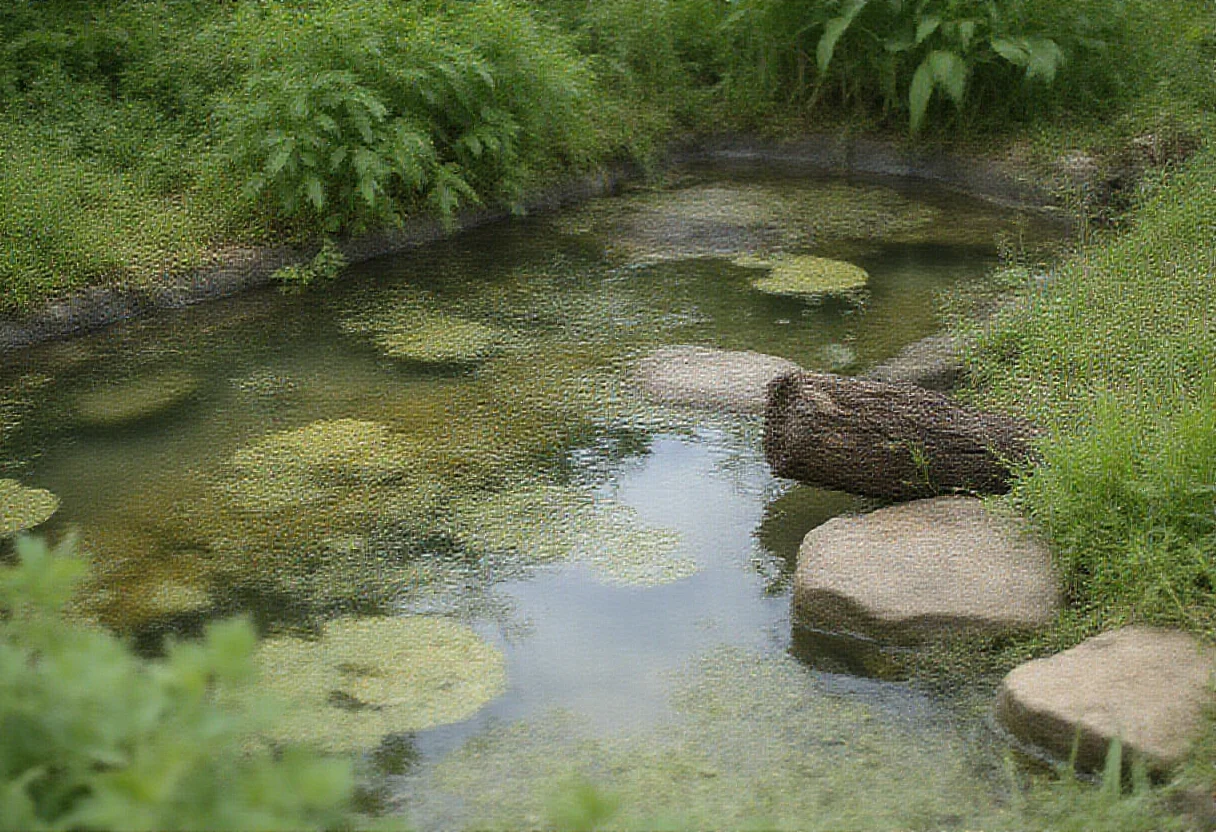
Maryland DNR is blunt about this. Fish eat amphibian eggs, larvae and even small amphibians. The RHS calls fish top predators that reduce biodiversity.
If you want frogs, build a separate fish-free pond. A small wildlife pond usually does not need a pump or filter, and any pump should have a wildlife protection system, per the RHS.
Installing the liner
Clear stones and roots from the hole first. Lay the liner loosely and let the water weight settle it into place. Do not stretch it tight.
When refilling after cleaning, Maryland DNR advises adding a de-chlorinator or letting the water sit for at least 24 hours before adding plants and animals. If you fear chemical pollution, drain the pond and remove animals and plants temporarily.
Plants and water quality
Maryland DNR suggests keeping plants to no more than 65 percent of the pond surface in summer. Use native or non-aggressive species and avoid invasive plants such as water hyacinth and parrotfeather.
For mosquito larvae, the agency recommends Bti or Bacillus sphaericus, which it says target only mosquitoes. Our guide to eco-safe pond filters covers filtered setups, and our pond net cover guide covers protection from predators and debris.
Common mistakes
Most failed frog ponds share the same few errors.
- A steep, smooth liner edge that frogs cannot climb.
- Adding fish for mosquito control.
- Planting over most of the surface.
- Cutting the liner too tight and having no overlap.
- Using tap water without dechlorinating or letting it sit before adding animals.
Choosing the spot
Maryland DNR says the ideal site gets at least 5 hours of sun a day, though more sun or some shade is acceptable. It warns that ponds under trees collect leaves, and decaying leaves use up oxygen. It also advises avoiding areas with heavy runoff, where a pond fills with sediment.
The RHS asks for a mix. Keep at least part of the pond in full sun so spring water warms quickly for spawning frogs and toads, and shade part of it to limit algae. The agencies differ on shelves: Maryland DNR puts them in shade because shallow water heats fast in sun, while the RHS wants some warm water for spawning. A pond with both sunny and shaded zones satisfies each.
Edges, ramps and hiding the liner
- The RHS suggests a gravel or pebble beach, or a stone lining, to hide the liner as the water level drops.
- Do not lay turf into the water. The RHS says grass roots wick water out, especially in hot weather.
- For a pre-formed pond or tub, Maryland DNR says to set it on several inches of sand, add water to check it is level, then let it stand a week and fill any gaps with soil.
- A container pond needs ramps inside and outside, according to the RHS.
- Tall grass along one edge gives young frogs and toads cover when they leave, the RHS adds.
A planting plan that suits frogs
The RHS lists three plant roles: oxygenators such as hornwort or water starwort for underwater cover, marginals such as lesser spearwort and marsh marigold for the edges, and floating plants such as waterlilies for shade. It advises planting in mid-spring to early summer, once the water has warmed a little.
Maryland DNR suggests a container mix of one quarter sand, one half garden loam and one quarter compost, and says to avoid potting soils with floating materials such as perlite. It notes that containers make thinning easy and can be lifted out to protect plants from cold.
The sources disagree on one plant. The RHS lists flowering rush among suitable marginals, while Maryland DNR lists it among invasive species to avoid. Check your local invasive species list before you buy.
A yearly care calendar
| When | Task | Source |
|---|---|---|
| Early spring | Usual annual clean: siphon out half the water and leave animals and plants in place | Maryland DNR |
| Mid-spring to early summer | Plant the pond | RHS |
| As needed | Net or rake out leaves before they sink, when there are many | RHS |
| Early autumn | Remove silt, but only half the excess at a time | RHS |
| Late autumn | Mow long edge grass after young amphibians have left | RHS |
| Late winter | Cut back faded marginals | RHS |
Neither source covers winter ice or care of a frozen pond, so we do not give advice on it here. The RHS says autumn is the least damaging time for changes to an existing pond.
Topping up and letting it dry
The RHS says to top up with rainwater and use tap water only as a last resort. It also says not to rush to refill in dry spells, because seasonal drying suits newts. Maryland DNR adds that you should use a dechlorinator or let tap water stand at least 24 hours before returning plants and animals after a refill. Excess algae shows as floating fuzzy green growth, and occasional fresh water helps prevent it.
Mosquitoes, pumps and when not to empty the pond
For mosquito larvae, Maryland DNR names Bti (Bacillus thuringiensis israelensis) and Bacillus sphaericus, which it says target only mosquitoes. It says to avoid fish, because fish eat eggs, larvae and small amphibians.
Maryland DNR says small ponds normally need no pump or filter and should not be emptied regularly. If you add a pump, it advises setting it on the bottom, slightly raised, to prevent clogs. The RHS says a pump for a fountain or cascade should have a wildlife protection system so tadpoles and small pondlife are not sucked in. The two agencies agree that a plain, still wildlife pond is the simplest option.
Frequently Asked Questions
What size liner do I need?
Maryland DNR suggests pond length plus twice the depth plus 2 feet, and the same for width. Add overlap of about one foot at the edges.
Is butyl better than other liners?
The RHS says butyl is the easiest way to create a natural-shaped pond. The sources we checked did not give a full ranking, so compare listings and maker advice.
How deep should a frog pond be?
The RHS suggests 20 to 60 cm (8 inches to 2 feet), varying across the pond. Maryland DNR advises shelves for ponds deeper than 1.5 feet.
Can I keep fish in a frog pond?
Maryland DNR advises against it, because fish eat amphibian eggs, larvae and even small amphibians.
Do I need a filter?
Small wildlife ponds usually do not need one, per Maryland DNR and the RHS. Any pump should have wildlife protection.
Can I use a pre-formed pond?
Yes, but add a ramp, since the RHS says they usually lack a shallow slope.
Bottom Line
A good liner is only the start. Make the shape wildlife friendly, keep fish out and give frogs ways to climb out.
You can also read our guides to pond net covers, pond filters and waterfall decor for the next steps.
Sources
- Creating a Wild Backyard: Backyard Ponds (Maryland DNR), accessed 12 November 2026. Used for: liner sizing, slopes, plants, chemicals and fish
- Wildlife ponds (Royal Horticultural Society), accessed 12 November 2026. Used for: butyl liners, depth, slopes, planting and care calendar
- Reptiles and Amphibians: Healthy Pets (CDC). Used for: Salmonella and hygiene advice