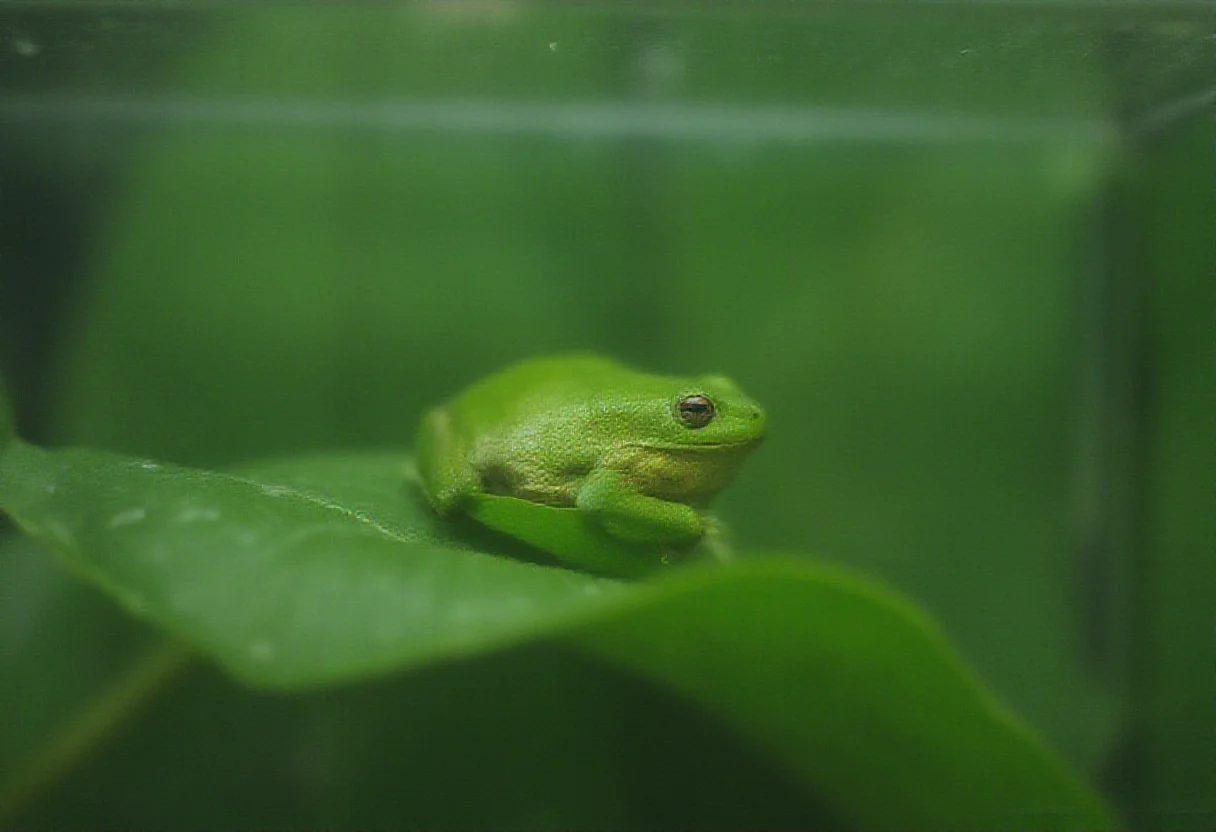
Best Remote Humidity Monitor for an Amphibian Vivarium
This post contains affiliate links. As an Amazon Associate I earn from qualifying purchases. Prices and availability are shown by Amazon and can change.
The best remote humidity monitor is one you can trust. Pick a sensor with a separate probe, readings you can check on a phone, and alerts for low humidity. Test accuracy with a salt test before relying on it, because cheap hygrometers drift. Vet-reviewed sources put salamanders at 70 percent humidity or more, and some fire salamander advice at 70 to 90 percent. No amphibian source rates monitor brands, so verify each unit yourself.
Amphibians absorb water through their skin, so humidity is a daily concern. A remote monitor lets you check conditions from your phone without opening the lid and letting moisture escape.
This guide explains what humidity range to aim for, which features matter, how to test a monitor, where to place the sensor and the mistakes that give false readings. It does not rate individual brands.
How this was made: prepared with AI assistance and checked against the sources listed at the end. Images are AI-generated illustrations, not photographs of real animals or products.
Key Takeaways
- Salamanders need humidity of at least 70 percent (RVC); fire salamander advice gives 70 to 90 percent.
- Remote monitors save you from opening the lid, but accuracy still has to be checked.
- A salt test can show whether a hygrometer reads close to 75 percent.
- Recalibrate or replace units that drift; one keeper source suggests every six months.
- Place the sensor in the animal zone, away from the mister nozzle and heat.
- Humidity targets differ by species, so confirm yours with a vet-reviewed sheet.
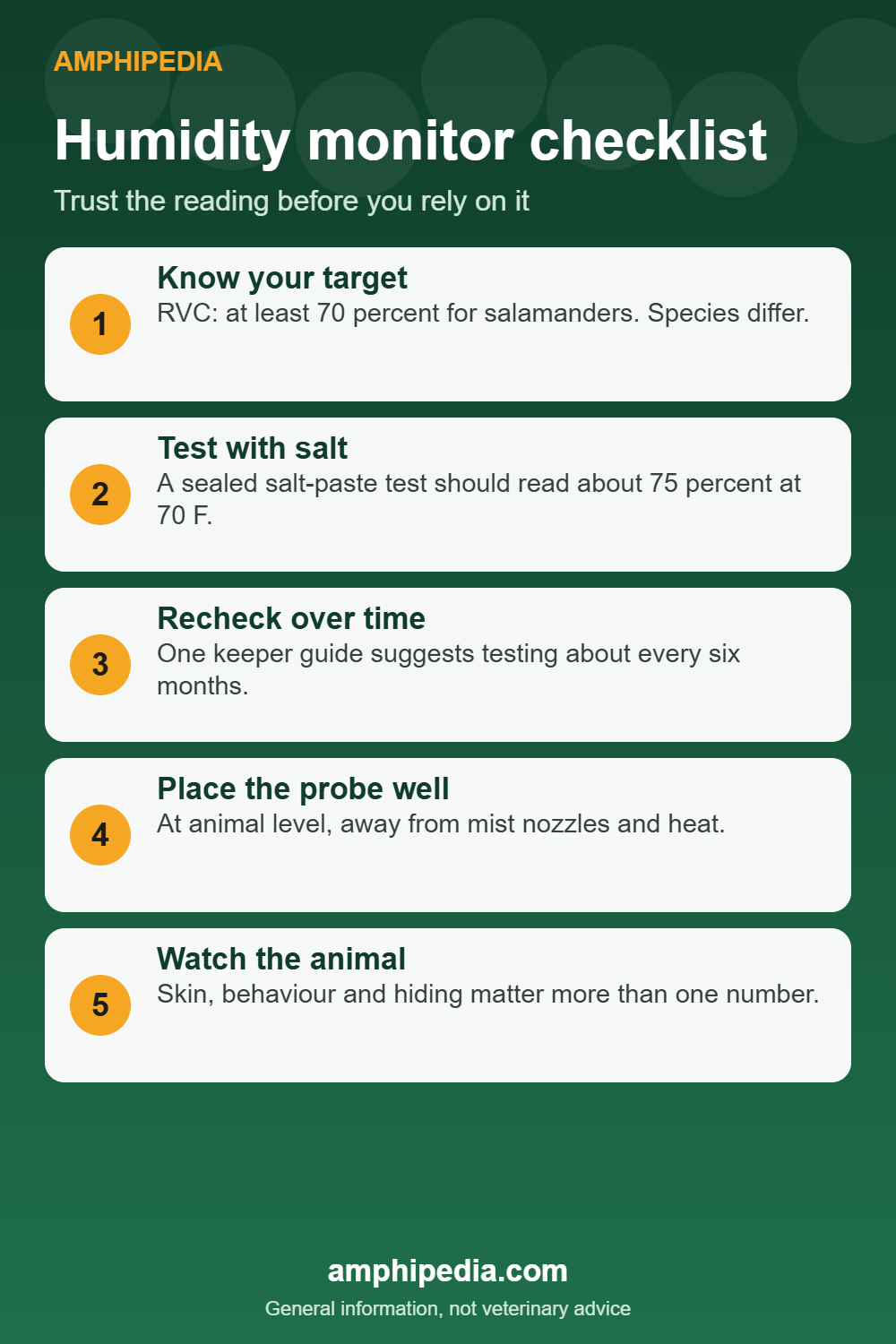
Pin this infographicShare on Facebook
Remote humidity sensors to consider
These sensors send readings to a phone or hub. Test each one with a salt test before you rely on it, as described on this page.


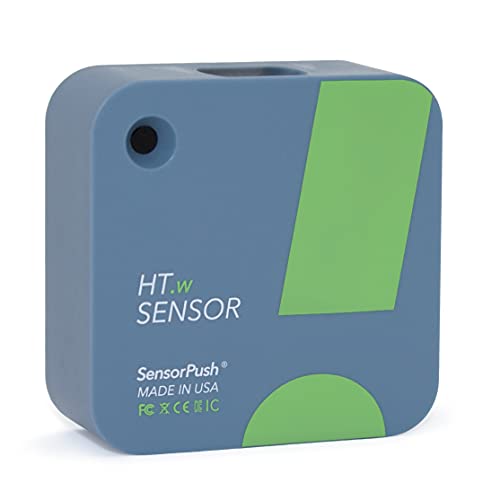


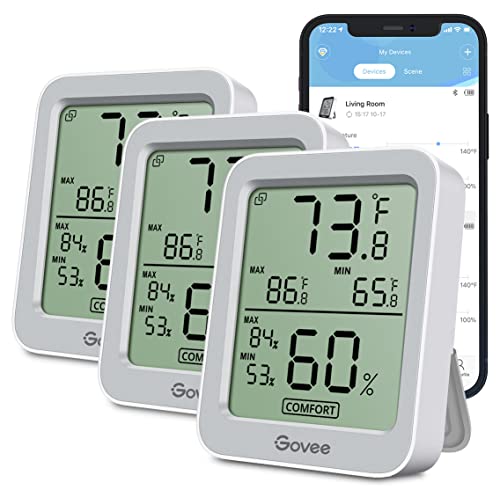
Product titles, prices and ratings are provided by Amazon and are accurate only at the time they are displayed.
Why amphibian humidity needs watching
The Royal Veterinary College explains that salamanders absorb water through their skin and need humidity of at least 70 percent. It advises misting several times a day and using a humidity meter.
VetVerified advises 70 to 90 percent humidity for the Cantabrian fire salamander. A Victorian government page gives 75 to 80 percent as a general guide for many amphibians, while noting that tropical species need more.
These ranges differ because species differ. Use the numbers for your species from a vet-reviewed source, and treat the monitor as a way to check them.

What a remote monitor adds
A remote monitor sends readings to a phone or hub. That has real benefits for an amphibian keeper.
- You can check humidity without opening the lid and letting moisture out.
- Alerts can warn you when humidity drops while you are away.
- Logged data helps you see patterns, such as a dry spell after the lights come on.
- A separate probe lets you read the animal zone, not the air near the lid.
- Multiple sensors can compare the dry and damp ends of a large tank.
Features that matter
Look for features that help you keep conditions steady and verify the readings.
- A probe on a cable, so you can place it where the animal lives.
- A humidity range that covers 30 to 100 percent and a display that shows 100 percent without error.
- Splash resistance, since the probe will sit in mist and condensation.
- Alerts that you can set for your own low and high limits.
- Battery or USB power that survives short outages.
- A logging history of at least a few days, so you can spot trends.
Wi-Fi, Bluetooth or hub
Bluetooth sensors are cheap but only work within a short range, so they suit checks from the same room. Wi-Fi sensors work from anywhere but depend on your router and an account with the maker.
Hub systems send readings from several small sensors to one base. They suit keepers with many enclosures, but they cost more and add another device to maintain.
Think about what happens when the internet or power fails. A sensor that stores readings and syncs later is more useful than one that shows only live data. Also consider whether the app is likely to be supported for years.
Whatever you choose, keep a simple backup, such as a basic hygrometer, so you can cross-check the readings.
Test accuracy before you trust it
Cheap hygrometers are often wrong. A frog keeper community guide describes a salt test: a small cap of salt moistened to a paste is sealed with the hygrometer in an airtight container for at least two hours. At about 70 degrees Fahrenheit the reading should be near 75 percent.
If the unit is off, adjust it using the maker instructions. If it cannot be adjusted, replace it. The same guide suggests repeating the test about every six months, since readings drift over time.
This is a keeper guide, not a laboratory protocol, so treat it as a practical check. Run it on every new unit, and test two units against each other if you own more than one.

Where to place the sensor
Put the probe at the level where the animal lives, such as near the hide or on the substrate surface. Keep it away from the mister nozzle, which gives spikes, and away from heaters, which give dry readings.
Check both ends of the tank at first. A gradient can be useful, but only if the animal can reach a damp area. See our guides to the humidity stabiliser and the compact mist generator for ways to keep levels steady.
Pair the monitor with a thermometer. Our magnetic thermometer guide covers temperature checks.
Reading the numbers wisely
Humidity swings through the day. A brief spike after misting is normal. What matters is that the average stays in the right range and that the animal has dry and damp choices.
Do not chase the number. Add moisture-holding substrate, live moss and a water dish before you add machines. Use the monitor to confirm that your setup works, not to replace good husbandry.
Write down your readings for the first two weeks at set times, such as morning and evening. A short log shows whether misting, lights or a vent are causing swings, and it tells you where to move the probe.
Mistakes to avoid
Most false alarms come from placement and calibration.
- Trusting an uncalibrated unit because it has a nice app.
- Placing the probe in direct spray from the mister.
- Mounting the sensor under a heat source, which gives low readings.
- Using a reptile humidity target for an amphibian without checking the species.
- Ignoring the animal. Dry or sticky skin, hiding all day or lethargy matter more than a number.
- Assuming a reptile label means the unit is amphibian-tested. It does not.
Humidity targets from different sources
A monitor is only useful if you know what number to look for. The ranges below come from the sources opened for this page. They are for different animals, so they should not be averaged.
| Source | Animal | Humidity advice |
|---|---|---|
| Royal Veterinary College | Salamanders | At least 70 percent |
| VetVerified | Cantabrian fire salamander | 70 to 90 percent |
| Merck Veterinary Manual (pet owner) | Most amphibians | 75 to 80 percent; tropical species 85 to 90 percent |
| Lafeber Veterinary | Poison dart frogs | 80 to 100 percent |
| BGSU Herpetarium | Poison dart frogs | About 95 percent, kept by a glass lid with a few small drilled holes |
The dart frog sources overlap but differ at the bottom of the range. Ask a breeder or an exotics vet which end suits your animals, and set your alerts a little inside the limits.
Setting alert limits that make sense
An alert that fires every time you mist will soon be ignored. Set the low limit just under the range for your species, and wait several minutes before an alarm, if your app allows a delay. Brief spikes after misting are normal, as noted above.
Merck recommends a humidity gauge in every enclosure, so a remote sensor is an addition to a local one, not a replacement. A basic gauge that stays in the tank still works when Wi-Fi fails.
What to do when the reading is off
The monitor shows a problem but does not fix it. Merck lists several ways to add moisture: small streams, waterfalls, ultrasonic humidifiers, or frequent misting with a spray bottle. It also says organic substrates and hiding places help hold humidity in small pockets.
- Low reading: check the probe position first, then mist, add moisture-holding substrate, or reduce open vent area.
- High reading with condensation everywhere: improve airflow. Merck advises 1 to 2 fresh air changes per hour.
- Reading swings sharply: move the probe away from the mister nozzle or heater.
- Substrate sodden: Lafeber says it should stay damp but not waterlogged, so shorten misting.
Why you should also watch temperature
Humidity and temperature move together. Warm air holds more water vapour, so a rise in temperature can drop the relative humidity reading even when the tank has not lost water. Merck also says temperatures outside a species preferred range can suppress the immune system and lead to infections.
Use a thermometer alongside the humidity probe, and compare the two when a reading looks wrong. Many remote sensors combine both.
Clean the misting tools
Merck advises disinfecting humidifiers and spray bottles weekly to remove potentially harmful bacteria. Wipe the sensor probe housing with a damp cloth, not a spray, and keep the cable dry where it exits the lid.
Frequently Asked Questions
What humidity do salamanders need?
The RVC says at least 70 percent. VetVerified gives 70 to 90 percent for the Cantabrian fire salamander.
Are remote humidity monitors accurate?
Not always. Test each unit with a salt test and recalibrate or replace it if it is off.
How often should I calibrate?
One keeper guide suggests about every six months, since readings drift over time.
Where do I put the probe?
At the animal level, away from the mister nozzle and heat sources.
Do I need a remote unit?
No. A simple, tested hygrometer works. Remote units save lid openings and can send alerts.
Is a reptile hygrometer safe for amphibians?
The sensor does not touch the animal, but humidity targets differ. Confirm your species range.
Bottom Line
A remote humidity monitor is a useful tool, but only if it reads correctly. Test it, place it well, and use it to confirm that your setup holds steady.
Pair it with good substrate, moss and a water dish, and match the target to your species.
Sources
- Royal Veterinary College: Salamander care sheet, accessed Humidity at least 70 percent; use a humidity meter.
- VetVerified: Keeping the Cantabrian fire salamander, accessed 70 to 90 percent humidity.
- Agriculture Victoria: Caring for your pet amphibian, accessed General guide of 75 to 80 percent humidity.
- FrogForum: Calibration of digital hygrometers for vivaria use, accessed Keeper guide to the salt test; not a laboratory protocol.
- CDC: Reptiles and amphibians, accessed Salmonella and hygiene.
- Merck Veterinary Manual: Housing for amphibians (pet owner version), accessed 12 November 2026
- Merck Veterinary Manual: Environment and husbandry for amphibians, accessed 12 November 2026
- Lafeber Veterinary: Basic information sheet, poison dart frog, accessed 12 November 2026
- BGSU Herpetarium: Poison dart frogs, general care, accessed 12 November 2026

One Comment