Best Smart Humidity Alarm for Frog Tanks: What to Check
This post contains affiliate links. As an Amazon Associate I earn from qualifying purchases. Prices and availability are shown by Amazon and can change.
A good smart humidity alarm for a frog tank sends a phone alert when humidity leaves a range you set, shows a local reading, and can be checked against a known reference. Set the limits from a sourced care sheet, place the sensor away from mist, and keep a second gauge. The alarm tells you something is wrong. It does not fix the tank.
Humidity can drop overnight when a mister fails or a room heats up. A smart alarm can warn you while you are out, which is why many keepers add one.
This guide covers alert limits, accuracy, placement, connection failures and what to do when the alarm goes off.
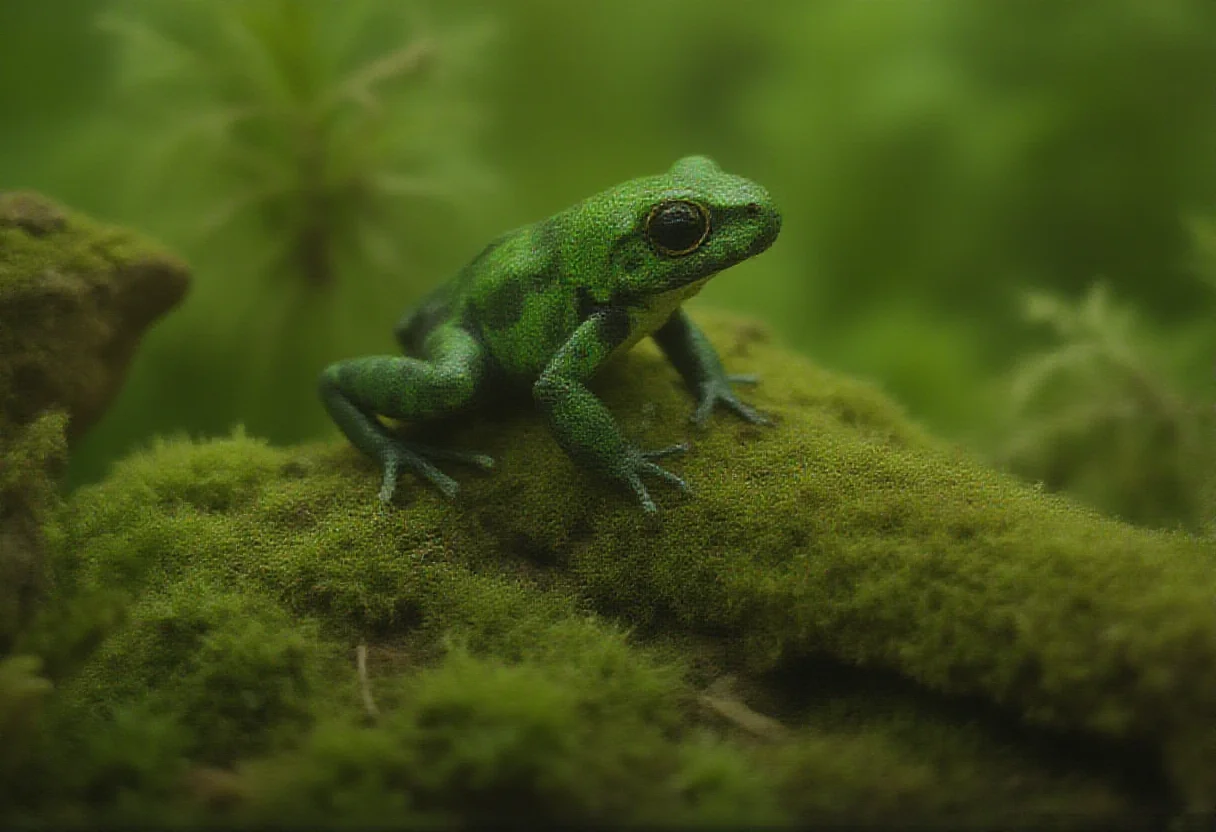
How this was made: prepared with AI assistance and checked against the sources listed at the end. Images are AI-generated illustrations, not photographs of real animals or products.
Key Takeaways
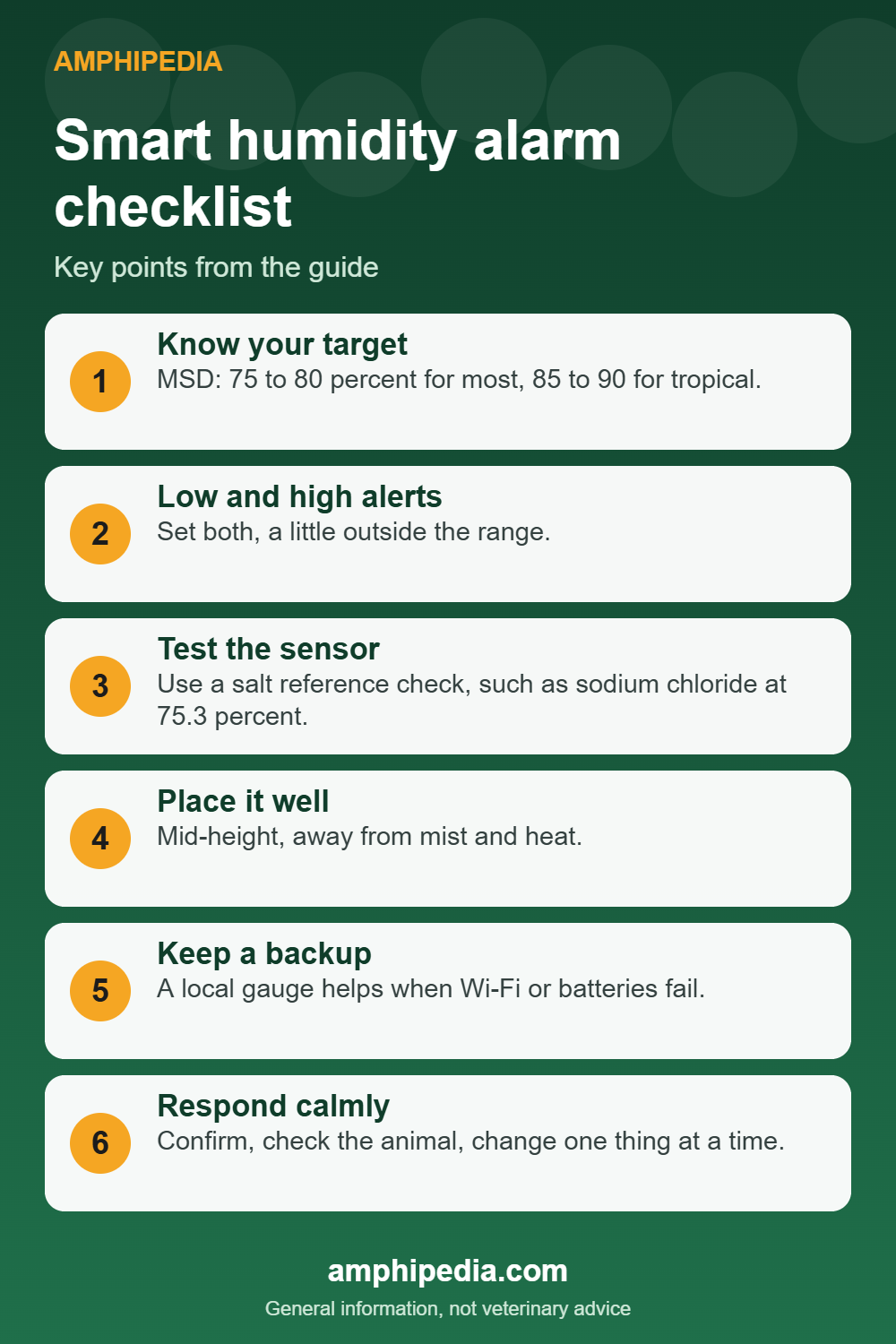
- Set alert limits around the range for your species, and add a high alert as well as a low one.
- MSD says most amphibians do well at 75 to 80 percent humidity, and tropical species may need 85 to 90 percent.
- Check the sensor against a salt test, because cheap sensors can read wrong.
- Place the sensor away from the mist outlet and keep a second gauge.
- Plan for a dead battery or a Wi-Fi outage.
Pin this infographicShare on Facebook
Humidity sensors with alerts to compare
These are general household sensors, not made for amphibians. Check accuracy and alert limits before you rely on one.


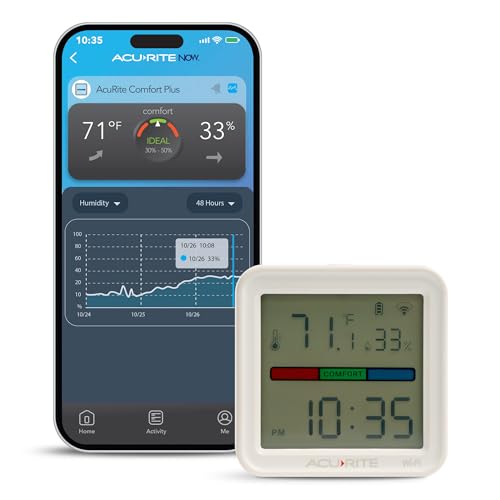
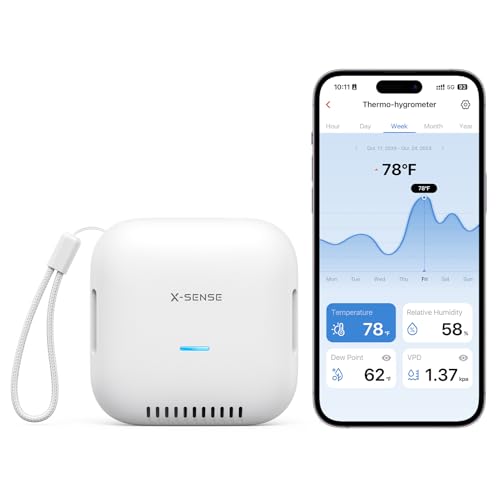


Product titles, prices and ratings are provided by Amazon and are accurate only at the time they are displayed.
What a smart alarm adds to a hygrometer
A plain hygrometer only shows a number when you look at it. A smart alarm watches the number for you and sends an alert to your phone when it crosses a limit you set.
The MSD Veterinary Manual says every amphibian enclosure should have a humidity gauge. An alarm does not replace that gauge. It adds a warning when you are not in the room.
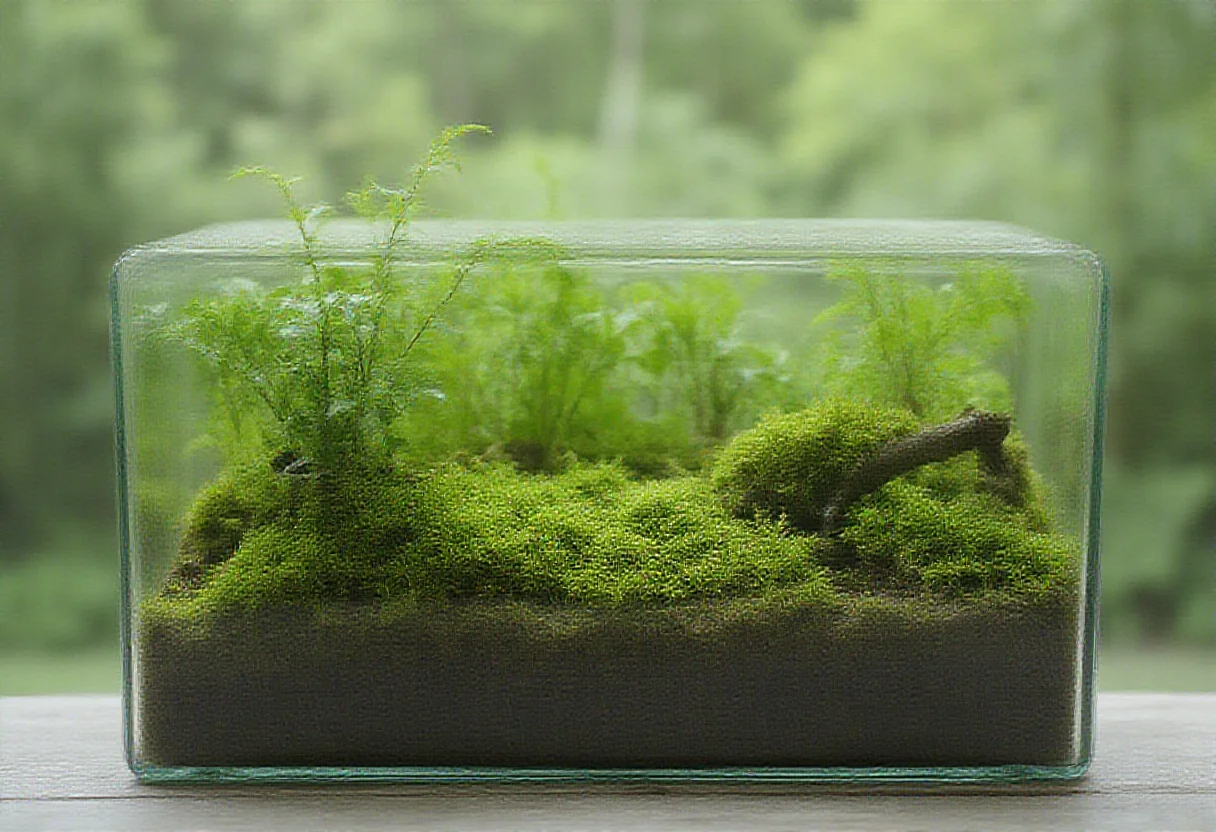
Choose targets and alert limits
MSD says most amphibians do well at 75 to 80 percent humidity, and tropical species may need 85 to 90 percent. Humidity matters most for land-dwelling species that could dry out.
Use a sourced care sheet for your own animal. Then set a low alert a little below the bottom of the range and a high alert a little above the top. A high alert matters too, because MSD says enclosures also need ventilation of about 1 to 2 air changes per hour.
Our humidity controller guide explains how to correct the reading once an alert arrives.
Features to compare
Read the specification rather than the box claims.
- Alerts for both low and high humidity.
- A delay setting, so a short spike after misting does not trigger an alarm.
- A local display and a sound, in case your phone is off.
- A low-battery warning.
- A stated accuracy and a way to recalibrate.
- A probe or housing that tolerates damp air.
- A history chart, which helps you see slow trends.
- An app that lets you send alerts to more than one person.
Check accuracy with a salt test
Small sensors can drift or start out inaccurate. A salt test gives a known reference. Kestrel, a weather meter maker, publishes values for saturated salt solutions at 25°C, and lists sodium chloride at 75.3 percent relative humidity.
Its procedure uses a large clear sealed container with a salt slurry, and a stable temperature. For its own meters it says to leave the unit undisturbed for one to two hours, and that a good reading is within 3 percentage points of the published value.
Those steps are for Kestrel meters. Check your sensor manual first, and do not put a sensor into a salt solution if the maker says not to.
Where to place the sensor
A sensor that sits in the fog outlet or a spray zone reads high all the time. A sensor next to a heat source reads low.
Put it at mid-height where the animal lives, out of direct mist. Compare it with a second gauge in another spot for a few days. If the two disagree by a lot, test both with the salt method.
Plan for connection and power failures
A smart alarm depends on batteries, Wi-Fi and a phone. Any of them can fail.
Ask what happens if the Wi-Fi goes down. Some units store readings and send them later, and others stop sending alerts. Check the manual, and keep a gauge with a local display as a backup.
Temperature alerts matter too
MSD says most amphibians do well at 60 to 70°F (16 to 21°C), and tropical species may need 75 to 80°F (24 to 27°C). Outside their range, amphibians may become immunosuppressed.
Most smart sensors read temperature and humidity together. Set a temperature alert as well. A heater fault or a hot room can dry the tank and stress the animal long before humidity looks wrong.
What to do when the alarm sounds
Stay calm and check before you adjust anything.
- Look at a second gauge to confirm the reading.
- Look at the animal for signs of stress.
- Check the water level in the fogger or mister and any timers.
- Check that the lid and vents are not blocked or sealed.
- Adjust one thing in a small step and wait before checking again.
- Write down the time and what you changed.
- If the animal looks unwell, contact an exotics vet.
Avoid alert fatigue
An alarm that fires every day gets ignored. If you get frequent false alerts, move the sensor, widen the range slightly or add a delay.
Do not widen the range so far that it stops protecting the animal. Use your care sheet as the limit.
Review the alert history once a week. A pattern, such as a drop each night, points to a cause you can fix, such as a timer set too short.
Common mistakes
These mistakes are common.
- Trusting a new sensor without a reference check.
- Placing it in the mist.
- Setting only a low alert.
- Relying on the phone alone with no local display.
- Ignoring a low-battery warning.
- Changing three things at once after an alert.
- Setting limits from a forum post instead of a sourced care sheet.
Related guides
See our guides to a wireless humidity monitor, a remote humidity monitor and a wireless thermometer hygrometer combo. For logging history, see the data logger guide.
Set alert limits per species, not per article
One humidity number does not fit every frog. Published targets for similar animals already differ.
- MSD: 75 to 80 percent for most amphibians and 85 to 90 percent for tropical species.
- WWF, White’s tree frog: 70 to 90 percent.
- Royal Veterinary College (RVC), White’s tree frog: about 60 to 70 percent, read in the middle of the vivarium.
- RVC, terrestrial salamanders: at least 70 percent.
An alarm set from the MSD range would fire all day for a White’s tree frog kept to the RVC range. Pick one sourced range for your species, say which source you chose in your notes, and set both alerts around it.
Learn your tank’s normal rhythm first
Humidity in a misted tank rises and falls on a schedule. Smithsonian’s National Zoo presets its automatic misters by time of day and duration, which shows how regular the pattern can be.
Before you enable alerts, log the reading for a week at three set times: morning, afternoon and night. Note the peak after each misting and the low point before the next one. Then set the alert delay longer than the post-mist spike, and keep the limits tied to the species range rather than to whatever your tank happens to do.
Use separate day and night temperature limits
Temperature alerts need the same care as humidity. WWF gives White’s tree frogs 75 to 85 F (24 to 29 C) by day and 65 to 75 F (18 to 24 C) at night. RVC describes a basking spot of about 30 C and says the overnight temperature should not drop below about 21 C. These sources disagree on the night floor, so a vet’s advice for your own frog matters.
If your alarm allows schedules, set one low limit for daytime and a lower one for night. If it allows only one pair, set the low limit at the lowest night value from your chosen source and the high limit at the top of the daytime range.
Write a hand-off note for whoever is home
An alert is only useful if the person who receives it knows what to do. Keep a short note beside the tank.
- The species and the humidity and temperature ranges you chose, with the source.
- The alarm limits, and which phone receives alerts.
- Where the spare water and the fogger or mister controls are.
- Your exotics vet’s contact details.
- A reminder to change only one setting at a time and to write it down.
Keep the daily look even with an alarm
An alarm watches two numbers. It cannot see a frog sitting in the wrong place, a blocked vent or a dry patch of substrate. Merck advises spot-checking enclosure temperatures daily, and that habit still matters once alerts are on.
Use the daily look to compare the app with the real tank. If the phone says the range is fine but the glass is dry or the frog is hiding on the damp side, trust what you see and check the sensor. A sensor that has drifted can look reliable for weeks.
Frequently Asked Questions
What humidity do most frogs need?
MSD says 75 to 80 percent for most amphibians and 85 to 90 percent for tropical species. Check your own species.
Is a smart alarm better than a plain hygrometer?
It adds alerts when you are away. MSD still says to keep a humidity gauge in every enclosure.
How do I check if a hygrometer is accurate?
A salt test with sodium chloride gives about 75.3 percent at 25°C, per Kestrel. Follow the maker instructions.
Should I set a high humidity alert?
Yes. Very damp, poorly ventilated tanks cause problems, and MSD says to provide about 1 to 2 air changes per hour.
What if Wi-Fi drops?
Check the manual. Some units stop alerting, so keep a gauge with a local display.
Where should the sensor go?
Mid-height, away from mist and heat sources. Compare it with a second gauge.
Bottom Line
A smart alarm is a warning light. Set sensible limits, test the sensor, and keep a backup gauge.
If your amphibian looks unwell, see an exotics vet. The ARAV directory lists vets who treat amphibians.
Sources
- MSD Veterinary Manual: Housing for Amphibians. Used for: Temperature, humidity, gauges, ventilation, cleaning
- Kestrel: RH Calibration Salt Refill Kit instructions. Used for: Salt test values and procedure for its meters
- CDC: Reptiles and Amphibians. Used for: Salmonella and hygiene
- Royal Veterinary College: White’s Tree Frog care sheet. Used for: White’s tree frog humidity and night temperature
- Royal Veterinary College: Salamander care sheet. Used for: Terrestrial salamander humidity target
- WWF Responsible Pet Guide: White’s tree frog. Used for: White’s tree frog humidity and day/night temperature
- Smithsonian’s National Zoo: How to care for frogs. Used for: Scheduled zoo misting
6 Comments