Best Waste Remover for a Terrarium: Spot-Cleaning Tools
This post contains affiliate links. As an Amazon Associate I earn from qualifying purchases. Prices and availability are shown by Amazon and can change.
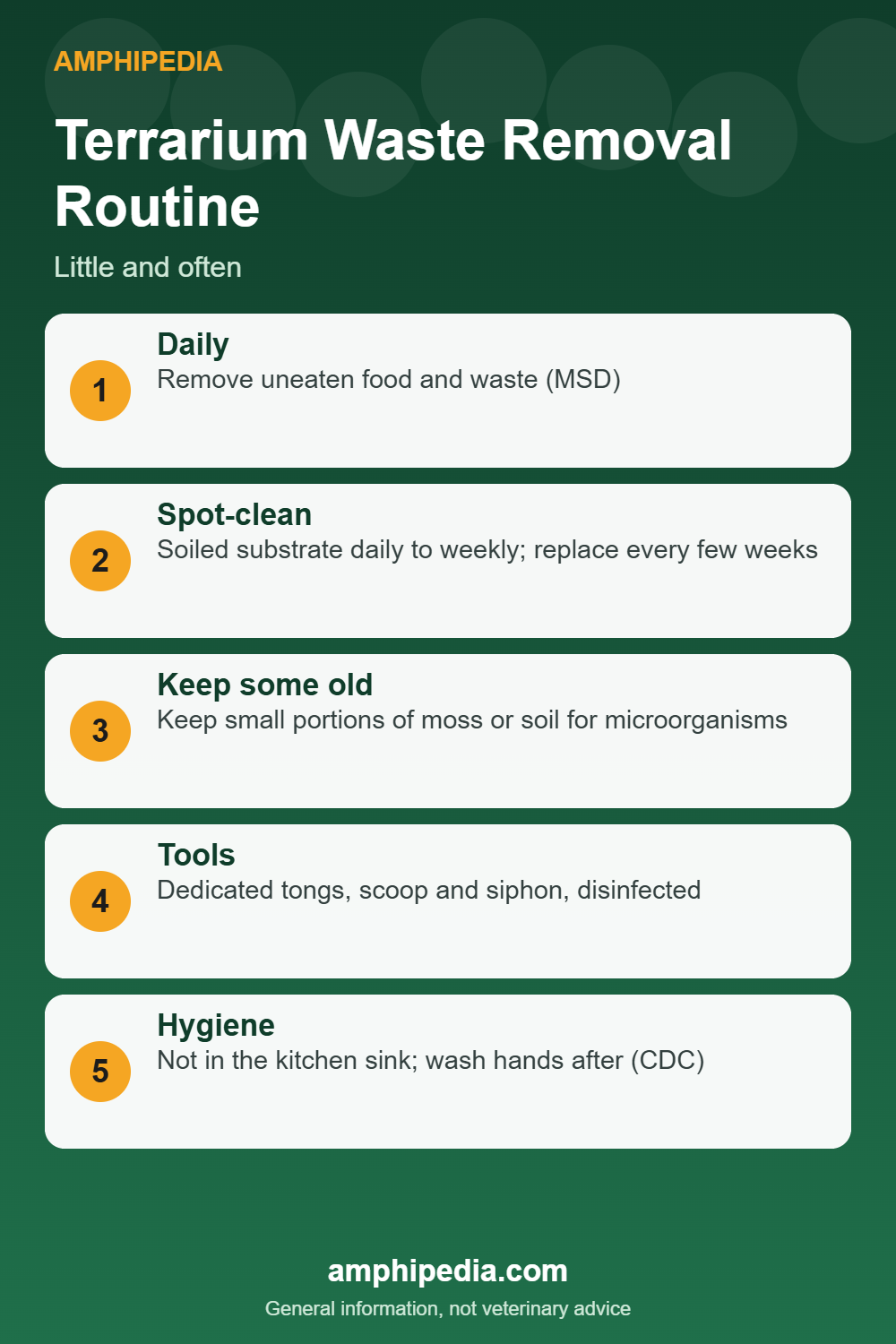
The best waste remover for an amphibian terrarium is a simple set of dedicated tools: long tongs or tweezers for waste and uneaten food, a fine scoop for soiled substrate, and a small siphon or turkey-baster style tool for water areas. The MSD Veterinary Manual advises removing uneaten food and waste daily and spot-cleaning substrate daily to weekly. Use gloves, keep the tools for the tank only, and wash up outside the kitchen.
Waste builds up fast in a small, humid enclosure. Uneaten insects, droppings and soggy leaf litter feed bacteria and mould. Daily spot-cleaning protects your animal and delays the big, disruptive tank clean.
This guide explains which tools help, how often to clean, how to do it with little stress and how to stay hygienic. It treats a waste remover as a set of simple tools, not a gadget.
How this was made: prepared with AI assistance and checked against the sources listed at the end. Images are AI-generated illustrations, not photographs of real animals or products.
Key Takeaways
- Remove uneaten food and waste daily. The MSD Veterinary Manual advises spot-cleaning substrate daily to weekly.
- Use dedicated tools, such as tongs, a fine scoop and a small siphon, that never leave the amphibian area.
- Do not clean tools in the kitchen sink. The CDC advises pouring wastewater down the toilet.
- Keep some old substrate or moss when you clean, so helpful microorganisms stay.
- Wear disposable gloves for cleaning and wash your hands afterwards.
Pin this infographicShare on Facebook
Cleaning tools worth a look
The table is ordered from the highest price to the lowest. Prices, images and buy buttons come straight from Amazon and are not edited by us.


Product titles, prices and ratings are provided by Amazon and are accurate only at the time they are displayed.
Why spot-cleaning matters
Amphibians absorb water and chemicals through their skin, so a dirty enclosure affects them directly. The MSD Veterinary Manual says to replace food and water daily and remove uneaten food and waste.
Small daily jobs keep the water area fresh, the substrate healthier and the smell low. They also let you check on your animal every day, which helps you spot problems early.
Types of waste removal tools
Different tank types need different tools.
| Tool | Best for | Notes |
|---|---|---|
| Long tongs or tweezers | Droppings, dead insects, uneaten prey | Choose smooth tips to avoid scratching decor |
| Fine mesh scoop | Soiled substrate and leaf litter | Plastic or stainless steel is easier to disinfect |
| Small siphon or baster | Water areas and shallow dishes | Keep it for one tank to avoid spreading germs |
| Paper towel or clean cloth | Spills and glass | Throw away after use |
What to look for
Choose tools that are easy to clean and disinfect.
- Smooth stainless steel or hard plastic that handles disinfectant
- Long reach, so your hand stays out of the tank
- Rounded tips that do not scratch glass or decor
- Mesh fine enough to catch waste but let clean substrate fall through
- Comfortable grip that works with disposable gloves
- A tool that you can rinse and dry in seconds
- Not a pet waste scooper meant for cats or dogs, which is often too large
How to spot-clean a terrarium step by step
Do this daily or as often as your species needs.
- Wash your hands and put on disposable gloves.
- Look for the animal first, and keep your movements slow.
- Remove uneaten food with tongs.
- Lift droppings and a small amount of surrounding substrate.
- Take out any water dish, empty it, rinse it and refill it with dechlorinated water.
- Wipe the glass with a clean damp cloth. Do not use household sprays.
- Rinse your tools, wash your hands and clean up outside the kitchen.
How often to deep clean
Spot-cleaning does not replace a deeper clean. The MSD Veterinary Manual advises replacing substrate every few weeks to months depending on the material, and keeping small portions of moss, mulch or soil to support helpful microorganisms.
VetVerified suggests a deeper clean and substrate replacement every 2 to 4 weeks for young terrestrial amphibians. Petco advises a thorough weekly clean for terrestrial newt and salamander habitats, with the animal in a secure container.
Hygiene and safe disposal
The CDC says amphibians often carry Salmonella even when they look healthy. Clean tanks and tools outside the home if you can, or use a laundry sink or bathtub and disinfect it afterwards. Never use the kitchen sink or food areas.
The MSD Veterinary Manual describes disinfecting tools and dishes with 1 ounce of bleach per quart of water (30 mL per litre) for at least 30 minutes, then rinsing and drying. Keep children under five away from amphibians and their equipment.
Choosing tools for different enclosures
A bioactive terrarium with live plants needs gentle tools, because digging disturbs roots and cleaner insects. A bare-bones quarantine tank can be stripped clean with a simple scoop and paper towels. An aquatic or paludarium setup needs a small siphon for the water side.
If you keep several tanks, label tools by tank. Cross-use is one way germs and parasites spread. Store tools dry, in a lidded box away from food, and replace anything that rusts or cracks.
Quick daily checklist
A routine is easier than remembering. Pin a short list next to the tank.
- Look for the animal and check it is moving normally
- Remove uneaten food and droppings
- Replace water in the dish with dechlorinated water
- Check humidity and temperature
- Wipe glass if needed and close the lid
- Wash your hands
Mistakes to avoid
A few habits cause most trouble.
- Using one tool in several tanks without disinfecting
- Spraying cleaners inside the tank
- Leaving uneaten insects in the enclosure overnight
- Removing all substrate at once, which resets beneficial microorganisms
- Cleaning in the kitchen sink
- Skipping handwashing after cleaning
Related guides
Keep humidity in range with our hand mist sprayer guide and consider bioactive tank cleaner bugs for planted setups. Read our quarantine tank guide for new animals.
Disinfecting tools in the right order
The MSD Veterinary Manual gives a clear order for tools and dishes. Merck adds that commercial animal-use disinfectants are also an option, so read the label of whichever product you choose.
- Remove visible waste first, because disinfectant works on cleaned items.
- Soak in the bleach solution the manual describes: 1 ounce per quart of water, or 30 mL per liter.
- Keep the items in for at least 30 minutes.
- Rinse thoroughly with fresh water.
- Dry fully before the tool goes back near an enclosure. Merck prefers drying before use.
Do this in a laundry sink, bathtub or outdoors, not the kitchen. The CDC says to clean and disinfect a bathtub afterward, and to pour tank water down the toilet instead of sinks or drains.
Cleaning around a new or sick animal
Cleaning rules get stricter when an animal may be carrying disease. Merck’s guidance for quarantine says to use separate cleaning tools for quarantined animals and for the main collection, and to consider changing clothes between them.
Merck also advises enclosures that are easy to clean. A moist paper towel works as substrate for most species, and PVC tubing can serve as hides and perches for arboreal species.
When a quarantine ends, Merck says to decontaminate all substrate and furnishings thoroughly before disposal. Treat the old bedding of any animal that has been unwell the same way, and ask an exotics vet if you are unsure.
- Clean the healthy tank first and the quarantine tank last.
- Never move a tool from the quarantine tank to another enclosure.
- Label tools by tank and store them separately.
Water changes for aquatic and semi-aquatic tanks
A scoop is for land. For the water side of a tank, the routine is different. The MSD Veterinary Manual says to change at least 10 percent of the water weekly in established aquatic tanks.
Merck adds that the water must be free of chlorine, ammonia, nitrite, pesticides and heavy metals. It says external canister or under-gravel filters help maintain quality in tanks, waterfalls, streams and ponds.
Use a siphon to remove waste from the bottom as you drain. Refill with dechlorinated water that is close to the temperature of the tank. Rinse the siphon after use and keep it for that tank only.
Cleaning a bioactive tank without resetting it
A planted tank with a cleanup crew needs a lighter touch. MSD says to leave small portions of moss, hardwood mulch or soil during each cleaning, because they support helpful microorganisms.
Josh’s Frogs says a heavy misting at least once a week pushes frog waste down into the substrate, where springtails can eat it. It also advises wiping the glass regularly with a terrarium cleaning sponge to remove waste and algae.
The same page warns that cleaning may startle the frogs, which might hide for a day or two. It also suggests checking plants monthly and doing a heavier trim about every six months.
Spot-clean visible waste with tongs, and leave the rest to the crew. Merck notes that live plants add humidity, cover and perches, and that aquatic plants oxygenate water and remove nitrogenous waste. Trim them when needed, but do not strip them out during a routine clean, because they are part of how the tank stays stable.
Putting a schedule together
Sources give different timings, so build a schedule from the ranges rather than one rule.
| Task | Timing in the sources | Source |
|---|---|---|
| Remove uneaten food and waste | Daily | MSD Veterinary Manual |
| Spot-clean floor coverings | Daily to weekly | MSD Veterinary Manual |
| Change water in an established aquatic tank | At least 10 percent weekly | MSD Veterinary Manual |
| Replace floor coverings | Every few weeks to months, by material | MSD Veterinary Manual |
| Disinfect spray bottles and humidifiers | Weekly | MSD Veterinary Manual |
| Check plants and glass in a bioactive tank | Plants monthly; glass regularly | Josh’s Frogs |
Start at the frequent end of each range with a new species or a new tank, then lengthen the gaps only if the animal is eating and acting normally. Keep a short note of the dates you cleaned, replaced substrate and disinfected equipment, so you can see at a glance which job is overdue and which routine suits your tank.
Frequently Asked Questions
How often should I clean a frog terrarium?
Remove waste and uneaten food daily, spot-clean substrate daily to weekly, and replace substrate every few weeks, per the MSD Veterinary Manual.
Can I use a cat litter scoop?
Only if it is new, clean and small enough. Dedicate it to the amphibian tank and never share it with pet litter.
Should I remove all the substrate at once?
No. The MSD Veterinary Manual advises keeping small portions of moss, mulch or soil to support helpful microorganisms.
Can I wash tools in the kitchen sink?
No. The CDC advises against using kitchen sinks for amphibian equipment. Use a laundry sink or bathtub and disinfect it.
Do bioactive tanks still need cleaning?
They need less spot-cleaning, but you still remove uneaten food and check the water. See our bioactive cleaner bugs guide.
Bottom Line
The best terrarium waste remover is a small set of smooth, dedicated tools that you use every day. Pair them with gloves, dechlorinated water and a clean-up routine away from the kitchen.
Little and often beats rarely and hard. Short daily jobs keep your animal healthier than a big monthly overhaul.
Sources
- MSD Veterinary Manual: Housing for Amphibians, accessed 12 November 2026
- CDC: Reptiles and Amphibians, Healthy Pets, accessed 12 November 2026
- VetVerified: Setting Up an Environment for Terrestrial Juvenile Amphibians, accessed 31 October 2026
- Petco: Salamanders and Newts Care Sheet, accessed 31 October 2026
- Merck Veterinary Manual: Environment and Husbandry for Amphibians, accessed 12 November 2026
- Josh’s Frogs: Maintaining Your Vivarium, accessed 12 November 2026


One Comment