Best Water Pump or Filter for a Frog Tank: Gentle Flow Guide
This post contains affiliate links. As an Amazon Associate I earn from qualifying purchases. Prices and availability are shown by Amazon and can change.
The best water circulation pump for a frog tank is a low-flow unit that moves water gently without strong current or suction. Petco says to avoid power filters with strong suction or fast water movement, and makes sponge filters its top recommendation for African dwarf frogs. Many land frogs need no pump at all, only clean, dechlorinated water in a dish. Choose an adjustable pump and baffle the outflow.
Not every frog tank needs a pump. Dart frogs and tree frogs live mostly on land, and a pump only matters when there is a pond, waterfall or fully aquatic tank.
If you do need water movement, gentle is the rule. This guide explains which frogs need flow, how to choose a pump or filter, and how to avoid the common mistakes. For waterfall setups, see the paludarium pump guide.
How this was made: prepared with AI assistance and checked against the sources listed at the end. Images are AI-generated illustrations, not photographs of real animals or products.
Key Takeaways
- Aquatic frogs and newts need gentle flow, not fast water movement.
- Sponge filters are the preferred option for African dwarf frogs, according to Petco.
- Land frogs usually need only a clean water dish, not a pump.
- Use dechlorinated water and keep the lid tight.
- Regular partial water changes matter as much as the pump.
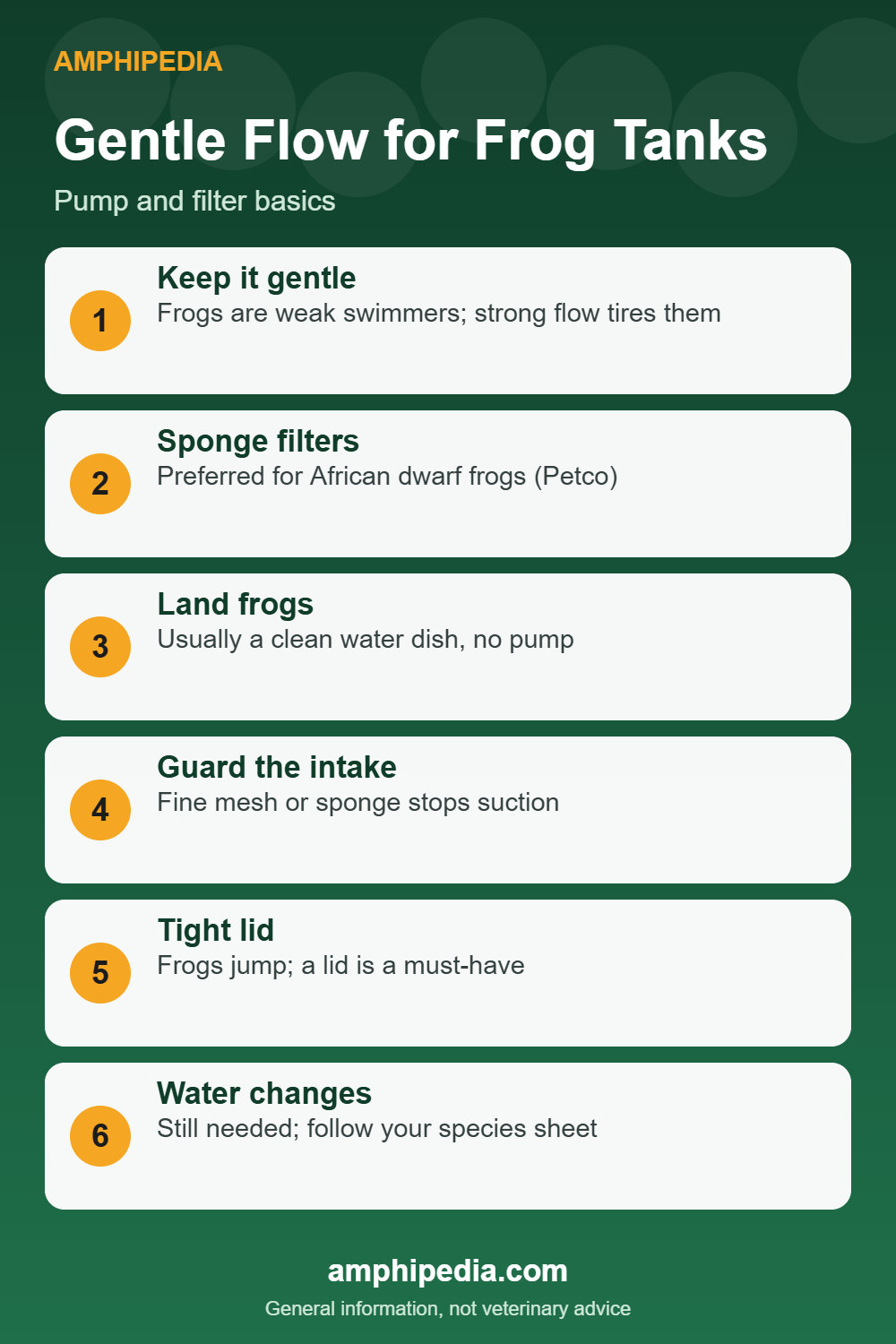
Pin this infographicShare on Facebook
Gentle pumps and filters for frog tanks
These pumps and filters are drawn from live Amazon listings. Pick an adjustable, low-flow model and guard the intake.


Product titles, prices and ratings are provided by Amazon and are accurate only at the time they are displayed.
Which frog tanks need a pump?
Fully aquatic frogs, such as African dwarf frogs, live in water all day. They need filtration to break down waste, and gentle movement helps keep water fresh. Semi-aquatic setups with a pond or waterfall also need a small pump.
Terrestrial frogs rarely do. Reptile Supply’s dart frog guide lists a digital thermometer, a hygrometer and misting, but no pump. For those tanks, a shallow dish refreshed daily is enough.
Why flow must stay gentle
Petco says to avoid power filters with strong suction or fast water movement, and accepts hang-on-back or under-gravel filters only if the flow stays gentle.
PetMD makes the same point for newts: slow to moderate circulation, since they cannot swim well in turbulent water. VetVerified recommends a gentle filter, such as a sponge filter or a low-flow internal filter, for the eastern newt.
Pump or filter: which to pick
A pump moves water, but it does not clean it. A filter, such as a sponge filter or a low-flow internal filter, does both jobs. Petco calls sponge filters its top recommendation because they give gentle flow and biological filtration.
Use a small adjustable pump for a waterfall or stream. Use a sponge filter for a fully aquatic tank. Our guides to nano filters and small newt filters go deeper.
| Setup | What suits it | Why |
|---|---|---|
| Fully aquatic frogs | Sponge filter or low-flow filter | Gentle, good biological filtration |
| Frog pond or waterfall | Small adjustable pump | Lets you reduce the flow |
| Land frogs with a dish | No pump | Clean, dechlorinated water daily |
What to look for
Choose an adjustable flow control so you can turn the current down. Look for a pump rated for the size of your tank, a guarded intake and a power cable long enough to loop up and form a drip loop.
Quiet running matters in a room where animals rest. A pump that vibrates against the glass can stress them.
- Adjustable flow rate.
- Fine-mesh intake guard or sponge pre-filter.
- Submersible or in-tank design for small tanks.
- Cord long enough for a drip loop.
- Easy to take apart and rinse.
- Suitable for freshwater and low-voltage setups.
Set up step by step
Place the unit in a back corner away from where frogs rest. Aim the outflow at the glass or a plant so it spreads and slows.
Fill the tank with dechlorinated water. Petco notes that frogs jump and need a tight-fitting lid, and calls this a must-have rather than an extra.
- Rinse the unit and all parts in clean water.
- Fit a sponge or guard over the intake.
- Position it in a corner and aim the outflow at the glass.
- Fill with dechlorinated water and turn the flow down.
- Watch the frogs for an hour; lower the flow if they struggle.
- Fit the lid and check there are no gaps.
Water changes still matter
A pump does not remove dissolved waste. PetMD advises changing 10 to 25% of the water every two to four weeks for newts and replacing filter media monthly. VetVerified suggests weekly changes of 25 to 50% for the eastern newt.
Use the schedule your species sheet gives. Always treat tap water first; see our dechlorinator guide.
Choosing flow for waterfalls and streams
In a paludarium, a pump often feeds a stream or waterfall. Keep the drop short and the flow soft so the sound stays calm and animals can approach the water without being knocked over.
Add a ramp, rocks or plants at the edge so small frogs can climb out. Check every few days that the pump has not clogged with debris, because a blocked pump can stop the flow and warm the water. Keep the reservoir topped up with dechlorinated water.
- Short, gentle drop rather than a strong jet.
- Ramp or rocks at the water edge.
- Clean the pump and tubing during water changes.
- Keep the reservoir full so the pump never runs dry.
Common mistakes
The biggest mistake is using a pump or filter made for fish that cannot be turned down. Another is leaving the intake open, which can trap small animals.
Also avoid placing the pump near a heater or in direct sun.
- Using a strong power filter in a small tank.
- Leaving the intake unguarded.
- Forgetting a tight lid.
- Skipping water changes because the pump runs.
- Using tap water without a conditioner.
Hygiene and electrical safety
Keep plugs and sockets above the tank and use a drip loop. The CDC says tank water and equipment can carry Salmonella, so wash your hands with soap and water after maintenance.
Clean pumps and tanks outside the kitchen and pour waste water down the toilet, not the sink.
Cycle an aquatic tank before the frogs arrive
A filter only helps once it carries beneficial bacteria. Petco’s African dwarf frog guide says ammonia, nitrites and nitrates should all read 0 before frogs are added. It suggests seeding the tank with a bottled bacterial supplement made for cycling, and optionally adding snails to help build the nitrogen cycle.
The same guide says to run the tank and test until the readings reach 0, and to turn on the heater and sponge filter once the tank is full. It advises acclimating frogs by slowly mixing tank water into their bag over about 20 minutes, then moving them with a cup rather than a net.
Where the filter and heater go
Petco says to place a sponge filter in a back corner and to keep the submersible heater near the filter. Taller plants can hide both pieces of equipment. It also says to leave space between the water surface and the lid, and to keep all structures stable so nothing can shift and trap a frog.
Add several hides spread around the tank so each animal has its own space. Keep the intake away from them, as covered in the suction note above.
Depth and temperature differ by species
Flow is only one part of the setup. Published figures differ between animals, so match them to yours.
- African dwarf frog (Petco): water no deeper than 12 inches, at 72 to 82 F.
- Fire-bellied newt (PetMD): water at least 1.5 times as deep as the longest newt is long, at 60 to 75 F and never above 78 F.
- Eastern newt (VetVerified): water 15 to 25 cm (6 to 10 inches) deep, at 18 to 22 C (64 to 72 F), with ammonia and nitrite at 0 ppm.
These sources are care sheets for different species, so they should not be averaged. PetMD also recommends a submersible aquatic thermometer in semi-aquatic habitats.
Testing and changing water: three schedules
The MSD Veterinary Manual pet-owner page advises weekly tests of temperature, pH, hardness, ammonia, nitrite and nitrate with an aquarium kit, and a change of at least 10 percent of the water each week in an established tank. It also says some aquatic amphibians need gentle filtration that does not create strong currents.
Other care sheets differ. PetMD gives 10 to 25 percent every two to four weeks for newts, and VetVerified gives 25 to 50 percent weekly for the eastern newt. The sources disagree because the animals and tank sizes differ, so follow the sheet for your species and let test results tell you when to change water sooner.
For tanks with a stream or waterfall, the Merck Veterinary Manual says external canister or under-gravel filters are used to keep that water safe. A small pump on its own moves water but does not treat it.
Frequently Asked Questions
Do dart frogs need a water pump?
Usually not. A shallow dish with clean, dechlorinated water works for most land frogs. Pumps are for ponds and waterfalls.
What filter is best for African dwarf frogs?
Petco makes sponge filters its top recommendation because they give gentle flow and biological filtration.
How strong should the current be?
As gentle as you can make it. Petco warns against fast water movement, and PetMD says newts cannot swim well in turbulent water.
How often should I change the water?
Follow your species sheet. PetMD gives 10 to 25% every two to four weeks for newts, and VetVerified gives 25 to 50% weekly for eastern newts.
Can a pump hurt a small frog?
Yes, if the intake is unguarded. Use a fine guard or sponge.
Do I need a lid?
Yes. Petco says a tight-fitting lid is a must-have.
Can I run a pump all day?
Most small pumps are made to run continuously, but check the maker’s manual and clean it often so it does not clog.
Bottom Line
Pick a low-flow, adjustable pump or a sponge filter for aquatic setups, and skip the pump for land frogs.
Guard the intake, keep the lid tight and stick to regular water changes. Rinse the pump at each water change.
Sources
- Petco: How to Set Up an African Dwarf Frog Tank, accessed 12 November 2026
- PetMD: Fire-Bellied Newt Care Sheet, accessed 12 November 2026
- VetVerified: Keeping the Eastern Newt, accessed 12 November 2026
- Reptile Supply: How to Care for Poison Dart Frogs, accessed 12 November 2026
- CDC: Reptiles and Amphibians, accessed 12 November 2026
- MSD Veterinary Manual: Housing for Amphibians (pet owner version), accessed 12 November 2026
- Merck Veterinary Manual: Environment and Husbandry for Amphibians, accessed 12 November 2026
9 Comments