Dart Frog Not Eating? How to Get It to Feed Again
This post contains affiliate links. As an Amazon Associate I earn from qualifying purchases. Prices and availability are shown by Amazon and can change.
You cannot make a dart frog eat, and you should never force-feed one. A frog that refuses food is usually telling you something about its setup. Check temperature and humidity, offer prey about one eighth of an inch or smaller, feed in daylight, cut stress and keep a feeding log. If it still refuses food for several feedings, see an exotics vet.
A dart frog that ignores its fruit flies worries every keeper. The urge is to do something dramatic, but the safe approach is calm and methodical.
This guide walks through the most common causes in order, from setup and prey size to stress. It also explains when a vet visit is needed, because some frogs stop eating when they are ill.
How this was made: prepared with AI assistance and checked against the sources listed at the end. Images are AI-generated illustrations, not photographs of real animals or products.
Key Takeaways
- You cannot force a frog to eat, so fix the cause instead.
- Most dart frogs will not eat prey much larger than one eighth of an inch.
- Dart frogs are active by day, so feed when they are out.
- Check temperature and humidity before changing food.
- New or stressed frogs may need quiet time to settle.
- Call an exotics vet if refusal continues over several feedings.
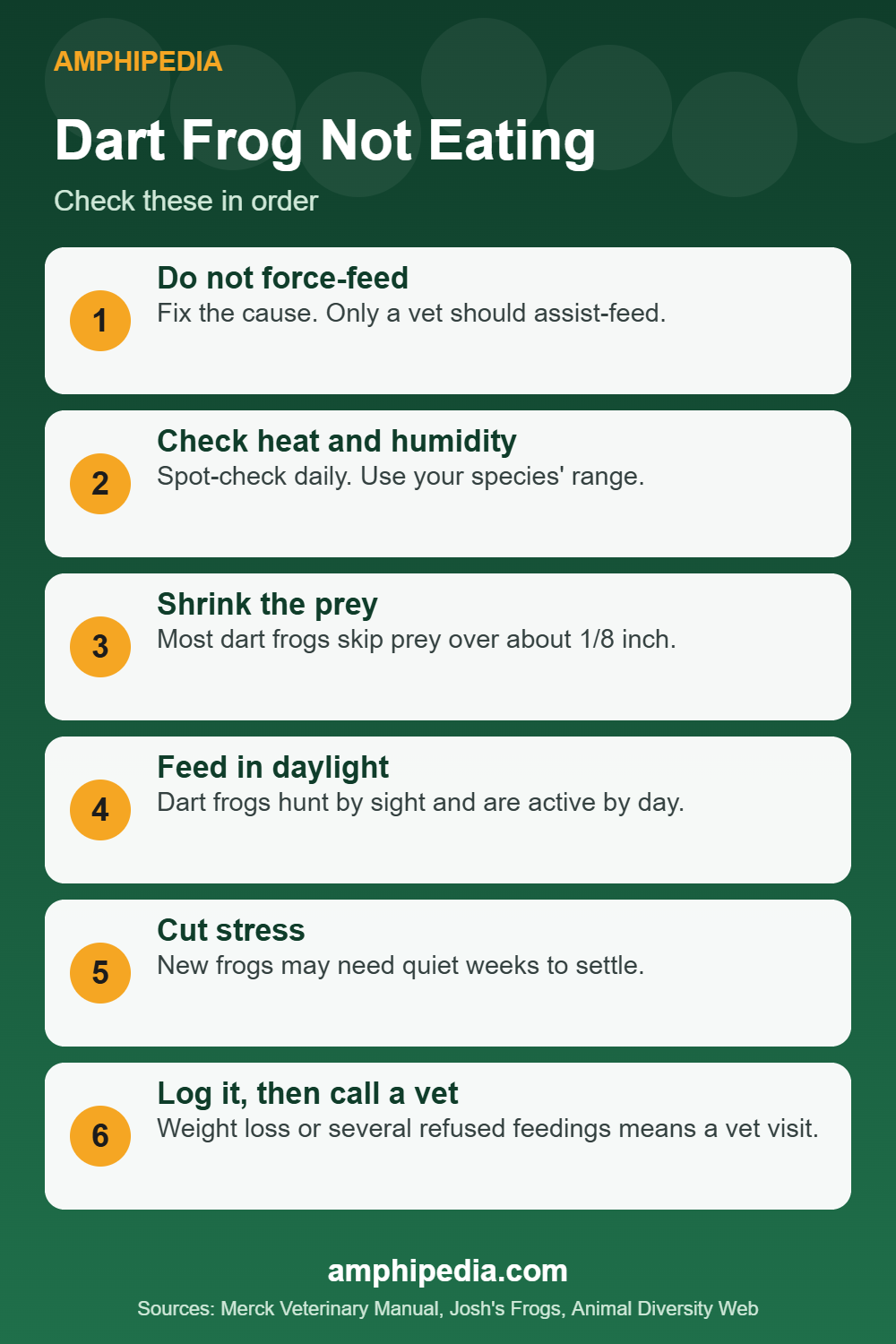
Pin this infographicShare on Facebook
Feeding supplies for dart frogs
These supplies help with feeder cultures, dusting and a consistent feeding spot.


Product titles, prices and ratings are provided by Amazon and are accurate only at the time they are displayed.
Why you cannot make a dart frog eat
No safe method forces a healthy frog to eat. Frogs feed when they see suitable moving prey and feel secure. The sources reviewed give no protocol for force-feeding, and any assisted feeding belongs in a vet’s hands.
So the job is to remove the reasons for refusing. Work through the steps below in order, change one thing at a time, and record what happens.
Step 1: Check temperature and humidity
Merck Veterinary Manual says each species has a preferred optimal temperature zone and that suboptimal conditions commonly cause disease in tropical amphibians. It says keeping amphibians outside their preferred range can weaken immunity.
For humidity, Merck says tropical species may need 85 to 90 percent, and it advises a thermometer and a humidity gauge in every enclosure. Check the range for your exact species, then spot-check the enclosure daily.
Step 2: Match the prey size
Josh’s Frogs, a dart frog retailer, says most dart frogs will not eat prey much over one eighth of an inch. Young froglets prefer even smaller prey. Melanogaster fruit flies are about one sixteenth of an inch and wingless, so they suit small frogs.
Hydei fruit flies are about one eighth of an inch. Reptiles Magazine also lists tiny Turkistan roach nymphs and the smallest phoenix worms as feeders for small frogs. If your frog ignores large flies, try a smaller type.
| Feeder | Size | Source |
|---|---|---|
| Melanogaster fruit fly | About 1/16 inch, wingless | Josh’s Frogs |
| Hydei fruit fly | About 1/8 inch | Josh’s Frogs |
| Turkistan roach nymph | About 1/8 inch at hatching | Reptiles Magazine |
| Smallest phoenix worms | For very small amphibians | Reptiles Magazine |
| Black soldier fly larvae | Treat, about monthly | Josh’s Frogs |
Step 3: Feed in daylight and offer movement
Animal Diversity Web describes the green and black dart frog as diurnal, with excellent eyesight, and says it catches prey with a sticky, retractable tongue. A frog that hunts by sight needs to see prey moving while it is awake.
Offer flies during the day, when the frog is out. Dead or still insects are less likely to draw a strike. Fresh, active cultures work better than a tired culture that is running low.
Step 4: Use a feeding station and track intake
Josh’s Frogs suggests placing a slice of banana, about a quarter inch thick with the peel removed, as a feeding station. Check it before the next feeding. If few flies are left, feed the same amount. If many are left, skip to the next feeding and feed less. If none, feed more.
This is a simple way to learn whether your frog is really eating. Pair it with a log, as Merck advises keeping a log of appetite and behaviour.
- Place a feeding station in the same spot each time.
- Dust the flies as your vet advises.
- Offer flies during the day.
- Check how many flies remain before the next feeding.
- Write down what you saw.
Keep a steady supply of flies
A frog cannot eat flies that are not there. Josh’s Frogs says melanogaster cultures begin producing flies about 14 days after setup and keep emerging through roughly day 28. Hydei cultures take 21 days or more to start and follow a boom and bust pattern, usually with two or three booms about 5 to 7 days apart.
Start a second culture before the first runs low so there is always a fresh batch. Fresh, active flies are more likely to draw a strike than a few stragglers from an old culture.
A simple reset routine
If the frog has been off food, use a calm, structured reset. This plan is a practical routine built from the steps above, not a medical protocol.
Change one item at a time and give each change a few feeding days. Do not wait for the routine to finish if the frog looks unwell.
- First, check temperature and humidity, and fix anything outside your species range.
- Next, switch to smaller flies and feed in daylight at the feeding station.
- Then keep the room quiet and skip handling and rearranging.
- Throughout, keep a log of what the frog eats and its weight.
- If the frog loses weight, looks unwell or refuses several feedings in a row, call an exotics vet without waiting.
Step 5: Review supplements and variety
Josh’s Frogs says to dust feeders with a quality vitamin and mineral supplement at each feeding. It notes that black soldier fly larvae do not need dusting or gut-loading, and lists larvae among treats given about monthly.
Merck says supplements prevent nutritional disease and can be given by gut-loading insects, using high-calcium commercial diets, or dusting insects with a multivitamin powder containing vitamin D3 and calcium. A frog fed only the same prey may also run short of nutrients. Offer variety within the size limit.
Step 6: Reduce stress and give new frogs time
Merck recommends quarantine for new amphibians, typically 6 to 8 weeks, with disturbances kept low. A newly arrived frog may hide and skip meals while it settles.
Avoid handling, loud noise and constant rearranging. Make sure the frog has plants and hiding spots, and keep the room quiet during feedings. Stress and poor conditions are common reasons for refusing food.
Common causes at a glance
This table lists the main causes and the first check for each. It combines the sources above with common sense, and it is not a diagnosis.
| Possible cause | What to check | Source |
|---|---|---|
| Wrong temperature | Spot-check daily with a thermometer | Merck |
| Low humidity | Check the humidity gauge | Merck |
| Prey too large | Try smaller fruit flies | Josh’s Frogs |
| Wrong time of day | Feed during daylight | Animal Diversity Web |
| Stress or new arrival | Reduce disturbance, allow settling | Merck |
| Illness | Weigh, log and call an exotics vet | Merck |
When to call a vet
If your frog refuses food for several feedings after you correct the setup, call an exotics vet. Merck notes that quarantine checks can include fecal tests, water quality tests and PCR assays, which a vet can run. Do not try to medicate a frog yourself.
Find a vet through the ARAV directory at arav.org/professionals. Take your log, the enclosure temperature and humidity readings, and a note of what you feed.
Common mistakes
The most common mistakes are offering prey that is too big, feeding at night to a daytime frog, and changing too many things at once. Another is overhandling a frog that is already stressed.
Handling also carries a health risk. For more on feeding schedules, see how many times frogs eat a day.
Related guides
For equipment, see magnetic feeding dishes for dart frogs and fruit fly culture kits. For other frogs, read what to do if your frog won’t eat.
How often a healthy dart frog is fed
A refusal only means something if the normal routine is known. Josh’s Frogs feeds all of its dart frogs three times a week, on Monday, Wednesday and Friday, and says daily feeding is possible but not necessary. It gives no exact fly count and no separate schedule for froglets and adults.
Before offering crickets to larger adults, the same retailer skips one feeding so the frogs hunt more eagerly. Merck adds that food and water should be replaced daily and uneaten food removed.
Feeder options when flies are ignored
Josh’s Frogs lists several small feeders. Most dart frogs will not eat prey much over one eighth of an inch, with exceptions that include Phyllobates bicolor, Phyllobates terribilis and Epipedobates trivittatus.
- Springtails: about 1/32 inch, and they can breed in the vivarium.
- Pinhead crickets: about 1/16 inch. Standard crickets: about 1/8 inch.
- Black soldier fly larvae: extra small and small sizes only.
- Isopods: small and soft-bodied.
Josh’s Frogs says to feed crickets a quality cricket food for at least 48 hours before offering them, and not to give crickets a water dish because they drown. Use fresh vegetables or insect watering gel instead. Reptiles Magazine says Turkistan roach nymphs hatch at around one eighth of an inch and suit dart frogs.
What wild diet suggests about appetite
Animal Diversity Web says the green and black dart frog eats small invertebrates, especially ants, and is seldom still during the day. It stores alkaloids from ants in its skin, and captive frogs fed insects without alkaloids lose their toxicity.
Treat this as reasoning, not proof: a frog that hides all day and ignores prey is behaving differently from that wild picture. Record what you see and share it with an exotics vet.
Frequently Asked Questions
Why is a dart frog not eating?
Common reasons are the wrong temperature or humidity, prey that is too large, stress and illness.
How long can a dart frog go without eating?
The sources reviewed give no safe number. If it refuses several feedings, call an exotics vet.
Can a dart frog be force-fed?
No. The sources reviewed give no protocol for force-feeding, and any assisted feeding belongs with a vet.
What size food do dart frogs eat?
Most will not eat prey much over one eighth of an inch. Froglets prefer smaller.
When do dart frogs eat?
They are diurnal, so offer food during the day.
Do new dart frogs eat right away?
Not always. New animals may need quiet time and a quarantine period of several weeks.
Bottom Line
A dart frog that stops eating is usually reacting to its setup. Fix temperature, humidity, prey size and stress, and change one thing at a time.
Keep a log, track what the frog eats and call an exotics vet if the refusal continues.
Sources
- How often and how much to feed dart frogs, Josh’s Frogs, accessed 13 November 2026. Used for prey size, feeding station, supplements.
- Dendrobates auratus, Animal Diversity Web, accessed 13 November 2026. Used for diurnal, eyesight, tongue.
- Environment and Husbandry for Amphibians, Merck Veterinary Manual, accessed 13 November 2026. Used for temperature, quarantine, appetite log.
- Housing for Amphibians, Merck Veterinary Manual, accessed 13 November 2026. Used for humidity and temperature ranges.
- Exotic Insect Feeders For Your Herps, Reptiles Magazine, accessed 13 November 2026. Used for small feeder options.
- Reptiles and amphibians, CDC, accessed 13 November 2026. Used for salmonella and hygiene.
- Find a veterinarian, ARAV, accessed 13 November 2026. Used for exotics vet directory.
2 Comments