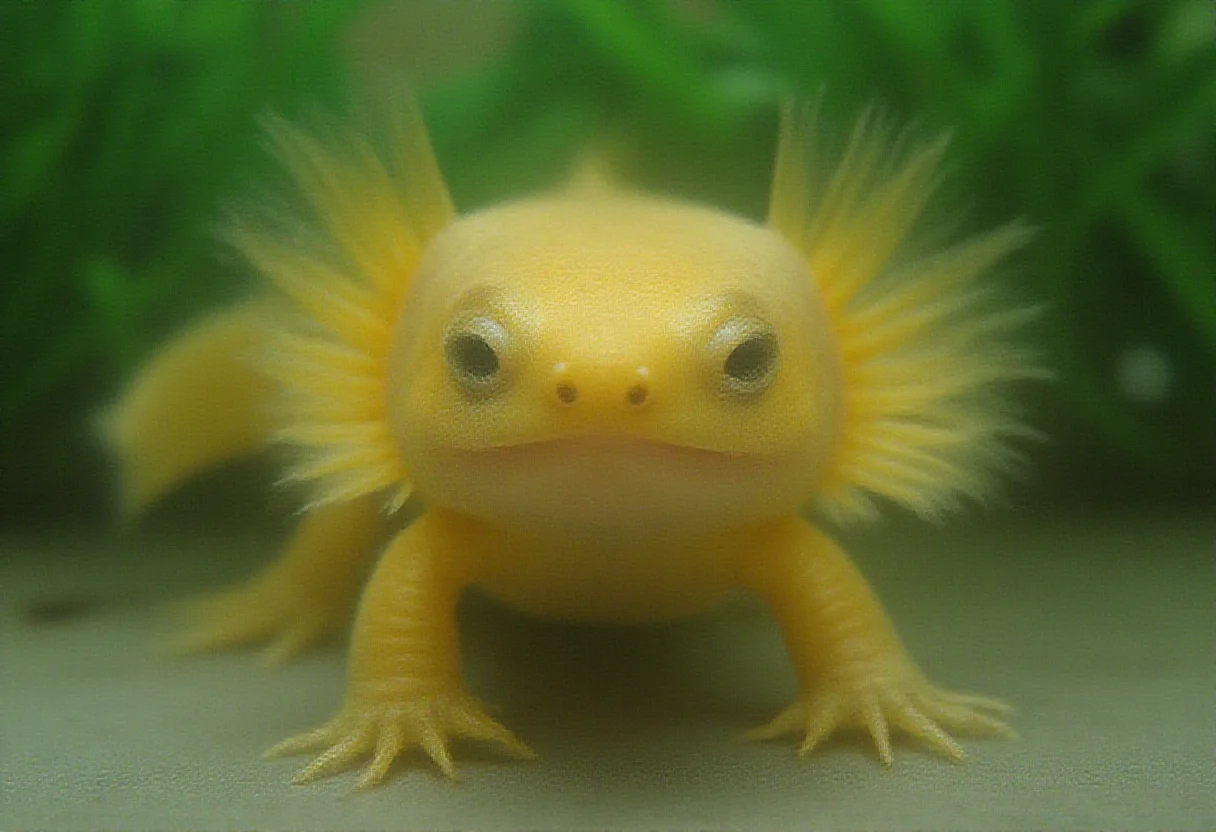
Axolotl Eggs: Size, Number, Hatching Time and Facts
Axolotl eggs are small, round and jelly-coated, about 2 mm across according to the Royal Veterinary College. Females lay them one at a time on plants or rocks. The Animal Diversity Web gives 100 to 300 eggs per spawn, and hatching takes 10 to 14 days. Another source reports about 14 days at 24°C.
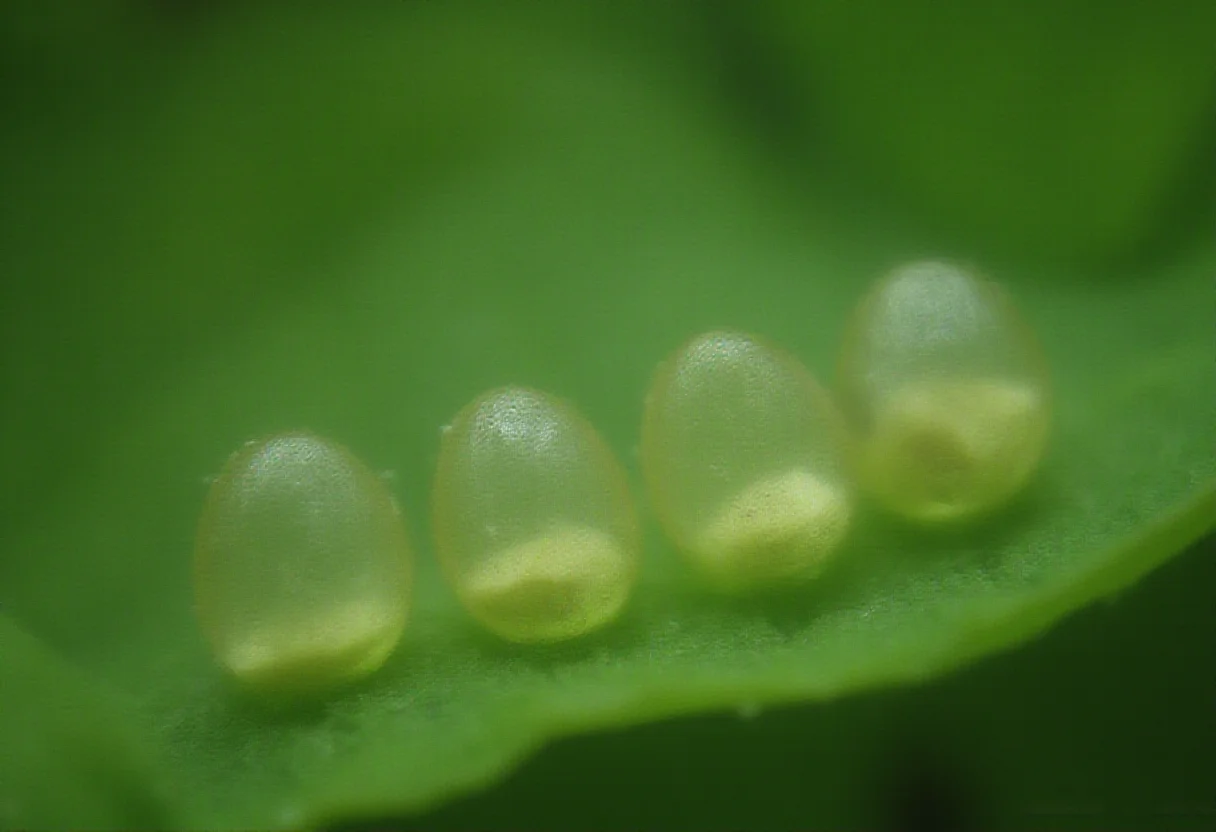
Axolotl eggs look like tiny glass beads. Each one holds a growing embryo inside a clear jelly coat, and it is easy to miss on a plant leaf.
This guide covers what the eggs look like, how many a female lays, how long hatching takes and what temperature does to development. It is an information guide, not a breeding manual.
How this was made: prepared with AI assistance and checked against the sources listed at the end. Images are AI-generated illustrations, not photographs of real animals or products.
Key Takeaways
- Eggs are about 2 mm across, with an embryo surrounded by jelly (RVC).
- Females lay eggs singly on plants or rocks, not in clumps.
- The Animal Diversity Web (ADW) gives 100 to 300 eggs per spawn. Another source reports 100 to over 1,000.
- Hatching takes about 10 to 14 days.
- Cool water slows development, and warm water speeds it up.
- Hatchlings begin feeding on tiny live foods once they swim and gulp air.
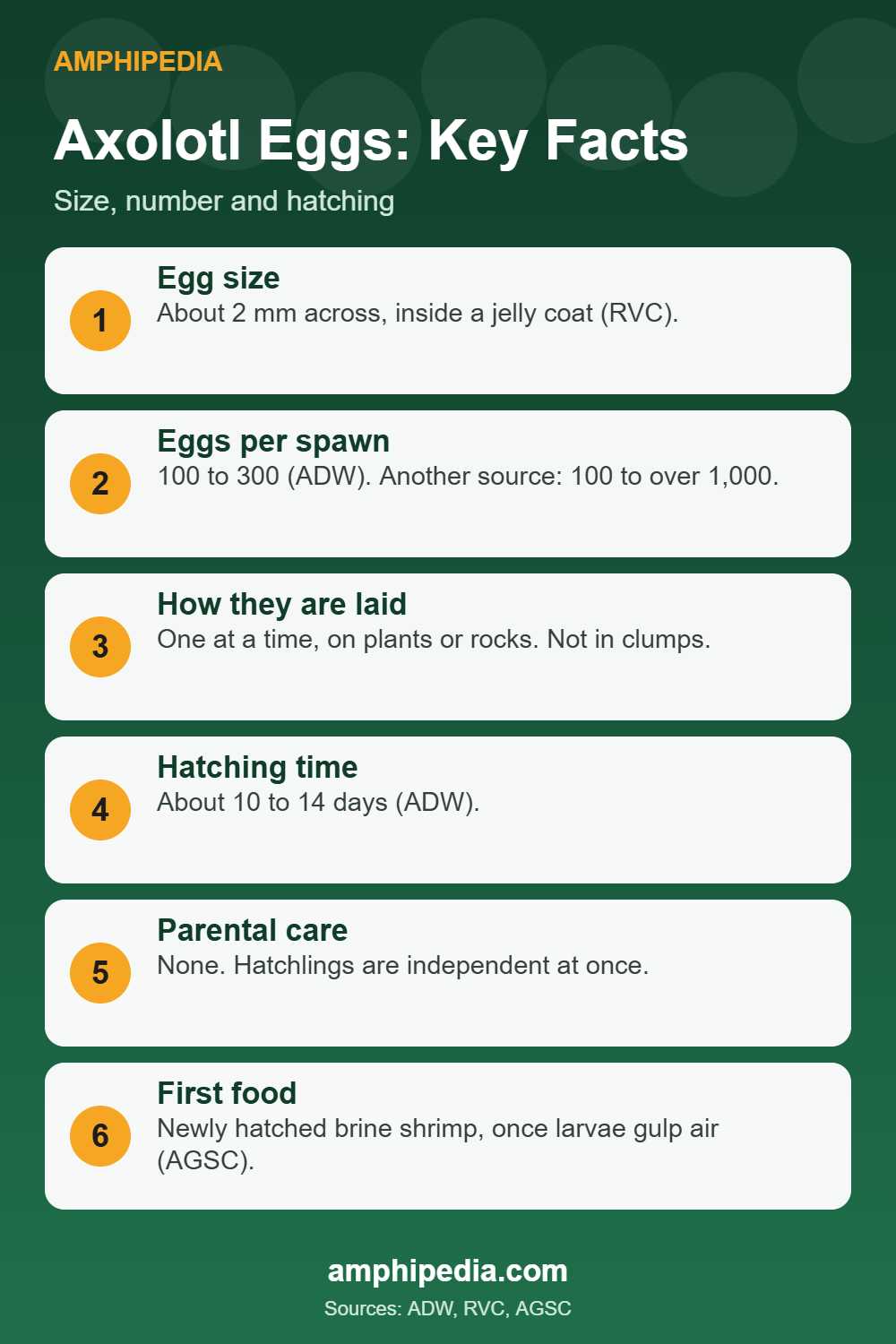
Pin this infographicShare on Facebook
What do axolotl eggs look like?
The Royal Veterinary College (RVC) describes axolotl eggs as about 2 mm in diameter, with an embryo surrounded by jelly. The eggs hatch into the larval form.
ADW adds that each egg has a protective jelly coat. Unlike many frogs, axolotls do not lay eggs in a mass. They deposit them one by one, and ADW links this habit to the eggs’ high oxygen needs.
A caudata.org species page, a hobbyist reference, says eggs are laid individually and usually on plants.
How many eggs does an axolotl lay?
Sources disagree, so here are both. ADW says a female lays 100 to 300 eggs. Caudata.org says a single spawning can produce from one hundred to over a thousand eggs, depending on the size of the female.
The University of Kentucky Ambystoma Genetic Stock Center (AGSC) says axolotls can breed more than once a year and produce considerably more offspring per spawn than salamanders that breed seasonally.
In the wild, ADW says breeding happens mainly from March to June, once a year.
| Fact | What sources say |
|---|---|
| Egg size | About 2 mm across (RVC) |
| Eggs per spawn | 100 to 300 (ADW); 100 to over 1,000 (Caudata.org) |
| Laid | Singly, on plants or rocks |
| Hatching time | 10 to 14 days (ADW); about 14 days at 24°C (Caudata.org) |
| Sexual maturity | About 1 year (ADW) |
Where are the eggs laid?
ADW says eggs are attached to substrates such as rocks or floating vegetation. In the lakes and canals of Mexico City, this means water plants and submerged objects.
Fertilization is internal, and the species is oviparous. There is no parental care, so the hatchlings are independent from the start, according to ADW.
How long do axolotl eggs take to hatch?
ADW states that hatching takes 10 to 14 days. Caudata.org reports about 14 days when the water is held at 24°C.
Temperature matters. The AGSC says its embryos can be held at 6°C to slow development or 24°C to speed it up, but only for short periods. The center usually keeps its animals at 15 to 17°C. That is a lab practice. It does not set a rule for home use.
Cool water slows the clock, and warm water speeds it up. If you are caring for eggs, ask an experienced breeder or an exotics vet before you change anything.
What happens after hatching?
Hatchlings are independent right away, ADW says. They are tiny larvae with external gills.
The AGSC notes that feeding begins when larvae come to the surface to gulp air. At that point they eat newly hatched brine shrimp. Unhatched eggs and shells are removed first to prevent intestinal blockage.
The AGSC also reports that larvae kept in groups often get bite injuries to limbs and tails. Those injuries usually heal by regeneration.
Eggs, laws and responsibility
Breeding axolotls creates dozens or hundreds of animals who need homes. Rules for keeping and selling axolotls vary, so check your state wildlife agency before you breed or sell.
Never release unwanted axolotls or eggs into the wild. The CDC advises contacting a pet store, rescue group, aquarium or zoo to rehome pets. For more, see our posts on axolotl breeding, how to breed axolotls and the full axolotl life cycle.
How the eggs get fertilized
Animal Diversity Web says fertilization is internal. Caudata.org, a hobbyist reference, describes how: the male deposits spermatophores, each a clear stalk with a white cap, on the tank floor. The female picks up a sperm capsule after a courtship dance.
Caudata.org says spawning follows a few hours to two days later. The Royal Veterinary College adds that sperm availability in males cycles through the year, so it is not always present.
This is why eggs are not simply laid on a schedule. Timing depends on courtship, the female’s condition and the male’s cycle.
Why clutch size varies so much
Two sources give different clutch sizes. Animal Diversity Web says 100 to 300 eggs, a figure for wild animals. Caudata.org says roughly 100 to over 1,000, depending on the size of the female. The University of Kentucky stock center says axolotls can breed more than once a year.
Those facts fit together. Larger females can carry more eggs, and repeat spawning changes the yearly total. Use 100 to 300 as the wild figure, and treat larger counts as captive reports.
Caudata.org advises against breeding females before 18 months and more often than once every two months. That is one hobbyist’s view, not a veterinary standard, and the Royal Veterinary College factsheet gives no advice for or against breeding.
From egg to juvenile: a rough timeline
| Stage | What sources report | Source |
|---|---|---|
| Egg | About 2 mm across, embryo inside jelly | RVC |
| Hatching | 10 to 14 days; about 14 days at 24 C | ADW; Caudata.org |
| First weeks | Larvae are transparent; limbs develop gradually | RVC |
| First feeding | When larvae gulp air at the surface | AGSC |
| Adult size | 18 to 24 months, averaging 25 to 30 cm | RVC |
| Maturity | About 6 months to over a year, usually near 20 cm | Caudata.org |
The maturity figures disagree. The Royal Veterinary College gives adult size at 18 to 24 months, while Caudata.org reports sexual maturity from about 6 months to over a year. Size, food and temperature probably explain part of the gap, but the sources do not say so directly.
What the temperature numbers do and do not mean
Caudata.org reports hatching at about 14 days at 24 C. The stock center holds embryos briefly at 6 C or 24 C to slow or speed development, and normally keeps animals at 15 to 17 C.
The Royal Veterinary College gives an optimum of 16 to 18 C for axolotls, and says water should never exceed 24 C. So 24 C sits at the upper limit. Treat it as a laboratory or short-term figure, not a target for a home tank.
What can go wrong with eggs
The stock center says dead embryos foul the water and must be removed. It also stirs embryo water once a day to add oxygen, which fits the high oxygen needs that Animal Diversity Web links to single-egg laying.
Unhatched eggs and shells are removed before larvae start feeding, because they can block a larva’s intestine. The sources used here do not describe egg fungus or how to tell fertile from infertile eggs, so this page makes no claims about either.
If eggs turn cloudy, or a whole spawn fails, ask an exotics vet or an experienced breeder instead of guessing.
Larvae together: bites and cannibalism
The stock center reports that most larvae kept in bowls get bite injuries to limbs and tails, and that these regenerate. It offers a paid service for rearing larvae individually. Caudata.org says many bloodlines are cannibalistic and warns against keeping many larvae in one tank.
Caudata.org also says infrequent feeding causes lost limbs, lost gills and deaths. The two sources agree on the main risks for young larvae: crowding and too little food.
First foods: what two sources say
Caudata.org says larvae will eat anything small enough to fit in the mouth after a few hours. It lists young daphnia, microworms and newly hatched brine shrimp without cyst shells as first foods.
The stock center feeds newly hatched brine shrimp once larvae gulp air at the surface. At 3 cm it moves larvae to larger bowls and adds California blackworms, then moves to pellets later. Caudata.org suggests larger foods such as frozen bloodworms from about 3 cm.
These are two different settings, a laboratory and a hobbyist page. Neither replaces advice from an exotics vet.
Telling males from females
The Royal Veterinary College says males are more elongated and less rounded than females. Once sexually mature, males have a more swollen cloaca. The sources describe sexing only for older animals, not for hatchlings.
Common mistakes when reading about axolotl eggs
- Assuming eggs come in a mass like frog spawn. Axolotl eggs are laid singly.
- Mixing wild and captive clutch sizes. The counts come from different settings.
- Copying laboratory settings, such as 24 C, into a home tank.
- Treating a hobbyist page as a veterinary rule. Check who wrote each claim.
- Forgetting the end of the story. A spawn can produce dozens or hundreds of animals who need homes.
Frequently Asked Questions
How big are axolotl eggs?
About 2 mm in diameter, per the Royal Veterinary College.
How many eggs do axolotls lay?
ADW says 100 to 300. Caudata.org reports 100 to over 1,000 depending on the female’s size.
How long do axolotl eggs take to hatch?
About 10 to 14 days (ADW). Caudata.org reports about 14 days at 24°C.
Are axolotl eggs laid in clumps?
No. ADW says they are laid singly and attached to plants or rocks.
Do axolotl parents care for eggs?
No. ADW states there is no parental involvement.
What do axolotl hatchlings eat first?
The AGSC feeds newly hatched brine shrimp once larvae gulp air at the surface.
Bottom Line
Axolotl eggs are small, single, jelly-coated and fast to develop. Numbers and timing vary, and two good sources disagree on clutch size.
Treat the numbers here as ranges. If you are caring for eggs, ask an exotics vet or an experienced breeder for hands-on help.
Sources
- Animal Diversity Web: Ambystoma mexicanum (University of Michigan), accessed 31 October 2026
- Royal Veterinary College: Axolotl care and advice, accessed 31 October 2026
- University of Kentucky Ambystoma Genetic Stock Center: AGSC Guide 2024, accessed 31 October 2026
- Caudata.org: Ambystoma mexicanum species page, accessed 31 October 2026
- CDC: Reptiles and amphibians, accessed 31 October 2026

3 Comments