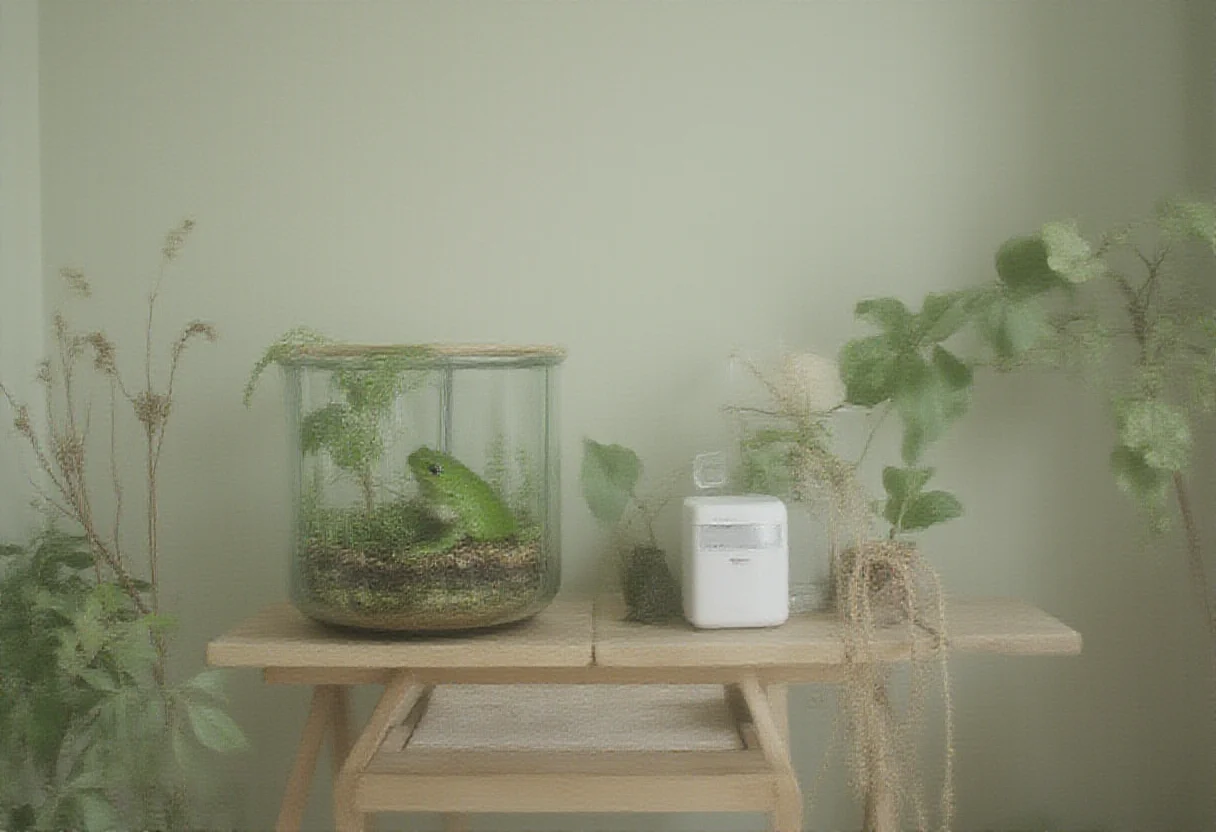
Best Compact Dehumidifier for an Amphibian Room
This post contains affiliate links. As an Amazon Associate I earn from qualifying purchases. Prices and availability are shown by Amazon and can change.
The best compact dehumidifier for an amphibian room is a quiet, small-tank unit with a reliable auto shut-off, a drain option, and enough capacity for the room size. It dries the room air, not the tanks. EPA advises keeping indoor humidity below 60% and ideally 30-50% RH, while amphibians still need moisture inside their enclosures. Place the unit away from the tanks and watch a hygrometer.
Many amphibian keepers run several humid tanks in one room. All that evaporation can leave walls, shelves and stands damp, and mold follows.
A compact dehumidifier helps the room, not the animals. The goal is a dry room around well-misted enclosures. The picks below are compact units pulled from live Amazon listings.
How this was made: prepared with AI assistance and checked against the sources listed at the end. Images are AI-generated illustrations, not photographs of real animals or products.
Key Takeaways
- Dehumidify the room, never the enclosure. Amphibians still need moisture inside their tanks.
- EPA advises indoor humidity below 60% RH, ideally 30-50%.
- Choose by room size, noise, tank size and drain option, not by price alone.
- Place the unit away from tanks so it does not pull moisture from the enclosure air.
- Measure the room with a hygrometer and fix leaks and poor airflow first.
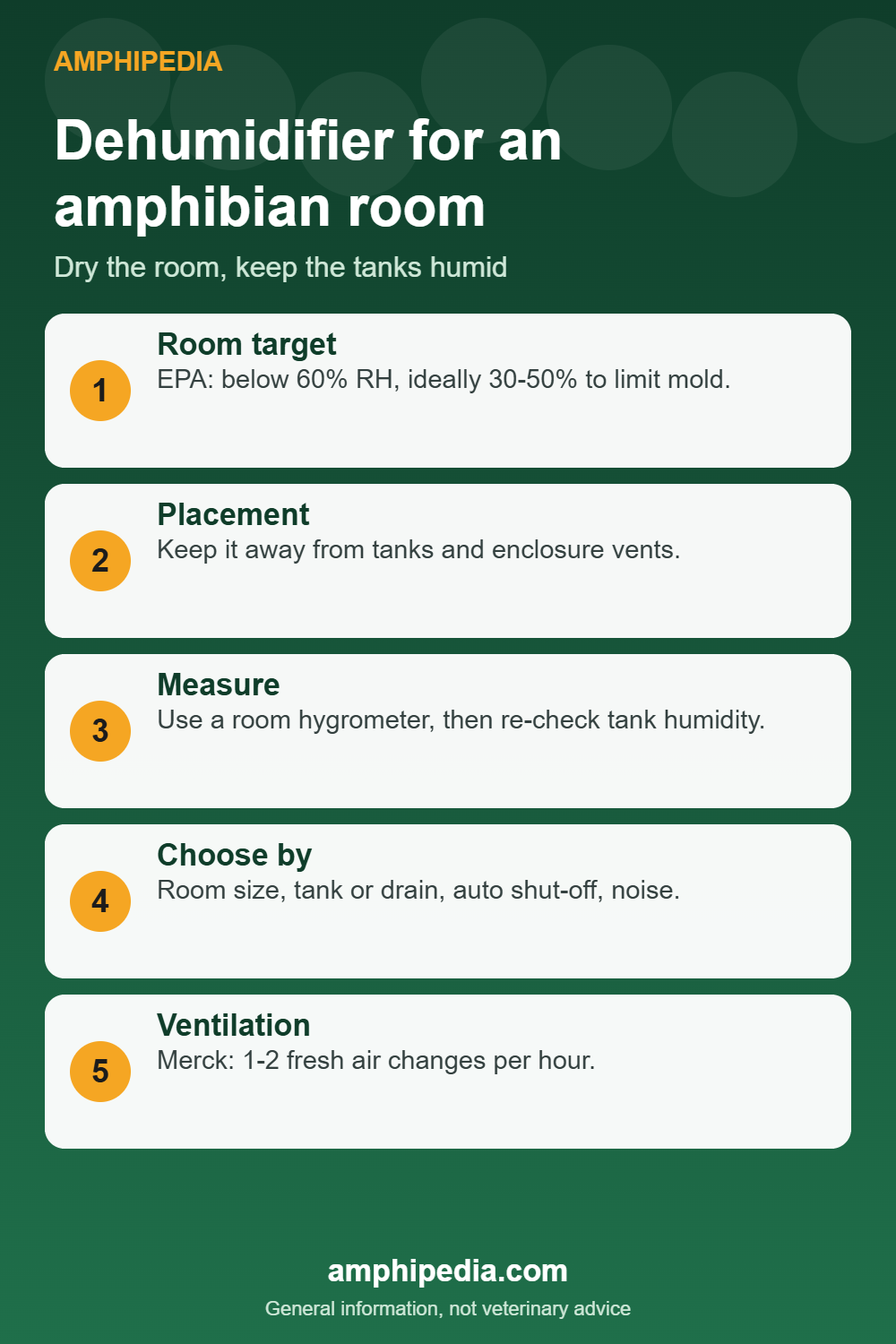
Pin this infographicShare on Facebook
Compact dehumidifiers and monitors worth a look
These listings are pulled from live Amazon data, sorted from highest price to lowest.


Product titles, prices and ratings are provided by Amazon and are accurate only at the time they are displayed.
Why an amphibian room gets damp
Misting, waterfalls, water dishes and live plants all add moisture to the air. Merck Veterinary Manual notes that amphibians need moisture to prevent drying out, and lists streams, waterfalls, ultrasonic humidifiers and frequent misting as ways to provide it.
That moisture does not stay in the tank. Over time it settles on cold walls, windows and shelves. Damp surfaces are where mold grows.
What humidity should the room have?
EPA guidance for mold control is to keep indoor humidity below 60% relative humidity, ideally 30-50%. EPA also lists dehumidifying as an option when outdoor air is warm and humid, and ventilation when outdoor air is cold and dry.
The enclosure is a separate space. Each species has its own humidity needs, so follow a species-specific care source for the tank. Merck also recommends 1-2 fresh air changes per hour for good ventilation.
How to choose a compact dehumidifier
Use these checks when you compare listings.
- Room size: match the stated coverage area to your room, and size up if the room is very damp.
- Water tank size: a small tank fills fast in a humid room. A drain hose option lets it run unattended.
- Auto shut-off: the unit should stop when the tank is full.
- Noise: check the listed decibel level if it runs near where you sleep.
- Type: small thermoelectric (Peltier) models suit small spaces. Compressor models usually suit larger or cooler rooms.
- Power and safety: use a plug with enough rating and keep the cord away from water.
| Check | What to look for |
|---|---|
| Room coverage | Matches your room area, with margin |
| Tank or drain | Large tank or continuous drain hose |
| Safety | Auto shut-off and stable base |
| Noise | Low listed noise level |
| Cleaning | Removable tank that is easy to rinse |
Setup and placement
Put the unit on a stable surface away from the tanks and at least a short distance from walls so air can flow. Do not aim it at an enclosure vent.
Place a hygrometer in the room, not just in the tank. Start the unit for a few hours, read the humidity, and adjust. Stop when the room sits in the 30-50% range.
- Fix leaks and standing water first.
- Place the dehumidifier away from tanks.
- Add a room hygrometer.
- Run for a few hours and read the result.
- Re-check tank humidity and mist as needed.
Cleaning and common mistakes
Empty and rinse the water tank often. Standing water grows bacteria. Never use the collected water for animals, since it can pick up dust and residue from the unit.
- Running the unit beside a tank and drying the enclosure air.
- Skipping the hygrometer and guessing.
- Buying a unit too small for the room.
- Ignoring ventilation and cold, damp walls.
- Letting the tank overflow and leaking onto the floor.
How to size a portable dehumidifier for the room
Capacity is the number that matters most. ENERGY STAR rates portable units in pints of water removed per day and says capacity depends on the size of the space and how damp it is before you start. Its guidance is that it is better to oversize than undersize.
ENERGY STAR gives these recommended minimums for portable units in rooms under 2,000 square feet. Most amphibian rooms are far smaller, so the damp-level column is the useful part.
| Room condition without a dehumidifier | Suggested minimum capacity (pints per day) |
|---|---|
| Slightly to moderately damp (50-75% RH) | 20-30 |
| Very damp (75-90% RH) | 25-40 |
| Wet (90-100% RH) | 30-50 |
Capacity figures differ a lot between listings, and small thermoelectric models are often rated well below the table above. Check the listed pints per day for the exact unit rather than relying on the product title, and size up if the room is very damp.
Setting the right target for each season
Both EPA and ENERGY STAR describe 30-50% relative humidity as the generally optimum range indoors. Levels above that range may promote mold growth. In cold climates during the heating season, ENERGY STAR suggests aiming for 30-40% to prevent condensation on windows.
That matters in an amphibian room because cold outside walls and window glass are where mist settles first. Check those surfaces on a cold morning. If they are wet, your target is too high or your airflow is too low.
Many units have a built-in humidistat. If yours only shows on and off, use a separate hygrometer placed near the unit and another across the room. EPA notes that a simple humidity meter is an inexpensive tool sold at hardware stores.
Cut the moisture source before you buy anything
A dehumidifier treats the symptom. EPA advises finding where the water comes from and reducing it. For a room with tanks, the usual sources are open water surfaces, misting, waterfalls and wet substrate, plus ordinary household moisture from showers and cooking.
- Dry any wet wall, shelf or window surface quickly. EPA says condensation can be a sign of high humidity.
- Run the bathroom fan or open a window when showering, and use exhaust fans when cooking.
- Raise the room temperature a little or insulate cold surfaces, since EPA lists both as ways to prevent condensation.
- Use fans or open doors to increase air movement when practical.
- Keep any air conditioner drip pan clean and its drain line clear, as EPA advises.
Fixing these first can mean a smaller, quieter unit is enough, and it runs for fewer hours.
Protecting the animals while the room dries
The goal is a drier room, not a drier enclosure. Merck Veterinary Manual says amphibians need moisture to prevent drying out, and it recommends checking enclosure temperature and conditions daily. Do that every day for the first week after you add a dehumidifier.
- Keep the unit at a distance from tank vents and screen lids so it does not pull enclosure air out.
- Read each tank hygrometer before the unit starts and again after a few hours.
- Mist or adjust only after you have seen a real drop, not on a guess.
- Keep ventilation at the 1-2 fresh air changes per hour that Merck recommends.
If a tank dries faster than before, move the unit farther away or run it in shorter cycles. Species that need high humidity are the first to show stress, so watch those tanks closely.
Electrical and water safety around tanks
Water and mains power share a small space here, so be strict. ENERGY STAR advises using a properly grounded outlet and keeping drain hoses away from cords. It also says never to set up drainage near electrical circuits.
- Run the hose down to a floor drain or sump, or use the bucket. Do not drape it across a shelf of tanks.
- Place the unit on a hard, level surface where a spill cannot reach a plug strip.
- Leave the cord free of tight bends and do not run it under a tank stand.
- Keep the unit away from dust sources, since dust clogs coils and grills.
Troubleshooting: when the room stays damp
| Problem | Likely cause | What to try |
|---|---|---|
| Tank fills in a few hours | Unit too small, or doors open | Close the room, check the capacity table above, or use a drain hose |
| Mold returns on one wall | Cold surface or poor airflow | Dry it, add air movement, insulate or warm the surface |
| Enclosure humidity falls | Unit too close to vents | Move it away and re-check the tank hygrometer |
| Unit runs constantly | Moisture source not fixed | Reduce open water and misting, add ventilation |
| No water collects | Room already near target | Check the hygrometer and turn the unit off |
If mold keeps returning after you have done all of this, look for a leak or a wet wall cavity. That is a building problem, not a tank problem.
A simple weekly routine
A dehumidifier works best as part of a habit, not a one-time purchase. Ten minutes once a week is enough to catch problems early.
- Read the room hygrometer and each tank hygrometer, and note the numbers.
- Empty and rinse the water tank, then check the drain hose for kinks.
- Look at cold walls, window frames and the wall behind each stand for damp spots.
- Wipe any condensation and look for new mold on shelves and stands.
- Follow the maker manual for filter and coil cleaning, since the instructions differ by model.
If the numbers drift for two weeks in a row, change one thing at a time: unit position, run time or airflow. Changing everything at once makes it hard to know what worked.
Frequently Asked Questions
Will a dehumidifier dry out my frog tank?
It can if placed close to open vents. It treats the room air. Keep it away from enclosures and check tank humidity after starting it.
What room humidity should I aim for?
EPA advises below 60% RH, ideally 30-50%, to limit mold. Tanks have their own species needs.
Can I use dehumidifier water for my amphibians?
No. Treat it as waste water. It can pick up residue from the unit.
Do I still need ventilation?
Yes. Merck Veterinary Manual recommends 1-2 fresh air changes per hour.
Should I use a compressor or small Peltier model?
Small Peltier units suit small spaces. Larger or cooler rooms usually suit a compressor model.
How do I know if it is working?
Use a room hygrometer and check that the water tank fills and mold stops appearing.
Bottom Line
Dry room air and humid tanks can coexist. Measure first, place the unit away from the enclosures, and adjust.
Keep the tank clean, watch the hygrometer, and fix moisture sources at the root.
Sources
- Merck Veterinary Manual: Environment and Husbandry for Amphibians (moisture needs and ventilation of 1-2 air changes per hour), accessed 12 November 2026
- US EPA: Mold Remediation in Schools and Commercial Buildings, Chapter 2 (indoor RH below 60%, ideally 30-50%), accessed 12 November 2026
- ARAV: Find a veterinarian, accessed 31 October 2026
- ENERGY STAR: Dehumidifiers (capacity, placement, 30-50% RH), accessed 12 November 2026
- US EPA: A Brief Guide to Mold, Moisture and Your Home (condensation, ventilation, humidity meters), accessed 12 November 2026


2 Comments