Best Eco Safe Pond Filter for Frogs: Do You Even Need One?
This post contains affiliate links. As an Amazon Associate I earn from qualifying purchases. Prices and availability are shown by Amazon and can change.
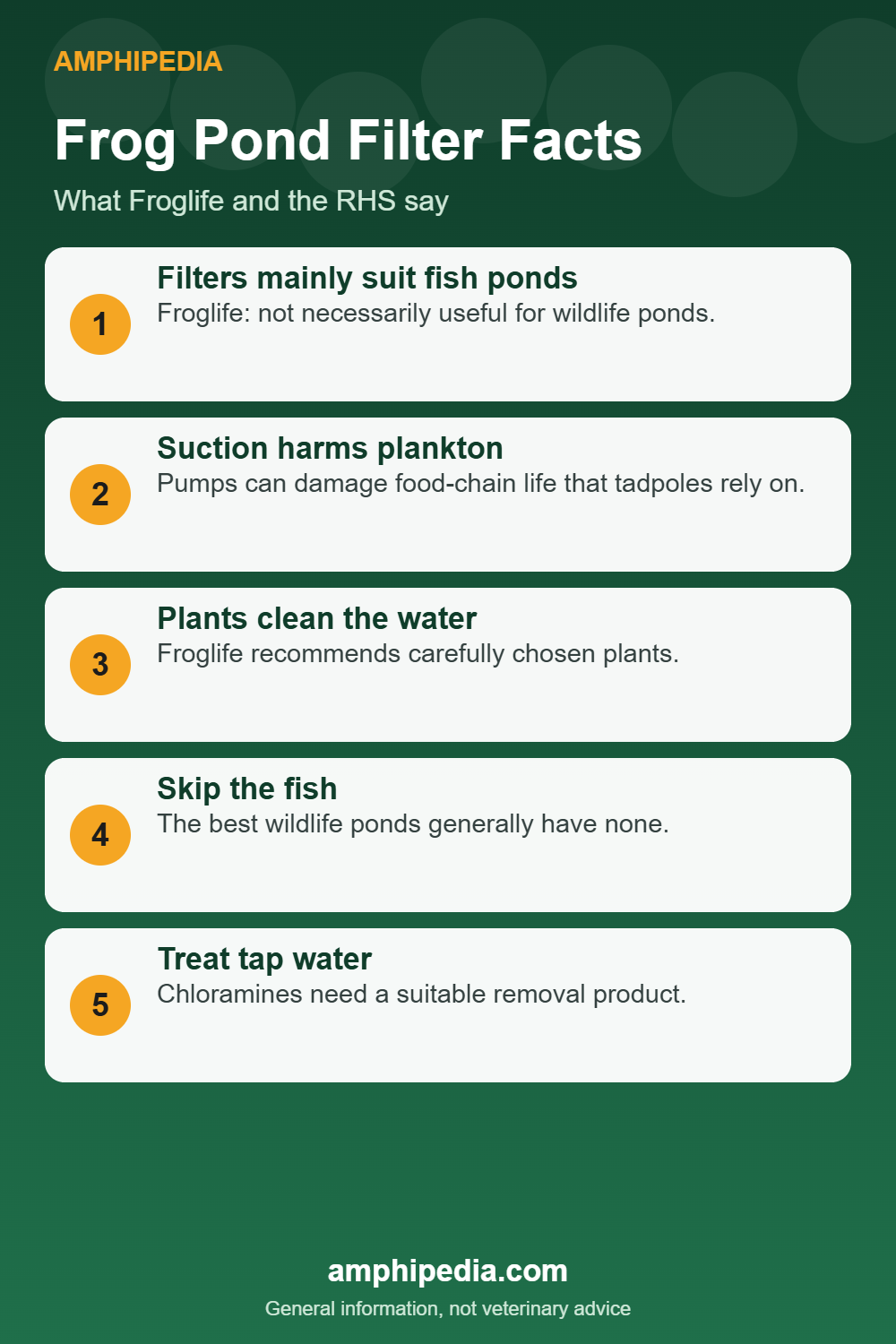
Many frog ponds do not need a mechanical filter. Froglife says filters and pumps mainly help ponds with ornamental fish, and that their suction can harm plankton that feed animals higher in the food chain. It recommends carefully chosen plants to keep water clean. If you add a filter, keep it gentle, fish-free and chemical-free.
An eco-safe pond filter sounds ideal for frogs, but wildlife ponds work differently from fish ponds. A healthy frog pond runs on plants, shade and balance.
This guide explains when a filter helps, what the evidence says and how to judge one if you decide you want it.
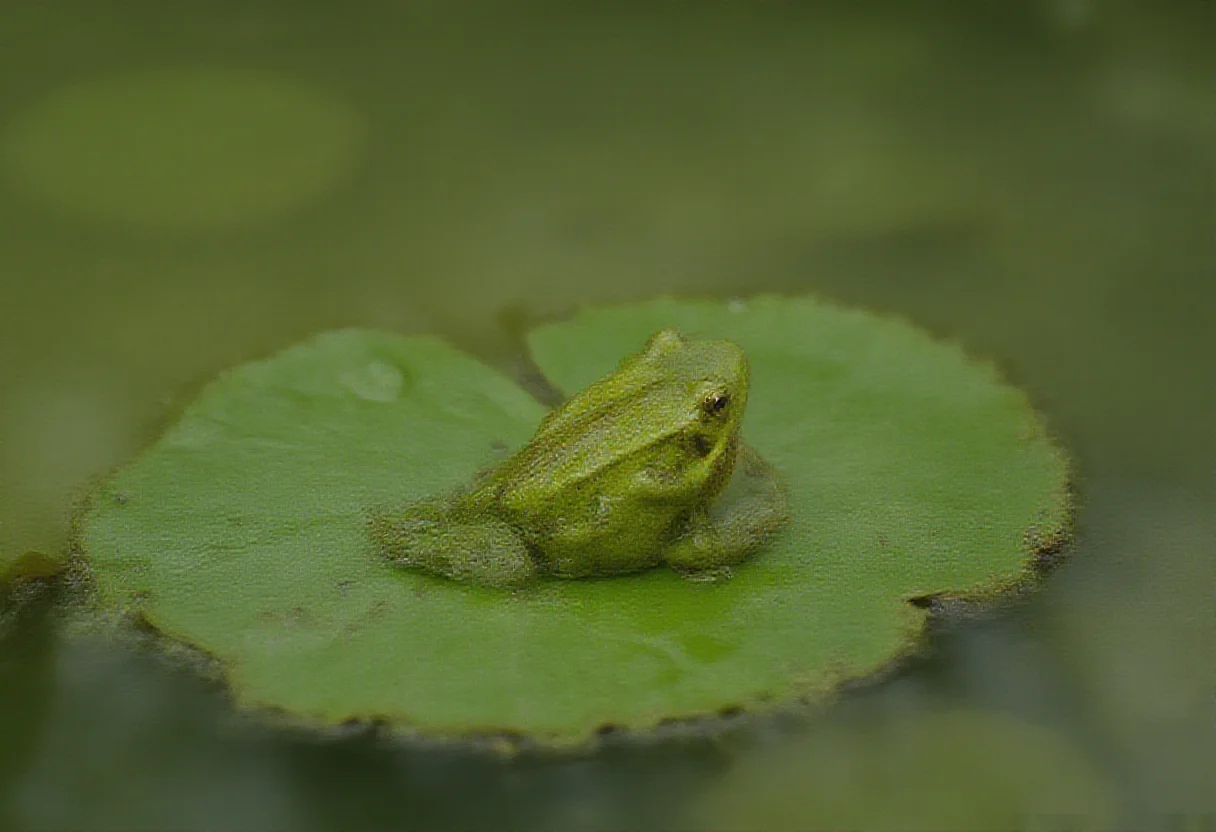
How this was made: prepared with AI assistance and checked against the sources listed at the end. Images are AI-generated illustrations, not photographs of real animals or products.
Key Takeaways
- Froglife says filters and pumps mainly help ponds with ornamental fish.
- Suction can harm plankton, which affects the food chain frogs depend on.
- Plants are the preferred way to keep wildlife pond water clean.
- The best wildlife ponds generally have no fish, so filter loads stay low.
- Treat tap water for chloramine and avoid chemicals in the pond.
Pin this infographicShare on Facebook
Pond filters to compare
These pond filters match the search terms. Many are designed for fish ponds, so size the unit to your pond volume and add an intake guard if the product allows it.


Product titles, prices and ratings are provided by Amazon and are accurate only at the time they are displayed.
Does a frog pond need a filter?
Often, no. Froglife says filters and pumps mainly help ponds with ornamental fish and are not necessarily useful for wildlife.
Fish create the waste that overwhelms small ponds. Froglife says the best wildlife ponds generally have no fish, because they can dominate the pond and their waste can clog the water.
Froglife says plants are the way to keep wildlife pond water clean. RHS notes that new or recently cleaned ponds can become overgrown with algae, so expect some green water at first.
What an eco-safe filter means
There is no official standard for the label eco safe. Treat it as a marketing term and check the details yourself.
Froglife warns that pump suction can harm phytoplankton and zooplankton, which feed animals higher in the food chain. A pump that moves a lot of water through a tight intake may therefore reduce the tiny life that tadpoles eat.
Whether any filter design avoids this is not covered in the sources used here, so evidence on frog-safe designs is thin.
Plants as the natural filter
Froglife recommends carefully chosen plants to keep water clean. Submerged plants, floating-leaved plants and marginals each play a role.
The Royal Horticultural Society suggests floating-leaved plants such as waterlilies for shade, which helps limit algae.
Keep fertilisers and compost out of the pond. The RHS notes they add nutrients that feed algae.
If you still want a filter
Froglife lists fish, filters and pumps among its “don’ts” for wildlife ponds. Some owners keep a few fish or run a water feature and still want mechanical help. In that case, use these checks.
- Choose a low-flow unit sized for your pond volume.
- Prefer a pre-filter or sponge guard on the intake so animals do not get drawn in. Check the product description.
- Make sure there is an easy way for frogs to climb out of the water, such as a sloping edge.
- Follow the manufacturer’s electrical safety instructions, and use a qualified electrician for outdoor power.
- Turn it off for maintenance and follow the manufacturer’s cleaning instructions.
Water quality basics
Merck says amphibian water must be free of toxins such as chlorine, ammonia and nitrite. Pond water is open to the garden, but the same logic applies to fills.
Froglife says tap water is fine if treated first. Chlorine dissipates over time, but chloramines must be removed with a suitable product. Add large amounts gradually, because sudden temperature changes can shock animals.
Avoid fertiliser runoff. Do not put salt, antifreeze or other chemicals on ice in winter.
Pond design that keeps water clear
Shape helps filtration too. Include a section at least 60 cm deep and a sloping edge, per Froglife. Shallow shelves hold plants and give tadpoles warm, food-rich water.
Net leaves out by hand in autumn instead of letting them rot. Froglife recommends daily removal if possible.
Common mistakes
These mistakes are easy to avoid.
- Adding fish and then needing a heavy filter.
- Using a strong pump with an open intake.
- Treating cloudy water in the first season with chemicals.
- Skipping plants because a filter exists.
- Using untreated tap water for large top-ups.
A note on the sources: UK guidance, local species
Froglife and the Royal Horticultural Society (RHS) are UK organizations, and their plant lists are native British species. The principles carry over to other countries: shallow edges, plant cover, no fish and clean water. The plants do not. Ask your state or national wildlife agency or a native plant society for a local list before you buy.
Where to put the pond and how big to make it
Froglife says to site a pond in full sun, especially in early spring, since frogs prefer warm, shallow water for spawn. Partial shade is acceptable. Keep it away from big trees, because autumn leaves clog it. Any size helps wildlife, but amphibians prefer ponds over 1 to 2 m across, and tub ponds such as old baths, half barrels or sunken paddling pools work in small spaces.
Froglife also recommends a section at least 60 cm deep, a sloping end so animals can get in and out, and curved edges for more microhabitats. Shallow shelves suit tadpoles and are often the most diverse part of the pond.
Plants that do the filtering work
Froglife lists plant groups, and each does something different:
- Marginal plants grow at the edge. Examples it lists include marsh-marigold, water forget-me-not, water mint and yellow flag iris.
- Submerged oxygenating plants include common water-crowfoot, curled pondweed, water-starwort, rigid hornwort and spiked water-milfoil.
- Floating-leaved plants include waterlilies and broad-leaved pondweed. Froglife warns that some waterlilies, yellow flag iris and bogbean can dominate, so use them only in large ponds.
Froglife also says to avoid non-native pond plants such as floating pennywort, parrot’s feather, New Zealand pygmyweed and water fern. Plant in baskets with aquatic compost and pebbles, and make sure the soil has no pesticides or fertilisers. Plant densely at one end to give tadpoles cover. Because the plants take up nutrients and shade the water, they do much of the work a filter would do.
Clearing algae without a filter
Froglife says blanketweed and duckweed signal excess nutrients. Its steps are simple.
- In spring, skim duckweed with a net.
- Twist a cane through blanketweed to pull it out.
- Leave the removed weed beside the pond for a day or two so trapped animals can return, then compost it. (RHS says 48 hours.)
- For an algal cloud, Froglife notes that water fleas (Daphnia) can clear phytoplankton within days, and that barley straw or barley straw extract is an option.
- If problems continue, clean the pond out the following autumn.
RHS adds that floating-leaved plants such as waterlilies provide shade that helps reduce algae. It says barley straw pads are less effective than shade and rainwater, and that if you use them you should add them early in the season and replace them every 3 to 4 months.
Rainwater or treated tap water?
The two UK sources differ here. Froglife says tap water is fine if treated first, and suggests a water butt or roof drainage where possible. RHS tells gardeners to fill the pond with rainwater rather than tap water and to keep soil and compost out, because they contain fertilisers that feed algae. If you have a rain barrel, use it. If you must use tap water, treat it for chloramine and add it gradually.
Leaves, netting and winter ice
- Remove fallen leaves daily with a net if you can, or cut back nearby trees, per Froglife.
- Do not use pond netting. Froglife says grass snakes and hedgehogs can be caught in it, and RHS advises removing netting and storing it away from the pond edge.
- In winter, clear snow from the ice so light reaches the plants and they keep producing oxygen.
- To make a hole in ice, Froglife suggests a pan of hot water or a floating ball removed after the pond freezes. Never smash the ice, and never use salt or antifreeze.
Froglife adds that frog deaths from winterkill can be unavoidable in severe winters. A pond with a deep section gives the best chance.
A simple yearly maintenance calendar
- Spring: check for blanketweed and duckweed, and watch for spawn. Do not move spawn from other ponds, as RHS notes this can spread disease and invasive plants.
- Summer: cut back plants if needed and avoid heavy disturbance. Walk the lawn before mowing, because Froglife says mowers and strimmers injure many young frogs.
- Autumn: clear leaves. Froglife says autumn is the best time for clearance, when the fewest species are affected, and that a full clearance is needed every three years or so, or every five to ten years if leaves are removed regularly.
Child safety around ponds
Froglife advises never leaving young children unsupervised near water. It gives fencing at least 1.1 m high with vertical railings no more than 100 mm apart, and a small gap at ground level for wildlife. A rigid grille that supports a child’s weight can make the surface safe. Gently sloping sides help wildlife and let anyone who falls in climb out.
Frequently Asked Questions
Do frog ponds need filters?
Often not. Froglife says filters and pumps mainly help ponds with ornamental fish.
Can a pond filter harm frogs?
Froglife says suction can harm plankton in the food chain. Direct harm to frogs from specific designs is not covered in the sources used here.
How do I keep a frog pond clear without a filter?
Use carefully chosen plants, keep fertilisers out and remove leaves by hand.
Is tap water safe for a pond?
Froglife says yes if treated first. Chloramines need a suitable removal product.
Should I keep fish in a frog pond?
Froglife says the best wildlife ponds generally have no fish.
Why is my new pond green?
Water often clouds while plants establish. Patience and plants are the usual cure; avoid chemical treatments.
Bottom Line
The greenest filter for a frog pond is a well-planted, fish-free pond with good depth and shade.
If you do add a pump or filter, keep it gentle and treat the claim eco safe with caution.
Sources
- Froglife: Just Add Water (7th edition), accessed 12 November 2026
- Royal Horticultural Society: Ponds in March, accessed 12 November 2026
- Merck Veterinary Manual: Environment and Husbandry for Amphibians, accessed 12 November 2026
- CDC MMWR: Reptile-Associated Salmonellosis, Selected States, 1998-2002, accessed 12 November 2026
4 Comments