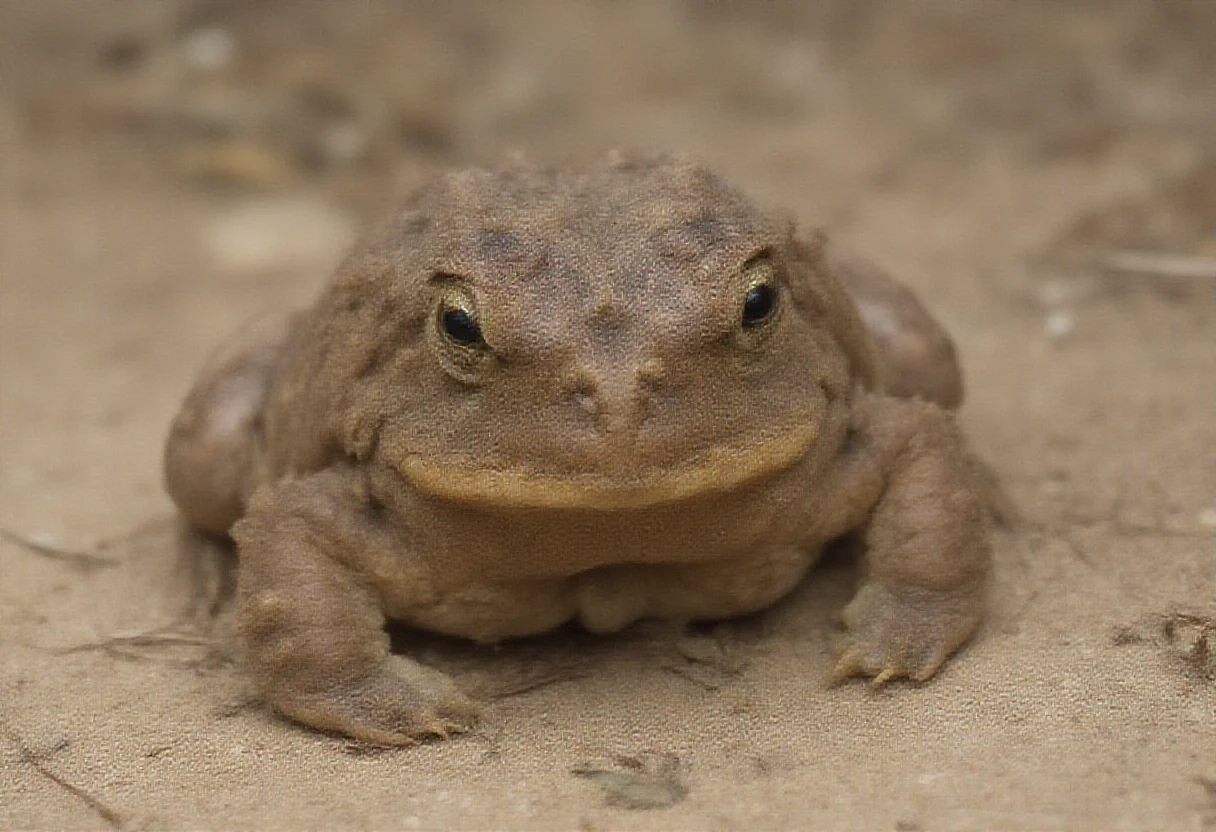
Southern Toad vs American Toad: How to Tell Them Apart
The easiest way to tell a southern toad (Anaxyrus terrestris) from an American toad (Anaxyrus americanus) is the head. Southern toads have prominent crests that end in knobs behind the eyes. Their calls are shorter and higher, and they live mostly on the southeastern coastal plain. American toads range much farther north and west. Where ranges overlap, the two can look alike and may hybridise.
Both toads are brown, warty and common in backyards. That makes them easy to mix up, especially in Virginia and the Carolinas, where their ranges meet.
This guide compares them feature by feature, using state wildlife agencies and the Animal Diversity Web, and explains which clues are reliable.
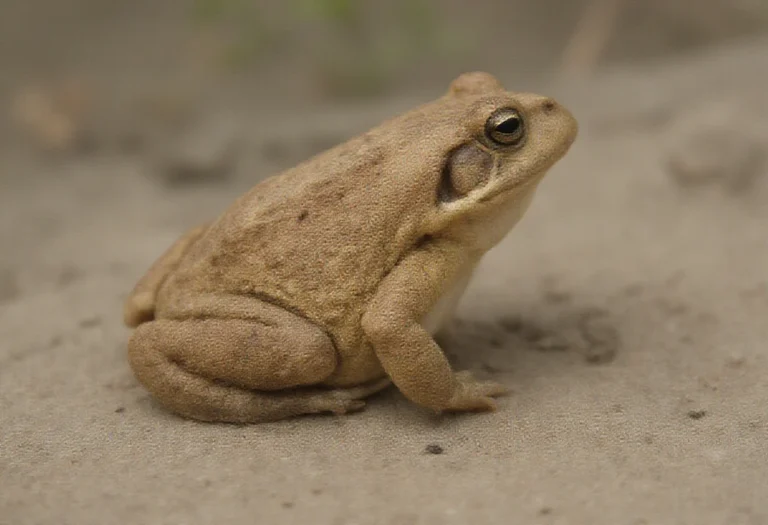
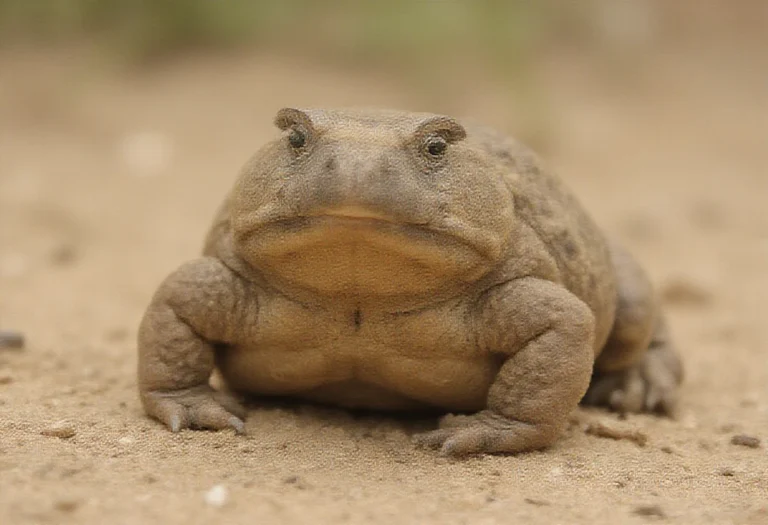
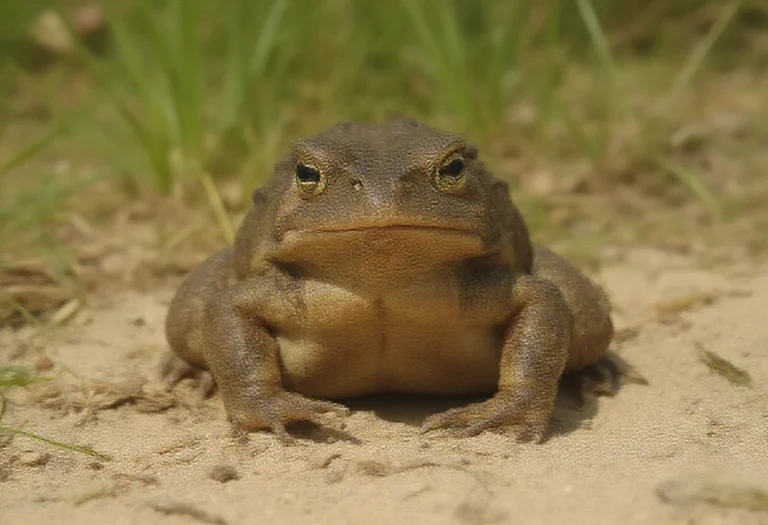
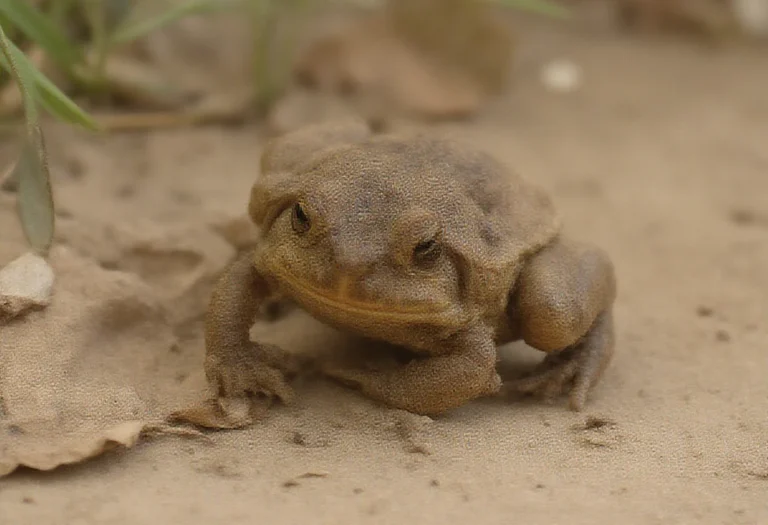
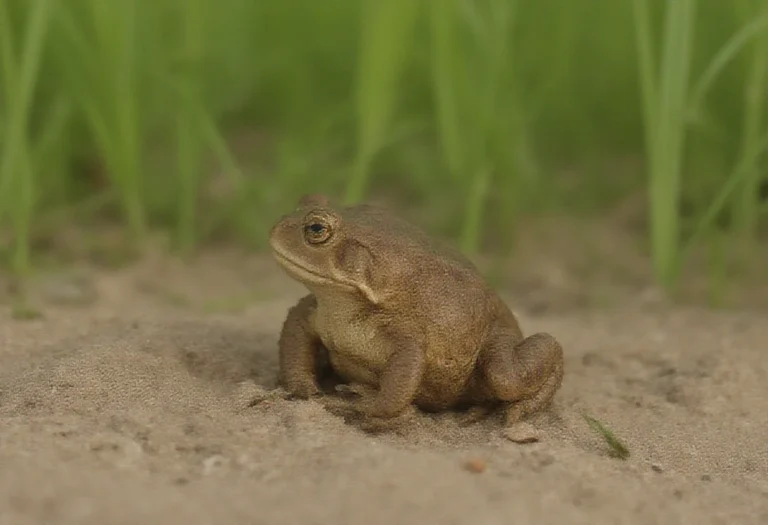
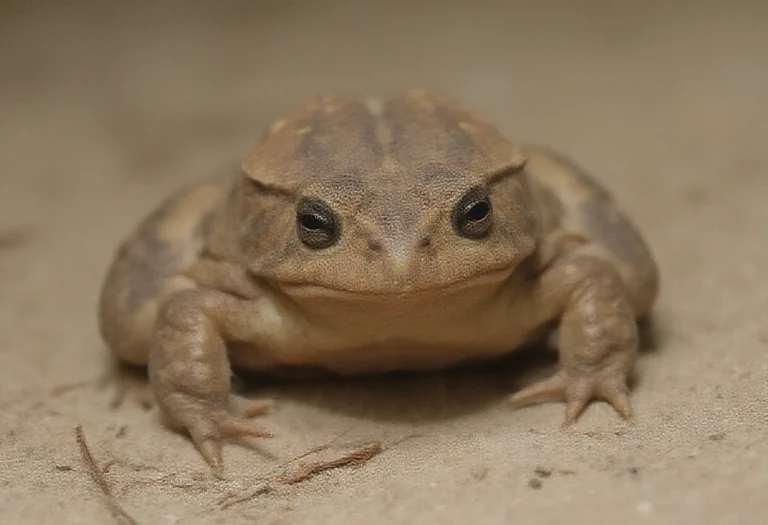
How this was made: prepared with AI assistance and checked against the sources listed at the end. Images are AI-generated illustrations, not photographs of real animals or products.
Key Takeaways
- Prominent knobs on the head crests point to a southern toad.
- Warts per dark spot is a weak clue, because sources disagree about southern toads.
- Southern toads trill for about 2 to 8 seconds at a higher pitch; American toads trill for 4 to 20 seconds.
- American toads range far beyond the Southeast, while southern toads stay in the coastal plain.
- Where the ranges overlap, the two may hybridise, so no single clue is perfect.
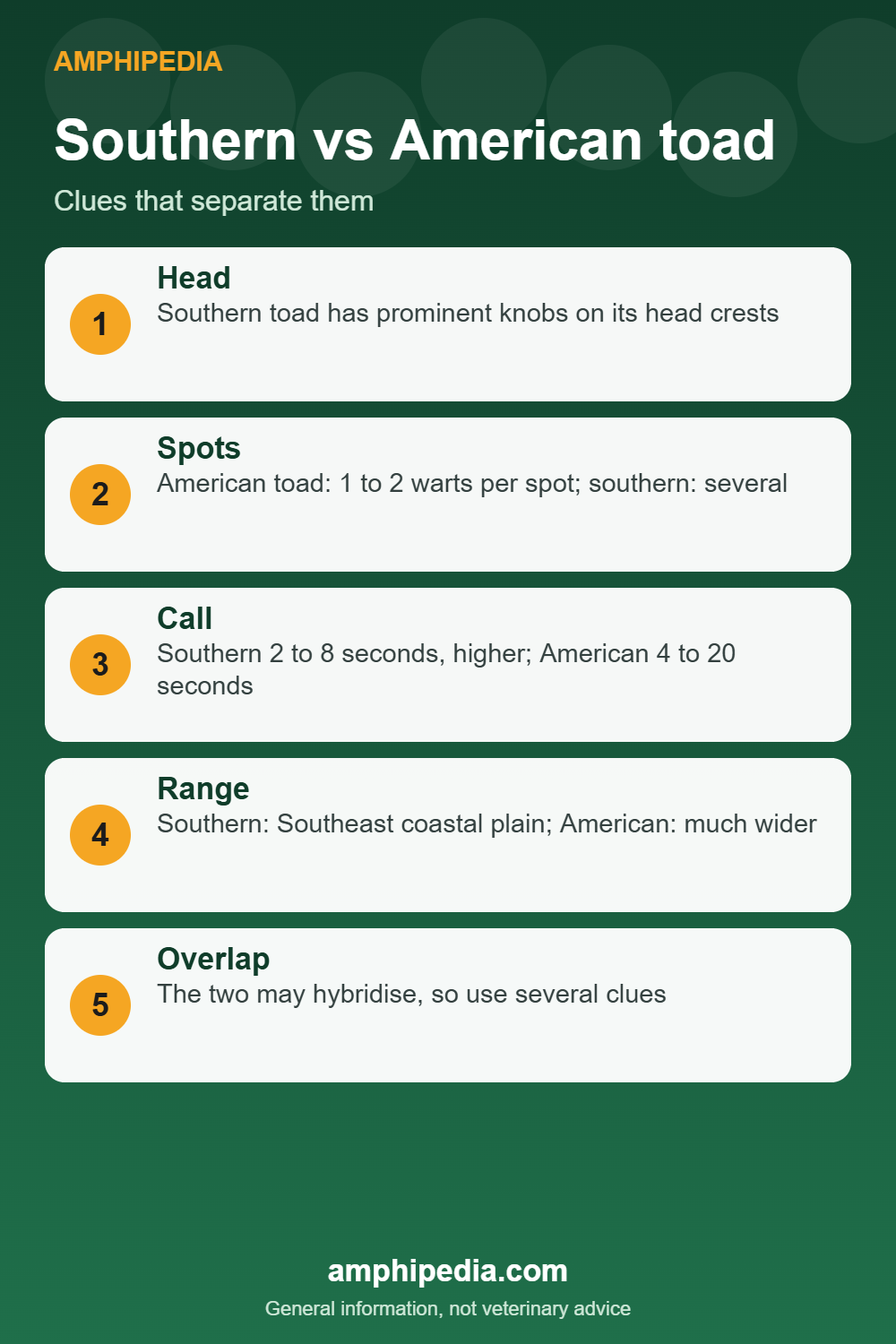
Pin this infographicShare on Facebook
Quick comparison
Use the table as a first pass. Individual toads vary in colour, so check several features.
| Feature | Southern toad | American toad |
|---|---|---|
| Head crests | High crests ending in prominent knobs | Some have a ridge on top of the head |
| Dark spots | Several warts in each spot per one state agency; UF says one or two | One or two warts in each spot |
| Call | Shrill trill, about 2 to 8 seconds, higher pitch | Long trill, about 4 to 20 seconds, lower pitch |
| Length | About 40 to 113 mm; typical 41 to 75 mm | 50 to 102 mm, average 75 mm |
| Range | Southeastern coastal plain | Northeast, Midwest and beyond |
| Breeding | February to October | March to July |
Head crests and knobs
The southern toad’s best clue is on its head. The North Carolina Wildlife Resources Commission calls the large knobs on the cranial crests its most distinctive feature. Animal Diversity Web says the knobs help separate it from the American and Fowler’s toads.
The Virginia Department of Wildlife Resources describes crests that run from the eye toward the parotoid glands and end in club-like knobs. Some American toads also have a head ridge, but it lacks these prominent knobs.
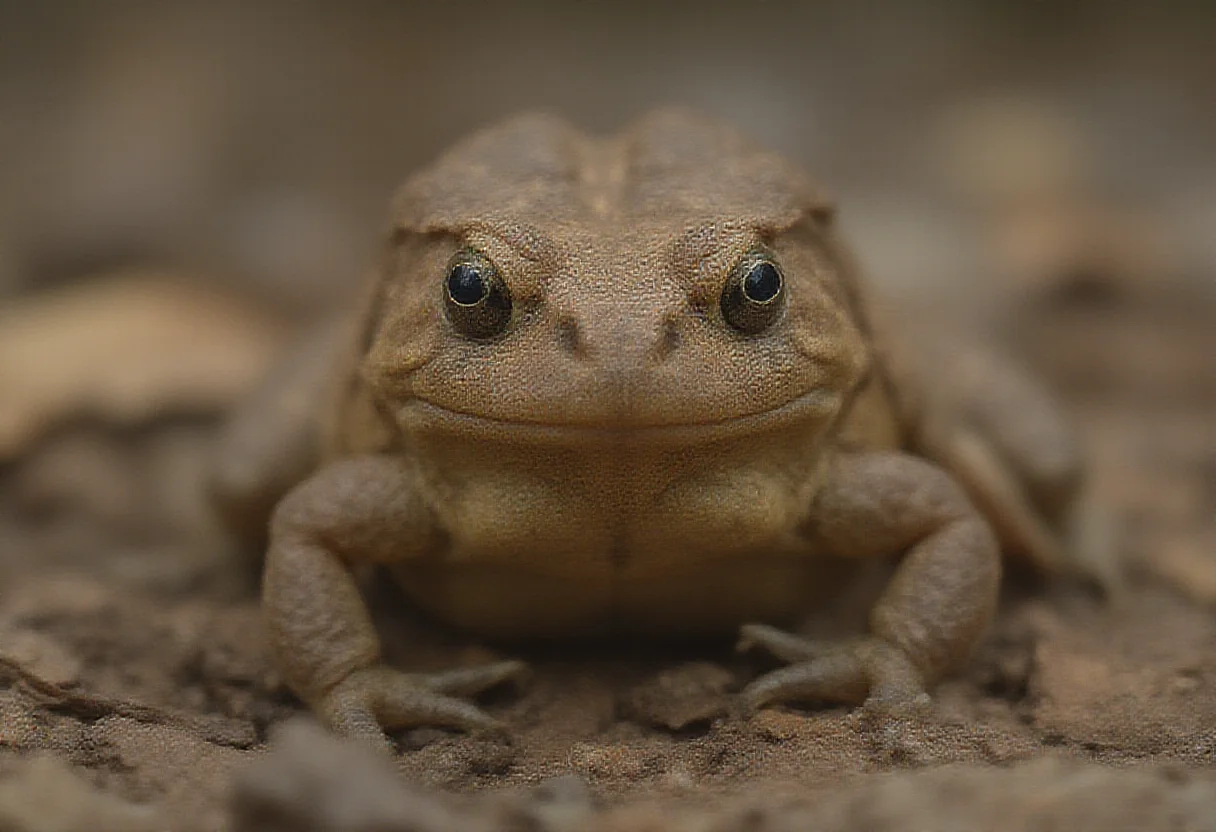
Spots, warts and colour
Both species are usually brown, but each can be tan, reddish, grey or nearly black. The back often has dark spots. In American toads, each spot has only one or two warts, according to Animal Diversity Web. The North Carolina agency says southern toad spots each hold several warts.
Some southern toads have a light stripe down the middle of the back, and breeding males have dark throats. These traits help, but they are not decisive on their own.
How the calls differ
Calls are the clearest field clue. The SREL herpetology site describes the southern toad’s call as a shrill trill lasting 2 to 8 seconds, higher in pitch than the American toad’s.
Animal Diversity Web says the American toad’s trill can last 4 to 20 seconds and becomes loud and constant in the breeding season. North Carolina notes that the southern toad’s call is usually shorter and slightly higher.
Where do they live?
Southern toads occupy the Southeast below the Fall Line. SREL describes a range from southeastern Virginia south through Florida and west to eastern Louisiana, with an isolated population in northwestern South Carolina.
American toads cover much more ground. Animal Diversity Web lists a range from northern Chihuahua to James Bay and from the Atlantic coast to the Pacific Northwest. They are generally absent from the most southern states.
Do they overlap and hybridise?
Yes, in parts of Virginia and the Carolinas. Both the Virginia and North Carolina wildlife agencies say the two species may hybridise where their ranges overlap.
That is why no single feature should be treated as proof. In the lower coastal plain of North Carolina, the southern toad is often the only large toad present.
How big are they?
Sizes overlap. Animal Diversity Web gives the southern toad a total length of about 40 to 113 millimetres, while SREL says typical adults are 41 to 75 millimetres, with larger insular populations. The American toad averages 75 millimetres and ranges from 50 to 102.
For more detail, read southern toad size and how big southern toads get.
What about other lookalikes?
Other toads can also be confused with these two. Our guides compare the southern toad with Fowler’s toad and the cane toad.
To learn the basics of the species, see what is a southern toad.
Where the sources disagree
Field clues are only as good as the descriptions behind them. Wart counts, call length and size are described differently by different sources, so read these as ranges, not rules.
| Clue | Source A | Source B |
|---|---|---|
| Warts per dark spot, southern toad | Several (North Carolina agency) | One or two (UF/IFAS Wildlife) |
| Warts per dark spot, American toad | One or two (Animal Diversity Web) | Not compared |
| Southern toad trill | 2 to 8 seconds (SREL) | 4 to 8 seconds (Animal Diversity Web) |
| Southern toad size | Typical 41 to 75 mm (SREL) | Usually 1.5 to 3 inches, maximum about 4.5 inches (UF/IFAS) |
When two credible sources disagree, the safest step is to rely on features that do not conflict, such as head knobs, call, and location.
Habitat and daily habits
Animal Diversity Web places southern toads on sandy soils of the Atlantic and Gulf Coastal Plains, in pinewoods, scrub oak and mixed forest, and also in farm fields and backyards. Adults can have home ranges up to 1.6 square kilometers. They spend the day in self-made burrows, and in colder months dig a foot or more deep.
American toads live from forests to backyards, gardens and farm fields. By day they hide under boards, logs, stones or porches, and in cold regions they hibernate by digging into soil. Breeding needs a semi-permanent freshwater pool with dense vegetation nearby.
Both are mainly nocturnal. A toad seen on a warm night near a porch light tells you the habit, not the species.
Breeding and tadpoles side by side
| Feature | Southern toad | American toad |
|---|---|---|
| Eggs per clutch | 2,500 to 4,000, average about 2,750 | 4,000 to 8,000 in two rows |
| Egg size | 1 to 1.4 mm | About 1.5 mm |
| Hatching | 2 to 4 days | 3 to 12 days, by water temperature |
| Larval period | 30 to 55 days | 40 to 70 days |
| Maturity | 2 to 3 years | 2 to 3 years |
Animal Diversity Web describes southern toad tadpoles as solid black with a diagonal gold line behind the eye, and as unpalatable or toxic to predators. American toad females prefer fishless ponds for laying eggs, and parents give no care to eggs or tadpoles.
Growth, lifespan and subspecies
Animal Diversity Web says American toad tadpoles grow hind legs within the first 20 days and front legs at 30 to 40 days, when the gills disappear. Metamorphosis usually occurs from June to August, and newly transformed toadlets measure 0.8 to 1.3 cm.
Wild American toads have an average lifespan under 1 year in that source, with a range of 0 to 10 years, because most tadpoles die before transforming. One captive toad lived 36 years. Captive southern toads have lived up to 10 years, and wild lifespan for that species is poorly documented.
The American toad has two subspecies: the eastern American toad in the eastern part of the range, and the dwarf American toad mainly in the west. That is one more reason size and color vary.
Diet, predators and defenses
Adult American toads eat insects, snails, slugs, beetles and earthworms, and one toad can eat up to 1,000 insects a day. Adult southern toads eat spiders, beetles, ants and other insects. Both catch prey with a sticky tongue.
Snakes are the main predators of American toads, and eastern hognose snakes specialize in eating them. Garter snakes are immune to the toxins. The toads secrete a toxic milky fluid from skin glands, inflate their bodies to deter swallowing, and may urinate when grabbed.
Hybrids and why calls can mislead
Animal Diversity Web says the southern toad can hybridize with both Fowler’s toads and American toads, and that hybrid calls mix elements of both species. A call that sounds in between may come from a hybrid, not from a toad of uncertain identity.
The Virginia and North Carolina agencies also note possible hybridization where ranges meet. In those zones, record the date, place and call, and do not force an answer.
Using recordings to check a call
Words like trill, hum and whistle are subjective. UF/IFAS Wildlife describes the southern toad call as a combination of a hum and a whistle, while SREL calls it a shrill trill. Both are describing the same animal in different terms.
UF/IFAS points readers to the USGS Frog Call Lookup for audio. Play a recording, then compare it with what you hear outdoors, and note the date and place. If you cannot match the call, say so instead of picking the closest guess.
A step-by-step identification method
- Start with location. Southern toads stay on the southeastern coastal plain; American toads range far beyond it.
- Listen for the call on a warm night. Compare length and pitch, remembering that ranges overlap.
- Look at the head crests. Large knobs behind the eyes point to a southern toad.
- Check size, but allow for overlap. Sizes differ by sex and by population.
- Photograph the toad from above and from the side, without handling it.
- Do not try to identify very small toads. UF/IFAS says it is nearly impossible to tell toad species apart at that size.
If you need to move a toad out of danger, wash your hands afterward. The CDC says children younger than 5 years old should not handle or touch reptiles or amphibians or their environments.
Common mistakes when telling these toads apart
- Using a single clue. Wart counts, color and size all overlap.
- Ignoring range. Location rules out many possibilities before any feature is checked.
- Treating an in-between call as a mistake. It could be a hybrid.
- Identifying toadlets by sight. They look much alike.
- Assuming a large toad in Florida is a southern toad. UF/IFAS says southern toads usually reach 1.5 to 3 inches.
Frequently Asked Questions
What is the main difference between a southern toad and an American toad?
The southern toad has prominent knobs on its head crests, while the American toad lacks them.
Which toad has the longer call?
The American toad. Its trill can last 4 to 20 seconds, versus about 2 to 8 seconds for the southern toad.
Which toad is bigger?
They overlap. The American toad averages 75 mm. Southern toads are typically 41 to 75 mm, and Animal Diversity Web gives a maximum of 113 mm.
Can they interbreed?
Wildlife agencies in Virginia and North Carolina say they may hybridise where ranges overlap.
Where can I find a southern toad?
On the southeastern coastal plain, from southeastern Virginia through Florida to eastern Louisiana.
Are both toads poisonous?
Toads have defensive skin secretions. See our guide on southern toads and humans, and wash your hands after contact.
Bottom Line
Use several clues together: head knobs, spots, call, range and size. Where the ranges overlap, even experts may need to check the call or location.
See the sources below for the original descriptions.
Sources
- Animal Diversity Web: Anaxyrus terrestris, cited for southern toad size, crests, call and range
- Animal Diversity Web: Anaxyrus americanus, cited for American toad size, spots, call and range
- SREL Herpetology: Southern toad, cited for size, call and range
- North Carolina Wildlife Resources Commission: Southern toad, cited for knobs, spots and comparison with the American toad
- Virginia Department of Wildlife Resources: Southern toad, cited for crests, calls and hybridisation
- CDC: Reptiles and amphibians, cited for handwashing advice
- UF/IFAS Wildlife: Southern toad, accessed 13 November 2026
3 Comments