Best UVB Bulb for Dart Frogs: Do They Need One?
This post contains affiliate links. As an Amazon Associate I earn from qualifying purchases. Prices and availability are shown by Amazon and can change.
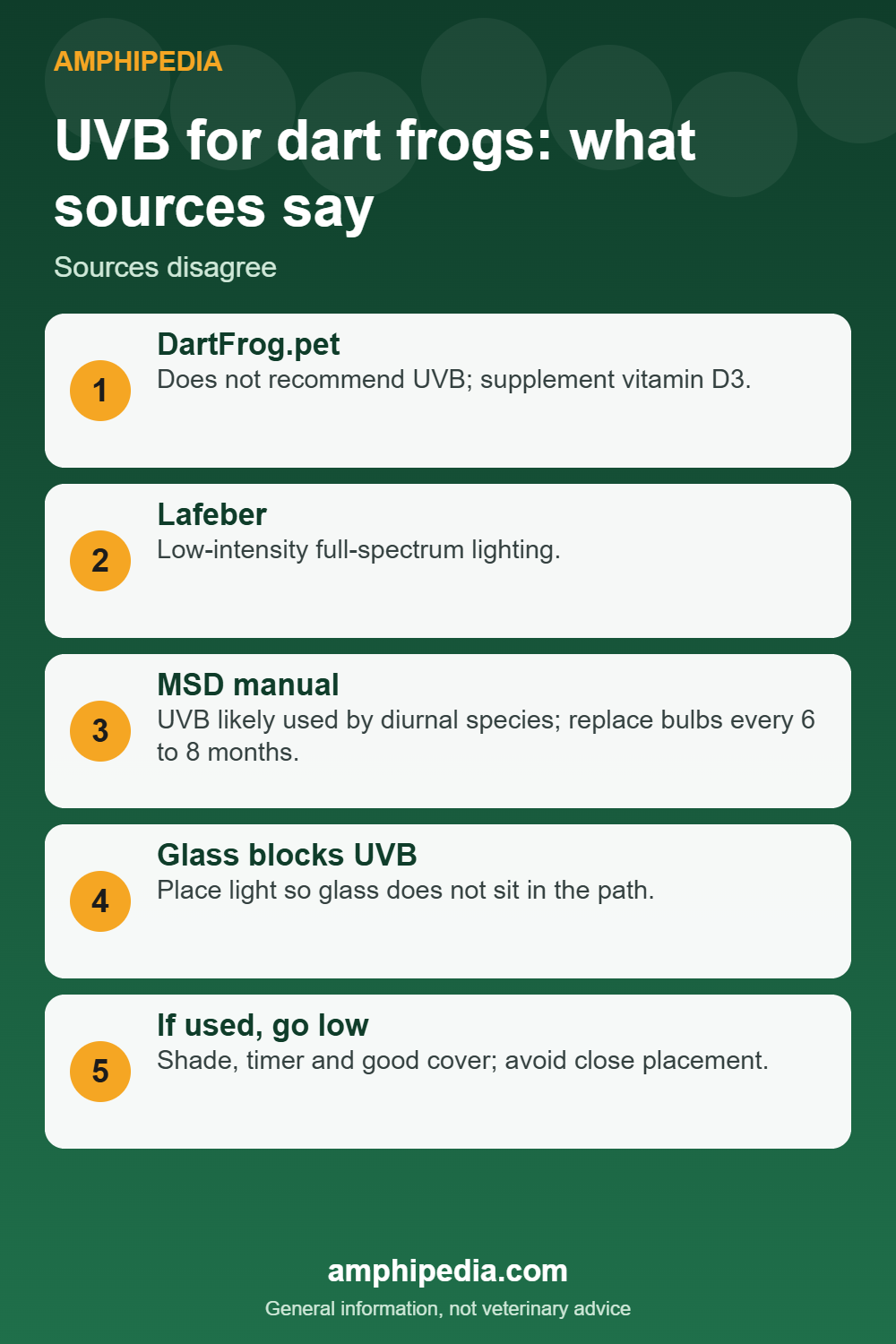
Sources disagree on UVB for dart frogs. DartFrog.pet does not recommend it, citing burn risk and a study showing dart frogs prefer low-UVB areas. Lafeber advises low-intensity full-spectrum lighting for calcium absorption. The MSD Veterinary Manual says UVB is likely used by diurnal species and bulbs should be replaced every 6 to 8 months. If you add UVB, keep it low, shaded and measured.
Dart frogs live on the forest floor, where canopy blocks much sunlight. That makes UVB a debated topic. Reptile bulbs are strong, and a bulb that is too close can harm an animal.
This guide sets out what the sources say, where they disagree, and what to check if you choose to add UVB. It does not recommend a bulb. For general options, see our UVB light guide.
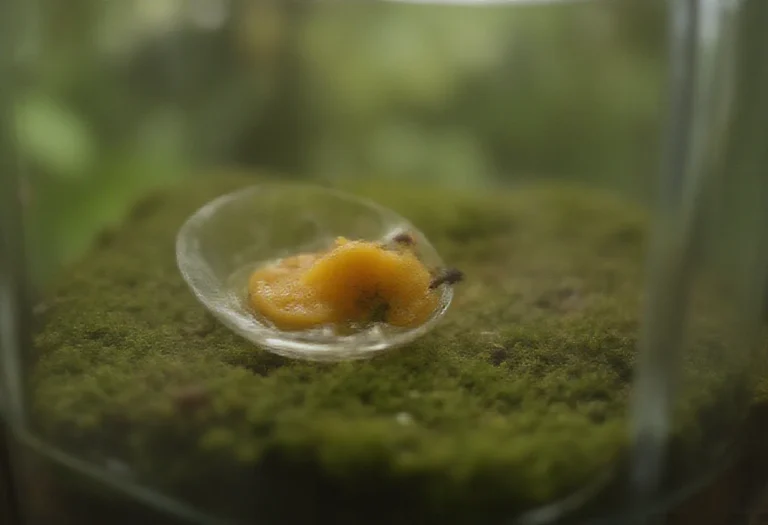
How this was made: prepared with AI assistance and checked against the sources listed at the end. Images are AI-generated illustrations, not photographs of real animals or products.
Key Takeaways
- Sources disagree: DartFrog.pet does not recommend UVB; Lafeber advises low-intensity full-spectrum lighting.
- The MSD Veterinary Manual says UVB is likely used by diurnal species, though benefits are not well understood.
- A study found UVB raised serum vitamin D3 in oriental fire-bellied toads (Michaels et al., 2015).
- Glass blocks UVB, so placement matters.
- Replace bulbs every 6 to 8 months or as directed, and measure output if possible.
Pin this infographicShare on Facebook
Low-output UVB lights to compare
These listings are UVB lights sold for terrariums. Sources disagree on UVB for dart frogs, so choose low output, provide shade and check the maker’s distance guidance.
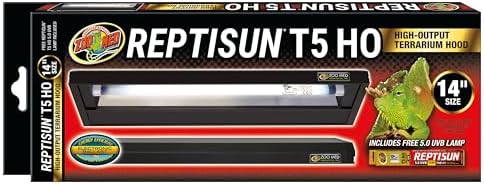


Product titles, prices and ratings are provided by Amazon and are accurate only at the time they are displayed.
What the sources say
There is no single rule. Read the table, then discuss your set-up with an exotics vet.
| Source | Position on UVB | Notes |
|---|---|---|
| DartFrog.pet | Does not recommend UVB for dart frogs | Cites burn risk; says to supplement vitamin D3 in the diet; notes a study in which wild Dendrobates preferred low-UVB areas |
| Lafeber Veterinary | Low-intensity full-spectrum lighting | For dietary calcium absorption; UVB not specifically mentioned |
| MSD Veterinary Manual (pet owner) | UVB required to prevent metabolic bone disease | Not all full-spectrum bulbs give enough UVB |
| MSD Veterinary Manual (professional) | UVB likely used by diurnal species | Benefits not well understood; replace bulbs every 6 to 8 months |

Why they disagree
Dart frogs are small, humid-forest animals, and little UVB research exists on them. A study of oriental fire-bellied toads found toads given UVB had significantly higher serum vitamin D3, even with dietary vitamin D3 (Michaels et al., 2015). That species is not a dart frog.
Lafeber’s UVB overview is mostly about reptiles and gives no dart frog guidance. It cites the Michaels paper as its amphibian example, so dart frog evidence is thin.
If you add UVB, keep it low
Reptile-strength bulbs are designed for basking animals. Lafeber’s UVB overview warns that a bulb 6 inches from an animal can deliver more UVB than a sunny beach. Dart frogs do not bask in the open.
Use a low-output tube or bulb, mount it above a shaded area and provide dense cover so frogs can retreat. Treat any advice that gives no output measurement with caution.
Glass, heat and humidity
The MSD Veterinary Manual says glass attenuates UVB, so light must be placed to avoid it. DartFrog.pet notes that keepers must remove a section of glass if they use UVB, which can lower humidity.
The manual also advises fluorescent or LED bulbs, which limit heat, and keeping lighting within 18 inches of the animals. Radiant heat dries amphibian tanks (Lafeber).
What to check before buying
Listings often target reptiles. Check these details before you buy.
- The product is low output, such as a low-percentage tube; avoid 10.0-type bulbs.
- The fixture suits the length and height of your tank.
- It has a timer-compatible plug or controller.
- The maker states the UVB output at a set distance.
- No mercury vapour or heat-lamp bulbs.
- A mesh guard or outside mounting keeps the bulb away from animals.
- The replacement schedule is clear, matching 6 to 8 months.
Set-up and timing
Use a timer to mimic natural photoperiods, as the MSD Veterinary Manual recommends.
- Decide on a shaded zone and a no-UVB zone.
- Mount the bulb outside the tank, above mesh, not behind glass.
- Keep it on a timer for a limited period.
- Watch the frogs: if they hide all day, reduce exposure.
- Replace the bulb every 6 to 8 months or as directed.
Measuring output
Lafeber’s UVB overview says output should be measured with a radiometer or photometer, because bulbs that look similar can differ greatly in UVB output. It prefers dosing in microwatts per square centimetre over bulb wattage.
Its figures are for reptiles, not dart frogs, and no dart frog target is given. If you use a meter, ask a vet what level is suitable for your species before you set a distance.
Common mistakes
UVB mistakes are usually about strength and distance.
- Using a reptile basking bulb with no shade.
- Placing the bulb too close.
- Mounting it behind glass and assuming it works.
- Leaving it on all day.
- Never replacing the bulb.
- Skipping dietary vitamin D3 advice from a vet.
What the dart frog UV-B avoidance study found
The DartFrog.pet page cites a study by Han, Kats, Pommerening, Ferrer, Murry-Ewers and Blaustein titled “Behavioral Avoidance of Ultraviolet-B Radiation by Two Species of Neotropical Poison-Dart Frogs”. It studied two diurnal Costa Rican species, Dendrobates pumilio and D. auratus.
In field enclosures split in half by two filters, one blocking UV-B and one transmitting it, both species spent significantly more time under the blocking filter. The filters did not significantly change substrate or air temperatures. Calling D. pumilio were also found at sites with significantly lower ambient UV-B than random rainforest locations.
This shows what these two species chose in the field and in enclosures. It does not show that captive frogs are harmed without UVB, and it does not cover other dart frog species.
What the fire-bellied toad study does and does not show
Michaels, Antwis and Preziosi (2015, Journal of Animal Physiology and Animal Nutrition 99(2): 391-403) raised captive oriental fire-bellied toads (Bombina orientalis) on crickets gut-loaded to 5 or 10 percent calcium, with or without UVB. Toads given UVB had significantly higher serum vitamin D3, even when their diet included vitamin D3. UVB and the 10 percent calcium diet also improved skeletal structure.
The authors conclude that standard calcium and vitamin D3 supplements may not fully replace UVB, and they support providing UVB to captive basking amphibians. Dart frogs do not bask in the open, so this recommendation does not transfer directly. DartFrog.pet takes the opposite view and favours dietary D3. The disagreement is real and not settled by either source.
Lafeber’s overview explains the biology behind the debate. UVB converts 7-dehydrocholesterol in the skin to pre-vitamin D3, which becomes vitamin D3. The liver and then the kidneys convert it to its active form. Whether dart frogs rely on this skin route, or can meet their needs from the diet alone, is the unsettled question.
The humidity cost of adding UVB
UVB hardware changes the tank climate, which matters for animals that need damp air. Sources give slightly different humidity targets for dart frogs.
- DartFrog.pet: most dart frogs at about 80 to 95 percent humidity, ideally with a gradient.
- Lafeber’s poison dart frog sheet: 80 to 100 percent relative humidity, with a daytime temperature gradient of 72 to 80 F (22 to 27 C).
- Both warn about drying: DartFrog.pet says removing glass for UVB lowers humidity, and the fixture’s heat lowers it further. Lafeber says to avoid radiant heat sources because they dry amphibian environments.
The MSD Veterinary Manual adds that enclosures need 1 to 2 fresh air changes per hour, so ventilation is part of the balance, not something to seal off.
Risks beyond burns
Lafeber’s UVB overview is written for reptiles, not dart frogs, but its warnings show why caution makes sense. It lists photokeratitis, cataracts and other eye disease among reported risks of excess UVB, and notes that mercury vapour bulbs produce significant heat and can cause burns.
It also says glass or plexiglass can block or diffract UVB, so it recommends a mesh top with the bulb outside the enclosure. Its exposure figures are for reptiles and should not be copied for frogs.
Questions to ask your vet before you decide
The sources split into three camps: UVB required (MSD pet owner version), UVB likely used by diurnal species with poorly understood benefits (MSD professional version), and no UVB with dietary D3 (DartFrog.pet). Because even one publisher gives two positions, a vet who sees your frogs is the best tie-breaker.
- Is my species likely to use UVB, or does it avoid it?
- Is my current vitamin D3 and calcium routine enough, given the fire-bellied toad findings?
- If I add UVB, how far from the frogs should the bulb be, and for how long each day?
- Can I measure output with a radiometer, and what reading would you accept?
- What signs of too much light should I watch for, such as hiding all day?
Frequently Asked Questions
Do dart frogs need UVB?
Sources disagree. DartFrog.pet does not recommend it; the MSD Veterinary Manual says diurnal species likely use it.
What does Lafeber recommend?
Low-intensity full-spectrum lighting to help dietary calcium absorption.
Can I use a reptile bulb?
Only if the output is low and you provide shade. Lafeber warns that close bulbs can deliver very high UVB.
Does glass block UVB?
Yes. The MSD Veterinary Manual says glass attenuates UVB.
How often should I replace a bulb?
Every 6 to 8 months or as the maker directs (MSD).
Is UVB proven for amphibians?
A study of fire-bellied toads linked UVB to higher vitamin D3 (Michaels et al., 2015). Dart frog evidence is thin.
Bottom Line
UVB for dart frogs is a judgement call. If you choose it, keep it low, shaded and on a timer, and replace the bulb on schedule.
For advice on your frogs, contact an exotics vet. The ARAV directory can help you find one.
Sources
- DartFrog.pet: Dart Frog information library, accessed 12 November 2026. Used for: UVB position, vitamin D3, humidity, citation of the wild Dendrobates UV-B study.
- Avoidance of ultraviolet radiation (UV-B) by two species of diurnal poison-dart frogs, SICB abstract, accessed 12 November 2026. Used for: methods and findings of the Han and colleagues study.
- Lafeber Veterinary: Basic Information Sheet, Poison Dart Frog, accessed 12 November 2026. Used for: full-spectrum lighting, radiant heat, temperature, humidity.
- Lafeber Veterinary: Sunburned! An Evidence-Based Update on UVB Lighting, accessed 12 November 2026. Used for: UVB distance, measurement, risks, glass.
- MSD Veterinary Manual: Housing for Amphibians (pet owner version), accessed 12 November 2026. Used for: UVB and metabolic bone disease, full-spectrum bulbs, bulb replacement.
- MSD Veterinary Manual: Environment and Husbandry for Amphibians, accessed 12 November 2026. Used for: glass, distance, timers, ventilation, bulb replacement.
- Michaels, Antwis and Preziosi (2015), Impacts of UVB provision and dietary calcium content on serum vitamin D3, growth rates, skeletal structure and coloration in captive oriental fire-bellied toads (Bombina orientalis), Journal of Animal Physiology and Animal Nutrition 99(2): 391-403 (Salford repository), accessed 12 November 2026. Used for: abstract and findings.
- CDC: Reptiles and Amphibians. Used for: Salmonella and hygiene.

5 Comments