Best Acrylic Terrarium for Dart Frogs: What to Check
This post contains affiliate links. As an Amazon Associate I earn from qualifying purchases. Prices and availability are shown by Amazon and can change.
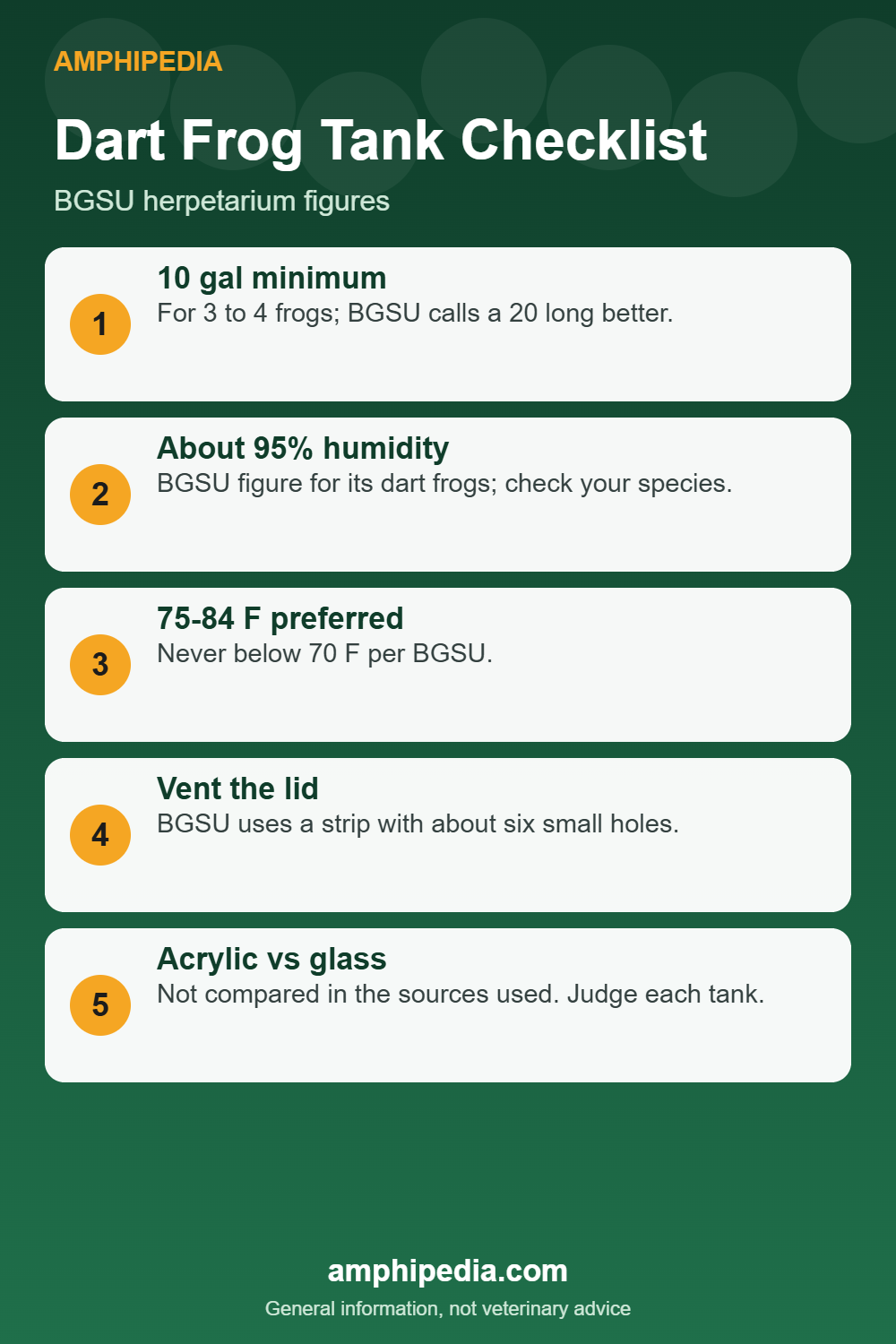
A good dart frog terrarium is big enough, holds high humidity and still lets some air in. The BGSU herpetarium uses a 10 to 20 gallon glass aquarium with a hinged lid, 95 percent humidity and 75 to 84 F. Sources used here do not compare acrylic with glass, so judge any acrylic tank on size, vents, seals, access and ease of cleaning.
Dart frogs are small, but they need a humid, planted home. Many keepers look at acrylic tanks because they are light and clear.
This guide sets out what a dart frog enclosure must do and how to judge an acrylic one, using university and veterinary sources rather than marketing claims.
How this was made: prepared with AI assistance and checked against the sources listed at the end. Images are AI-generated illustrations, not photographs of real animals or products.
Key Takeaways
- Dart frogs need high humidity; BGSU lists about 95 percent.
- BGSU lists 75 to 84 F as preferred and says never below 70 F.
- Size matters: BGSU gives a 10 gallon minimum for 3 to 4 frogs and calls a 20 long better.
- Leave controlled vents; do not seal the tank fully.
- Evidence comparing acrylic and glass is thin in the sources used here.
Pin this infographicShare on Facebook
Terrariums to compare
These enclosures match the search terms. Check the size, vents, door seal and material notes on each product page against your species needs.


Product titles, prices and ratings are provided by Amazon and are accurate only at the time they are displayed.
What the BGSU herpetarium uses
The Bowling Green State University herpetarium describes a 10 gallon aquarium as the minimum for 3 to 4 dart frogs, with a 20 long as better. The tank has a hinged glass lid.
A strip of plastic along the back of the lid has about six small holes. That allows air exchange while keeping humidity high.
Inside, it uses washed pea gravel under untreated sphagnum moss, a shallow pool in one corner, hiding places and potted plants.
Humidity and temperature targets
BGSU lists 95 percent humidity for its dart frogs. It lists a preferred range of 75 to 84 F and says room temperature is fine as long as it does not fall below 70 F.
Species differ. Merck says each amphibian has a preferred optimal temperature zone and recommends a gradient. Check your exact dart frog species before you buy.
Acrylic or glass?
The sources used here describe glass aquariums and do not compare acrylic with glass for dart frogs, so evidence is thin.
Instead of relying on material claims, judge the specific tank on practical points: how it vents, how it seals, how you open it and how it handles water.
Merck says glass attenuates (weakens) UVB. If you use a UVB light, check that the lid or panel does not block it, and read the product notes for the material.
Features to check
Read the product page closely for the points below.
- Usable footprint: BGSU gives 10 gallons as the minimum for 3 to 4 frogs.
- Ventilation: look for vent strips or mesh you can adjust.
- Door or access: front doors make feeding easier, but check the seal.
- Drainage: a drain or false bottom helps keep the soil from staying waterlogged.
- Seals and seams: water must stay in the tank, not on the floor.
- Cleaning: smooth interior with no tight corners.
- Cable holes: placed for lights and misters.
Set-up basics
Layer drainage under soil and moss. Merck says substrate must not contain chemical additives and that some amphibians react to the low pH of peat and sphagnum. Watch your frogs for skin irritation.
Add live plants for humidity and cover. Merck says plants help generate humidity and offer hiding and perching places.
Include a shallow water area. BGSU uses a pool in one corner.
Cleaning
Merck gives household bleach at 30 mL per liter of water for tools and housing, with 30 minutes of contact and a thorough rinse. UC Davis warns disinfectant residues can be highly harmful.
Product care sheets for acrylic may tell you to avoid certain cleaners that can cloud or crack the surface. Follow the maker advice and keep cleaners out of the tank.
Common mistakes
These choices cause most problems.
- Buying too small for a group.
- Sealing the tank to push humidity.
- Ignoring temperature while chasing humidity.
- Skipping drainage under the soil.
- Choosing by looks and not by access and seals.
Match the tank to the adult frog and its lifespan
A tank has to suit the adult frog, not the juvenile you bring home. The BGSU herpetarium care sheet lists adult sizes and lifespans for four common dart frogs. Those numbers help you decide how much floor space and how many years of upkeep you are signing up for.
| Species (BGSU) | Adult size | Lifespan |
|---|---|---|
| Dendrobates tinctorius (dyeing frog) | 2.5 in | 7-15+ years |
| Dendrobates azureus (blue) | 2+ in | 5-8 years |
| Dendrobates leucomelas (yellow and black) | 1.25 in | 7-15+ years |
| Dendrobates auratus (green and black) | 1.25 in | 7-15+ years |
The larger dyeing and blue frogs are the ones to plan extra room for. BGSU gives its 10 gallon minimum for 3 to 4 frogs, but it does not say which species. Treat that as a floor for the smaller species and check care notes for your own.
Think about lifespan before you pick a tank. A sealed, cleaned, planted terrarium is something you will maintain for a decade or more, so buy one you can reach into and repair.
Lighting inside a closed terrarium
BGSU lists full-spectrum lighting for the plants in its dart frog tanks. Plants are the reason most keepers add a light. Whether the frogs themselves need UVB is less clear.
Merck Veterinary Manual says diurnal amphibians likely use UVB for calcium metabolism and colour, though the benefits in amphibians are not well understood. It also says glass attenuates UVB, so lights should be positioned to avoid passing through glass.
- Put lights on a timer to match a natural day length.
- Choose fluorescent or LED bulbs to limit heat, as Merck suggests.
- Merck advises keeping lights within 18 inches of the animals.
- If you use a UVB bulb, replace it every 6 to 8 months or on the maker schedule.
- Check your thermometer after the light has run for an hour, since a closed tank can heat up fast.
No source reviewed compares how acrylic and glass pass UVB, so read the product notes and do not assume.
The first weeks: quarantine before the planted display
Merck calls quarantine a preventive practice that owners often overlook. A period of 6 to 8 weeks is typical, though the right length depends on the risk in your collection and where the animal came from.
A quarantine tank is a different job from a display tank. It should be plain and easy to clean.
- Merck says moist paper towel is adequate substrate for most species in quarantine.
- PVC tubing can give hides and perches for arboreal species.
- Use separate cleaning tools for new animals and your existing collection.
- Disinfect spray bottles and humidifiers weekly, as Merck advises for quarantine.
- Log appetite and behaviour so changes stand out.
Merck lists an entrance exam and tests such as fecal parasitology and PCR for chytridiomycosis among recommended checks. Ask an exotics vet which apply to your animals. The ARAV directory is a good starting point.
A daily and weekly routine that fits a planted tank
UC Davis Office of the Attending Veterinarian sets the standard for laboratory frogs. A home dart frog set-up is different, but the habits carry over. Its guidance asks staff to observe every animal daily for signs of illness, injury or abnormal behaviour, and to record minimum and maximum temperature and humidity each day.
- Daily: look at every frog, check the thermometer and hygrometer, and note anything odd.
- Daily: feed small items. BGSU uses flightless fruit flies and 1/8 inch crickets, dusted with a calcium and vitamin supplement.
- Weekly: wipe the glass, empty and refill the water pool, and remove dead plant matter.
- Every few weeks: check drainage and look for soggy patches in the substrate.
- As needed: spot-clean waste instead of tearing down the whole tank.
UC Davis also says direct drafts should be avoided, since moving air can dry amphibians out. Keep the tank away from vents, fans and open windows.
Handling and moving frogs
BGSU says captive-bred dart frogs are not poisonous but are very fragile and should not be handled. To move a frog, it describes chasing it into a small plastic container, closing the lid and letting it climb out at the new spot.
Plan your tank so you rarely need to do this. A side door that opens wide, a lid you can lift cleanly and a cleaning tool with a long handle all keep your hands out of the habitat.
Questions to ask before you buy any terrarium
Product pages often leave out what matters for amphibians. Look for the answers in the description, or message the seller before you order.
- What are the inside floor dimensions, not just the outside size?
- How large is the vented area, and can you close part of it?
- Does the lid or door seal, or does water leak at the seams?
- Is there a drain, a false bottom or space to add one?
- What cleaners does the maker say are safe for the material?
- Can you reach every corner with a hand or a long tool?
If a listing cannot answer these, treat that as information. A tank you cannot clean or ventilate will cause problems whatever it is made of.
Frequently Asked Questions
What size tank do dart frogs need?
BGSU gives a 10 gallon minimum for 3 to 4 frogs and calls a 20 long better.
What humidity do dart frogs need?
BGSU lists about 95 percent for its group. Check your species.
What temperature is right?
BGSU lists 75 to 84 F and says not below 70 F.
Is acrylic better than glass?
The sources used here do not compare them. Judge the individual tank.
Can the tank be sealed?
No. Merck advises fresh air exchange, and BGSU uses a lid with vent holes.
Where can I find a vet?
The ARAV directory lists exotics vets: arav.org/professionals.
Bottom Line
A good dart frog tank is about size, humidity, controlled air flow and easy cleaning, not just the material.
Check the details on the product page, and match the enclosure to your species.
Sources
- BGSU Herpetarium: Poison Dart Frogs, General Care (tank size, ventilation, humidity, temperature, feeding, handling), accessed 12 November 2026.
- Merck Veterinary Manual: Environment and Husbandry for Amphibians (moisture, ventilation, lighting, substrate, quarantine and cleaning), accessed 12 November 2026.
- UC Davis Office of the Attending Veterinarian: SC-35-100 Husbandry Care of Frogs (2025) (laboratory standards for frogs: daily observation and records, drafts, disinfectant residues), accessed 12 November 2026.
- CDC MMWR: Reptile-Associated Salmonellosis, Selected States, 1998-2002 (Salmonella risk from reptiles and amphibians), accessed 12 November 2026.