Best Battery Backup for Terrarium Heaters: Buying Guide
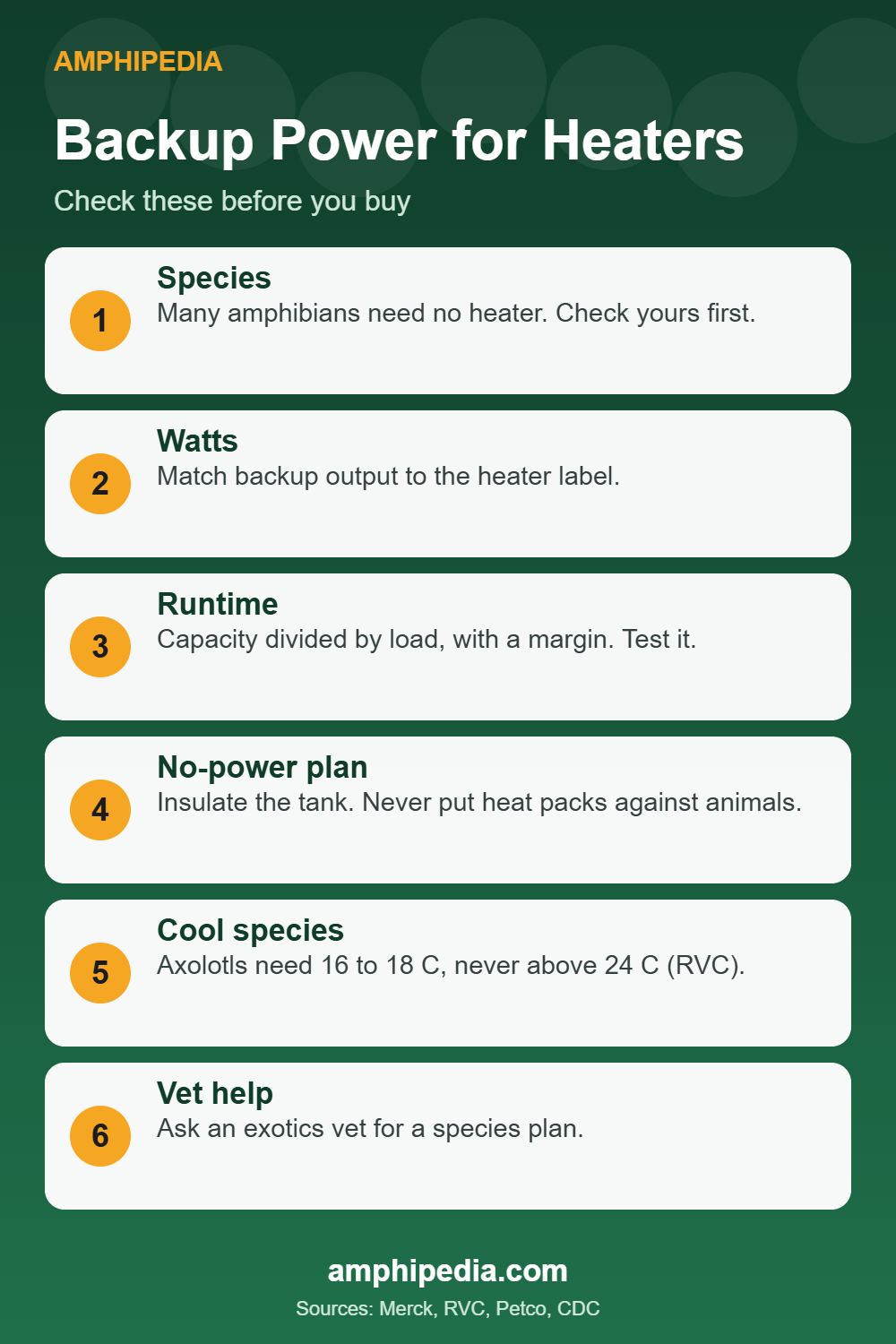
Before you buy a battery backup for a terrarium heater, check whether your amphibian needs heat at all. Many species prefer cool or moderate temperatures, and some, such as axolotls, are harmed by warmth. If you do use a heater, match the backup to the heater’s wattage on its label, plan for the runtime you need and never leave heating gear running unattended on an untested setup.
A power cut can drop a tank to room temperature within hours. For heat-sensitive or tropical species, that matters. For cool-water species, the real risk may be the opposite.
This guide explains how to decide whether you need backup power, what to check on the label and which options to compare.
How this was made: prepared with AI assistance and checked against the sources listed at the end. Images are AI-generated illustrations, not photographs of real animals or products.
Key Takeaways
- Many amphibians do not need a heater. Check your species before buying backup power.
- Match the backup unit to your heater’s wattage and the hours you need to cover.
- Short outages are often handled with insulation and a plan, not extra gear.
- Never place heat packs or hot bottles in direct contact with an animal.
- Evidence on amphibian outages is thin. Ask an exotics vet about your species.
Pin this infographicShare on Facebook
Does your amphibian need a heater at all
Temperature needs differ widely. The Merck Veterinary Manual says each amphibian species has a preferred optimal temperature zone, and that caudatans (salamanders and newts) generally prefer cooler temperatures than anurans (frogs and toads).
The Royal Veterinary College advises keeping axolotl water at 16 to 18 C and never above 24 C. For these animals, a backup heater makes no sense. A power cut that stops a chiller or fan would be the danger.
Tropical frogs differ. A care sheet for your species gives the safe range. Ask your vet if you are unsure.

What outages do to a tank
Amphibians cannot regulate body temperature on their own. A tank that drifts away from the right range stresses the animal, and prolonged extremes can harm it.
A Petco article on reptile outages notes that reptiles can usually handle a few hours, or even a day or two, of slightly poor temperatures without permanent harm. That article covers reptiles, not amphibians, so treat it only as a rough guide.
Humidity matters too. Heaters, misters and pumps may all stop in a power cut.
| Species type | Main outage risk | Backup focus |
|---|---|---|
| Cool-water salamanders and axolotls | Water warming, filter stopping | Cooling, air pump, shade |
| Temperate frogs and toads | Cold drop in winter | Insulation, small heat source |
| Tropical frogs | Chill and low humidity | Heat and humidity plan |
| Aquatic frogs | Cold water, filter stop | Air pump, heater backup |
Types of backup power
Several kinds of backup exist. Each has limits, so check what your heater really draws.
- Small UPS (uninterruptible power supply): made for electronics, usually rated for modest loads.
- Portable power station: a larger battery with outlets, which may run low-wattage gear for hours.
- Power inverter with a battery: converts battery power to household power. Follow safety rules and run vehicles outdoors.
- Generator: runs heating gear for long outages. Use only outdoors and follow the manual.
- Battery-powered air pump: keeps water moving in an aquatic tank when mains power fails.
How to size a backup
Look for the heater’s wattage on its label. Then check the backup unit’s rated output and capacity. Capacity is usually given in watt-hours.
A rough runtime is capacity divided by the load, with some loss. Do not trust the number blindly. Real runtime depends on the unit, its age and the load.
Heaters on a thermostat cycle on and off, so average draw is lower than the label wattage. Do not assume a number, test the setup while you are home.
- Find the heater wattage on its label.
- Find the backup’s rated output and capacity.
- Check that the output exceeds the heater wattage.
- Estimate hours of use and add a margin.
- Test the setup while you are home and time it.
No-power plans that work without a battery
The Petco article suggests chemical heat packs for short outages, warm water bottles wrapped in a towel and a smaller carrier to hold heat. It warns that hand warmers must not touch the animal directly. This advice is written for reptiles.
Keep an insulated cover or towels ready to wrap the tank. Skip feeding during a short cold spell if your species digests slowly in the cold, and ask your vet before you do.
For cool-water species, move the tank away from sun and keep the room as cool as possible.
Make a written outage plan
A plan is the cheapest backup. Write down your species, safe temperature range, heater wattage and where you keep emergency supplies.
Include a phone number for your exotics vet. The ARAV directory can help you find one. Keep a flashlight, towels and spare batteries with the plan.
Test your plan when the weather is mild. If the backup fails, you will know before a real outage.
- Write the safe temperature range for each species.
- List heaters, pumps and chillers with their wattage.
- Store towels, a thermometer and spare batteries together.
- Share the plan with anyone who cares for the animals.
Common mistakes to avoid
A few errors cause most problems with backup power.
- Buying backup for a heater that your species does not need.
- Plugging a heater into a unit not rated for it.
- Skipping a test run.
- Putting heat packs or hot bottles in direct contact with the animal.
- Leaving heating gear unattended on a new setup.
- Forgetting the pump, fan or chiller in cool-water tanks.
Hygiene and care during outages
Amphibians often carry Salmonella. The CDC says germs can spread through tank water and equipment even if you never touch the animal.
Wash your hands after handling backup gear, tank items or the animal. Keep equipment out of the kitchen.
Write down your temperature limits before the power fails
A backup is only useful if you know what it must protect. The MSD Veterinary Manual says most amphibians do well at 60-70 F (16-21 C), while tropical species may need 75-80 F (24-27 C). It warns that temperatures outside a species’ preferred range can lead to immunosuppression and secondary infections. It also says each species has its own optimal temperature zone.
Those are broad ranges, so use your species-specific care sheet or vet for exact limits. Then do three things now, not during a blackout.
- Write the low and high limits for each species on the outage plan.
- Place a thermometer where the animal lives, not on the wall of the room.
- Note how many hours your tank takes to drift outside the limits in a cold or hot room. Time one real power-off test while you are home.
Generators and inverters: the carbon monoxide risk
Petco calls a home generator the ideal solution for running reptile heating equipment during an outage. It also suggests a power inverter with extension cords from a vehicle, following all safety guidelines and keeping the car outdoors. Both options burn fuel, and fuel exhaust contains carbon monoxide.
The CDC says to run portable generators outside, at least 20 feet away from doors, windows and vents, and to have a battery-operated carbon monoxide detector in your home. The CDC adds that carbon monoxide cannot be seen, smelled or heard.
- Never run a generator or a vehicle inside a garage or near the room that holds the tank.
- Keep fuel and the generator away from the animals’ room.
- Run cords from the generator through a door gap, not a window left open next to the exhaust.
- Check the carbon monoxide detector batteries before storm season.
Heat packs and warm bottles: if you use them
Petco describes chemical hand warmers as a quick, inexpensive way to give heat during an outage, but says they must not touch the animal. It adds that packs last from hours up to a day, so read the package, and that they warm only a small area, so a smaller enclosure helps.
For a warm bottle, Petco suggests a plastic bottle filled with warm water and wrapped in a towel so the animal does not touch hot water. That article covers reptiles. Amphibians have delicate, moist skin, so keep any heat source outside the enclosure or behind a barrier, and ask your vet first.
Short outage or long outage?
Petco says reptiles can endure a few hours, or even a day or two, of slightly less-than-ideal temperatures. We found no equivalent figure for amphibians, so we cannot give a safe number of hours. Use tiers for planning, and let your vet set the limits for your species.
- Hours: keep the tank closed, add towels or an insulating cover, and watch the thermometer.
- A day: start your backup heat or cooling plan, and move the tank away from windows or sun.
- Several days: Petco suggests asking a friend or relative who has power to look after the animal. Move the animals in a ventilated carrier.
Cool-water species and the opposite problem
The MSD manual says water chillers and air conditioning must be considered for amphibian enclosures, and RVC says axolotl water should never exceed 24 C. A power cut that stops a chiller, fan or air conditioner can be the larger risk for these animals, especially in summer.
- Move the tank to the coolest, shadiest room.
- Take off covers that trap heat, but keep the lid on so the animal cannot escape.
- Keep a thermometer in the water and check it often.
- Do not add ice directly to the tank. Ask your vet how to cool the water gently.
Looking after the backup gear
Treat the backup like safety equipment. These are our practical suggestions, not published rules.
- Charge portable batteries on a calendar reminder, and read the manual for storage advice.
- Label the outlets for the heater, pump and chiller so you plug the right items in during a blackout.
- Keep a list of the equipment wattages taped to the unit.
- Replace any unit that swells, overheats or stops holding a charge.
Frequently Asked Questions
Does my frog need a heater?
It depends on the species and room temperature. Check a species care sheet or ask your vet.
Can an axolotl tank use a heater backup?
Usually not. RVC advises 16 to 18 C and never above 24 C, so cooling and aeration matter more.
How long can an amphibian go without heat?
Evidence is thin for amphibians. Reptiles often tolerate a few hours to a day or two, per Petco, but species differ. Ask a vet.
Can I plug a heater into a small UPS?
Only if the label says it supports the load. Many units are made for electronics and may not handle heating gear.
Are heat packs safe in the tank?
Keep them outside and away from the animal. The Petco article warns against direct contact.
How do I test a backup?
Run the setup for a few hours while you are home and watch the temperature and the unit.
Bottom Line
The best backup plan starts with your species. Decide what the animal needs, size the unit to the heater and test it before an outage happens.
For related guides, see our aquarium thermometer, magnetic thermometer and smart humidity alarm articles.
Sources
- Merck Veterinary Manual: Environment and Husbandry for Amphibians, accessed 12 November 2026. Used for: preferred temperature zones, chillers
- Royal Veterinary College: Axolotl Care Factsheet (2024). Used for: axolotl water temperature
- Petco: Caring for Your Reptile During a Power Outage, accessed 12 November 2026. Used for: reptile outage tips (not amphibian-specific)
- CDC: Reptiles and Amphibians, Healthy Pets. Used for: Salmonella risk and handwashing
- CDC: Prevent Carbon Monoxide Poisoning, accessed 12 November 2026. Used for: generator placement and carbon monoxide detectors
- MSD Veterinary Manual: Housing for Amphibians, accessed 12 November 2026. Used for: typical temperature ranges