Terrarium Light Cycle Timers: How to Choose One
This post contains affiliate links. As an Amazon Associate I earn from qualifying purchases. Prices and availability are shown by Amazon and can change.
The best terrarium light cycle timer is one that matches your lights’ total wattage, switches reliably every day, and lets you set a steady schedule. Many keepers run low-heat plant lighting for about 12 hours on and 12 hours off, but species differ. Choose a timer with a clear load rating, a grounded outlet and a manual override so you can check the tank.
Frogs, salamanders and tank plants all follow daily light rhythms. A timer makes the day and night pattern the same every day, even when you travel.
This guide covers how long lights should run, the main timer types, how to size one to your lights, and the set-up mistakes that cause trouble.
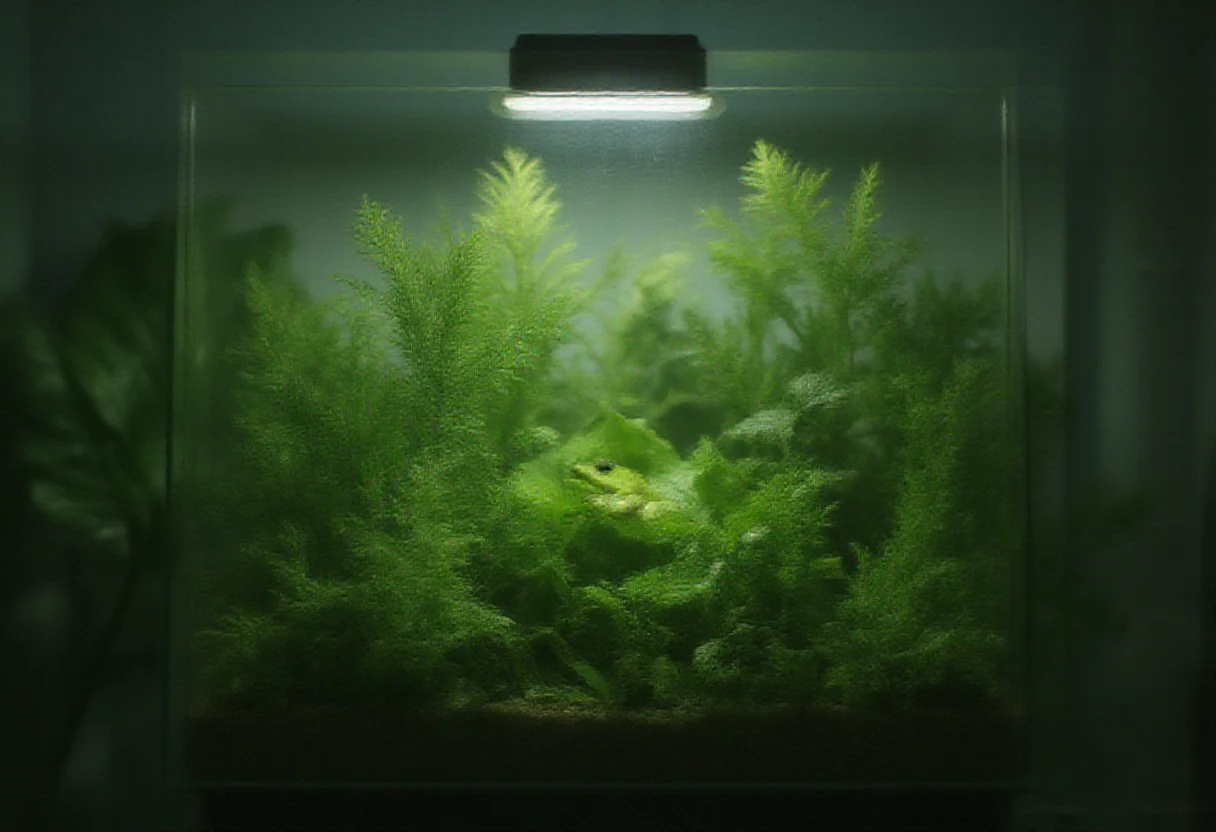
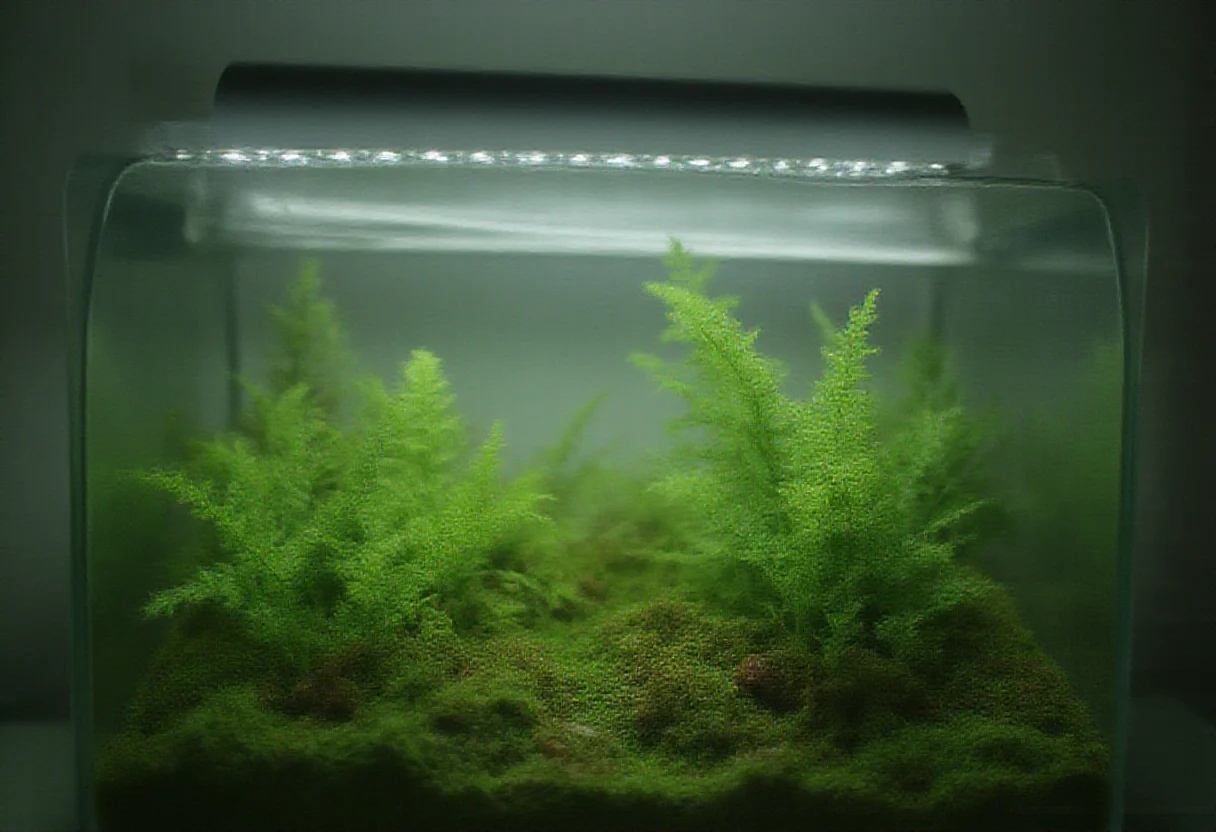
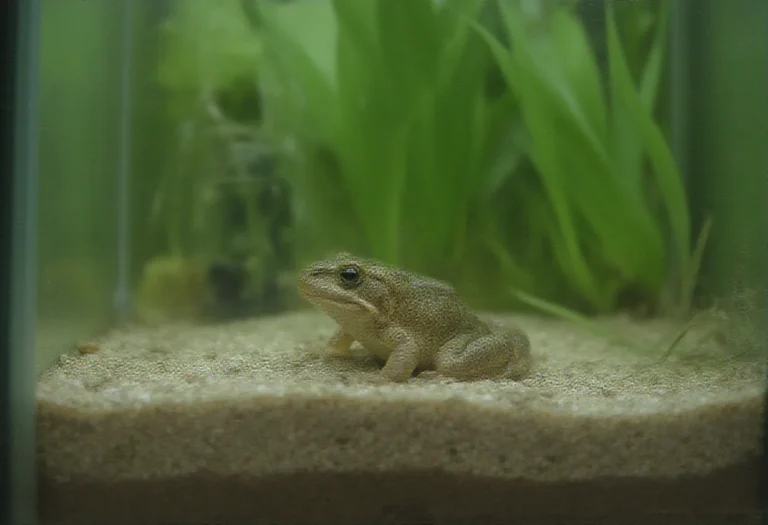
How this was made: prepared with AI assistance and checked against the sources listed at the end. Images are AI-generated illustrations, not photographs of real animals or products.
Key Takeaways
- A timer keeps day and night regular without daily effort.
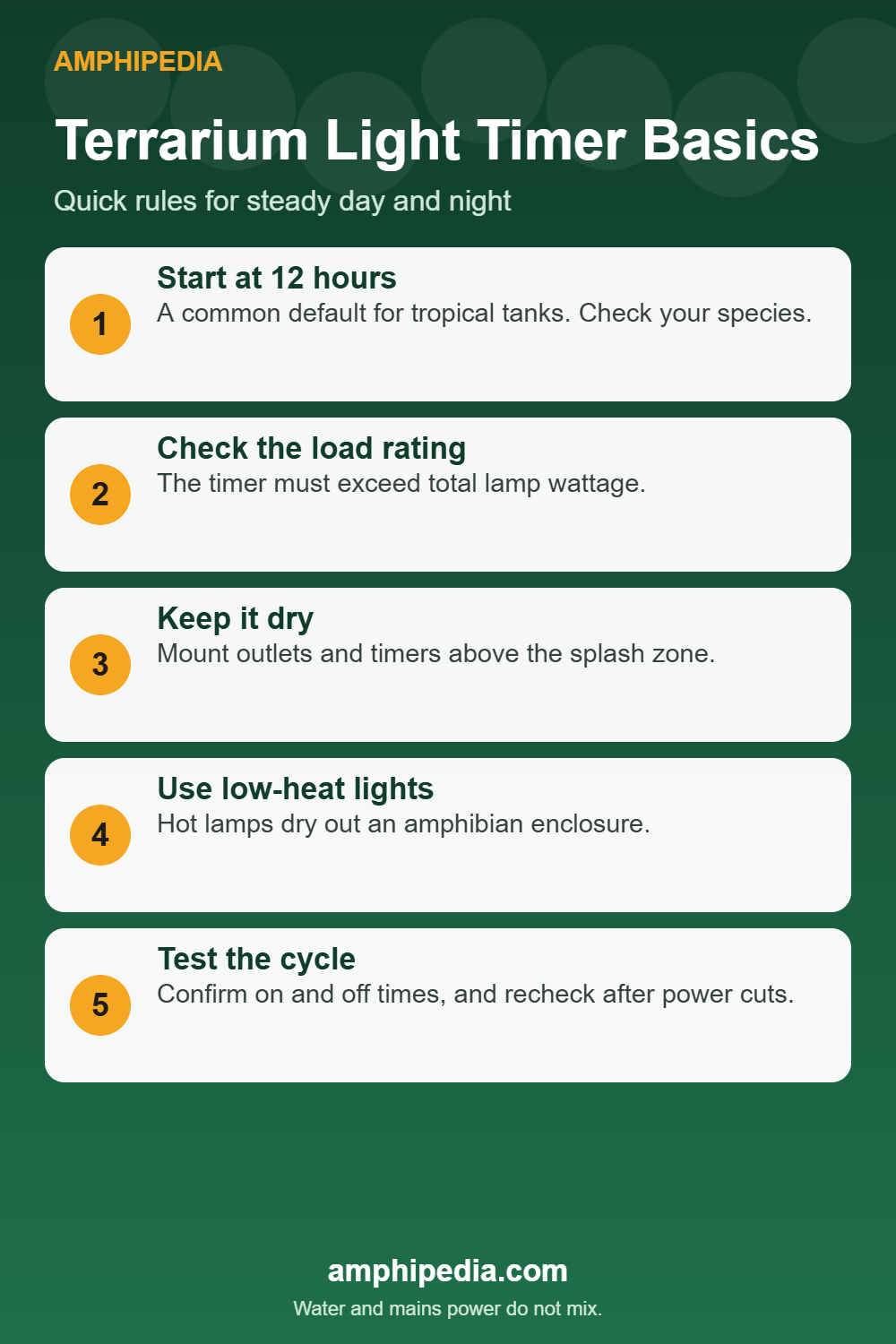
- About 12 hours of light is a common starting point for tropical tanks; check your species.
- Match the timer’s load rating to your total wattage.
- Digital timers are more precise than mechanical dial timers.
- Keep electrical parts away from splashes and mist.
- Low-heat lights are safer for amphibians than hot lamps.
Pin this infographicShare on Facebook
Timer picks
These timers are sorted by price from high to low. Compare load rating, number of outlets and programming options.


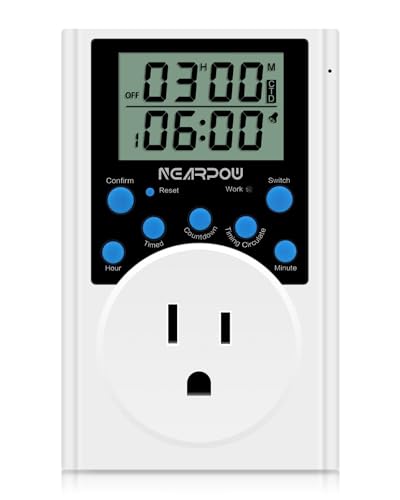


Product titles, prices and ratings are provided by Amazon and are accurate only at the time they are displayed.
Why a light timer matters
Many amphibians are active at dusk and night, but plants need light to grow. A timer gives both a predictable cycle. PetMD notes that many frogs are nocturnal and need little light, and that seasonal light changes may mimic natural conditions and can influence breeding.
A steady cycle also protects plants. Lights left on too long raise temperatures and dry out the air. Lights left off for days stop growth.
How many hours of light?
VetVerified suggests 12 hours on and 12 hours off for a bioactive setup, and a Chewy care sheet for red-eyed tree frogs advises 10 to 12 hours of light a day. That is a sensible starting range for tropical frogs and live plants, but it is not a rule for every animal.
Types of timers compared
Timers differ in precision, number of cycles and how they connect.
| Type | Good for | Trade-offs |
|---|---|---|
| Mechanical dial timer | Simple, one daily cycle, low cost | Larger time steps; noisy ones can be annoying |
| Digital plug-in timer | Exact on and off times, several programs | Needs a battery or a power-cut memory |
| Smart plug with an app | Remote control, schedules, sunrise and sunset steps | Needs Wi-Fi; check the privacy settings |
| Built-in controller on a fixture | One device for lights and timer | You cannot swap the lamp without changing the system |
Sizing a timer to your lights
Find the wattage printed on each lamp or fixture. Add them together. The timer’s rated load should be higher than that total, with some safety margin.
LED lights draw little power, so most timers handle them. If you also power a heater or a fogger, use a separate device made for that load, and do not chain extension cords.
Placement and water safety
Terrariums are wet places. Keep plugs, timers and power strips above the splash zone and outside the tank. Use a drip loop so water cannot run down the cable into the outlet.
Never plug a timer into a wet outlet. If mist or condensation reaches the timer, unplug it and dry it completely before use.
What to look for when you buy
This page does not include hands-on tests. The checklist below comes from the way terrarium lights and timers are normally used.
- A load rating higher than your total wattage.
- Grounded three-prong outlet.
- Clear on and off times, in 15-minute steps or finer.
- A manual override button.
- Battery or memory backup for power cuts.
- A compact body that does not block other outlets.
How to set a schedule
Choose a start time that fits your own routine, so you can watch the tank in the evening. Then keep the schedule fixed.
- Add up the wattage of all lights on the timer.
- Set the clock and the time zone.
- Program the on and off times for about 12 hours of light, or the figure your species needs.
- Run a test cycle and check the lights switch on and off.
- Check the tank temperature at the end of the day.
- Review the schedule when seasons or plant needs change.
Heat and light choice
LafeberVet advises avoiding radiant heat sources for dart frogs because they dry out the enclosure. Pick low-heat lights and use a timer to limit their run time. See our LED lights for dart frog tanks and LED strips.
If your species needs UVB, plan the schedule with the lamp maker’s guidance. Our UVB light guide explains the basics.
Common mistakes
Avoid these problems.
- Using a timer rated below the lights’ total wattage.
- Daisy-chaining power strips and extension cords.
- Leaving lights on 24 hours a day.
- Changing the schedule every week.
- Placing the timer where mist or drips can reach it.
- Forgetting to reset the clock after a power cut.
Related gear
A timer is one part of an automated tank. You may also want a mist timer, a smart plug or a safe extension cord.
Why the dark period should be dark
A timer does two jobs: it switches lights on and it guarantees a dark night. The second job matters too. A 2022 study in Frontiers in Ecology and Evolution by Smit and colleagues looked at male tungara frogs (Engystomops pustulosus) in Panama. In the lab, artificial light at night increased the amplitude of their calls.
The authors describe the direct effects as minor overall, and the study was on wild frogs of one species. It does not show harm to a pet frog. It does suggest that frogs respond to light at night, so avoid lamps, screens and night lights that shine into the enclosure.
PetMD adds that many frog species are active at night and need very little light, and that varying the amount of light by season can make an enclosure more natural and may affect breeding behaviour.
Where care sources disagree on lighting
Care sheets do not agree on how long lights should run or whether to use heat lamps. Check which one matches your species before you set the timer.
- Hours: VetVerified gives a typical 12 hours on and 12 off. The Chewy red-eyed tree frog sheet gives 10 to 12 hours of light a day.
- Heat: Chewy suggests a low-wattage incandescent bulb above a high perch for light and heat. PetMD says heat lamps are often not needed for frogs, and LafeberVet advises avoiding radiant heat for dart frogs because it dries out the enclosure.
- Plant lighting: PetMD says light for live plants is often enough for the frog, while LafeberVet recommends low-intensity full-spectrum lighting for dart frogs.
- Night temperature: Chewy gives about 68 to 70 F at night for red-eyed tree frogs, and LafeberVet gives 65 to 70 F for dart frogs.
The practical point for a timer is simple. Whatever lights you attach, the night period should be cooler and dark, so do not put a heater or heat lamp on the same timer unless the species sheet calls for it.
Add a GFCI for wet rooms
The U.S. Consumer Product Safety Commission fact sheet What Is a GFCI? says a ground-fault circuit interrupter protects people from electric shock by cutting power when it detects a ground fault. It says to test every GFCI after installation, at least once a month, after a power failure and as the manufacturer directs.
Its method is to plug in a lamp, press the test button and confirm that the light goes out, then press reset and confirm that it comes back on. The fact sheet does not mention timers or terrariums. It does describe a portable GFCI built into an extension cord for receptacles that have no protection.
If your tank stands in a room with no GFCI outlet, ask a qualified electrician about adding one. Do not rely on the timer for shock protection, because a timer only switches power on and off.
Troubleshooting a timer that misbehaves
- Lights come on at the wrong hour: check the clock, the AM and PM setting and the time zone, and re-check after a clock change.
- Lights do not switch off: confirm the timer is in automatic mode and not on manual override.
- Schedule resets after an outage: add a battery-backed timer or write the schedule down so you can re-enter it quickly.
- Lights flicker or the timer clicks often: unplug it, check the total load and try a different lamp to find the fault.
- Timer feels warm: unplug it, check the load against the rating and replace it if the plastic is discoloured.
Keep a note of your schedule near the tank. When something looks wrong, check the timer before you adjust the animals’ environment.
Frequently Asked Questions
How long should terrarium lights stay on?
A common starting point is 12 hours on and 12 hours off for tropical setups. Species differ, so check a care sheet for your animal.
Do frogs need darkness at night?
Yes. Many frogs are nocturnal, and a regular dark period is part of a natural cycle.
Can I use a regular household timer?
Only if its load rating is above the total wattage of your lights, and only away from water. Many keepers prefer timers made for aquariums or reptile gear.
Is a smart plug better than a digital timer?
A smart plug allows remote control, but it needs Wi-Fi. A digital plug-in timer works without a network.
Should I put heaters on the same timer?
Not unless the timer is rated for the combined load. Heaters often need a thermostat, not a simple timer.
What happens after a power cut?
Some timers reset the clock. Pick one with a battery backup, and check it after any outage.
Bottom Line
A good light cycle timer is cheap insurance. It keeps day length steady, protects plants and removes a daily chore.
Match the timer to your lights, keep it dry and review your schedule when your animals or plants change.
Sources
- PetMD: Frog Care 101, accessed 12 November 2026.
- VetVerified: How to create a bioactive setup for amphibians and reptiles, accessed 12 November 2026.
- LafeberVet: Basic Information Sheet, Poison Dart Frogs, accessed 12 November 2026.
- CDC: Reptiles and Amphibians (Healthy Pets, Healthy People), accessed 12 November 2026.
- Chewy: Red-Eyed Tree Frog Care Sheet, accessed 12 November 2026.
- Smit JAH et al. (2022), Interactive and independent effects of light and noise pollution on sexual signaling in frogs, Frontiers in Ecology and Evolution, accessed 12 November 2026
- U.S. Consumer Product Safety Commission: What Is a GFCI? (fact sheet), accessed 12 November 2026


5 Comments