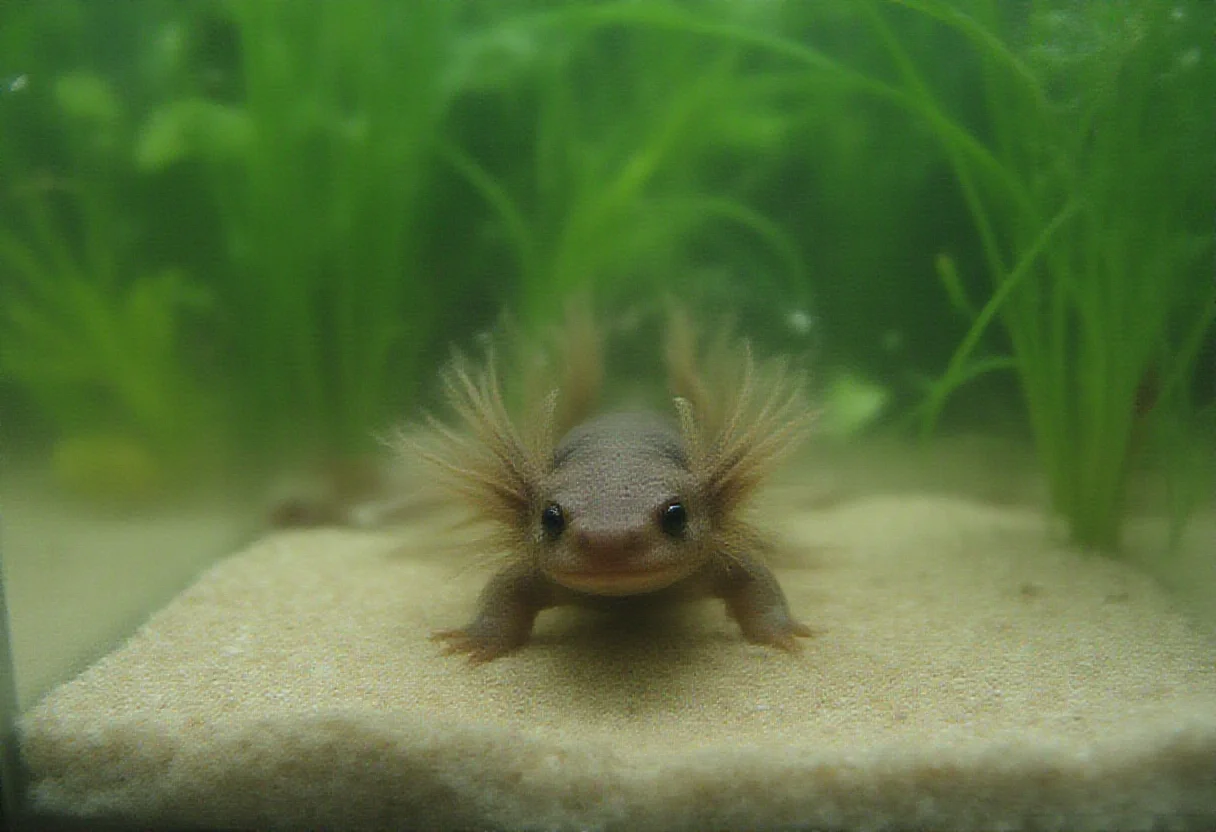
Nano Water Filter for Amphibians: Water Quality Guide
This post contains affiliate links. As an Amazon Associate I earn from qualifying purchases. Prices and availability are shown by Amazon and can change.
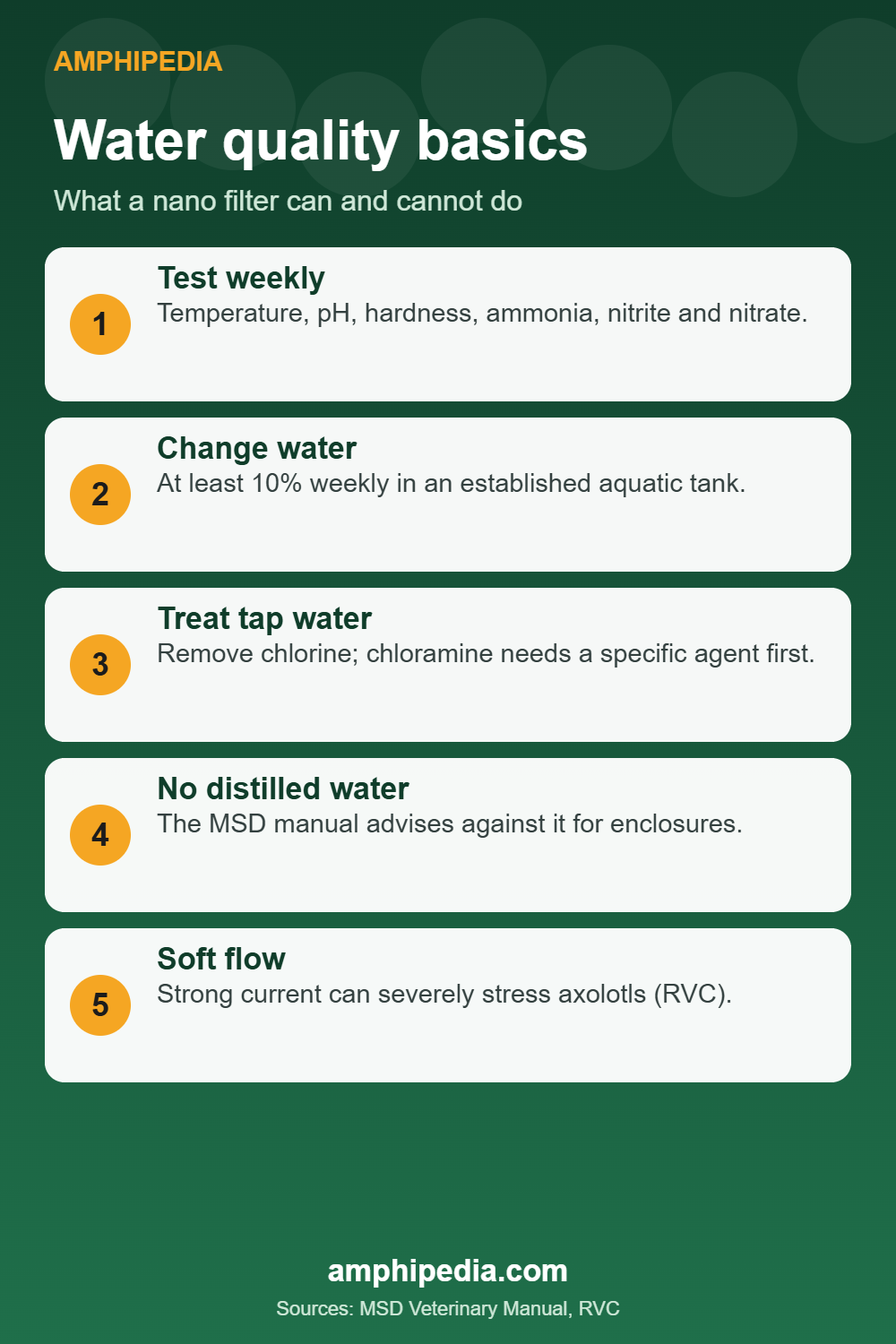
A nano water filter for amphibians is a small filter whose job is water quality: it holds beneficial bacteria that break down waste and traps debris. It should do this with gentle flow. The MSD Veterinary Manual says water must be free of chlorine, ammonia, nitrite, pesticides and heavy metals, and recommends weekly tests and water changes of at least 10% in established aquatic tanks. A filter helps, but it never replaces testing and water changes.
Many keepers buy a filter and assume the water is safe. In a small tank this is risky. Waste builds up quickly, and amphibian skin is permeable, so what is in the water gets into the animal.
This guide is about water quality. It explains what the different filter media do, what a filter cannot remove, and how to test and maintain a small aquatic setup. For help picking a gentle unit, see our companion guide on a nano filter for amphibian tanks.
How this was made: prepared with AI assistance and checked against the sources listed at the end. Images are AI-generated illustrations, not photographs of real animals or products.
Key Takeaways
- Amphibians absorb substances through permeable skin, so water quality matters more than for many fish.
- The MSD Veterinary Manual says to test weekly for temperature, pH, hardness, ammonia, nitrite and nitrate.
- Change at least 10% of the water weekly in an established aquatic tank (MSD).
- A filter is no substitute for treating tap water: chloramine needs a dechlorinating agent first, and carbon takes at least 24 hours of circulation to remove chlorine (MSD).
- Do not use distilled water in enclosures, according to the MSD manual.
- Keep flow gentle, since strong current stresses axolotls (Royal Veterinary College).
Pin this infographicShare on Facebook
Small powered filters with modest flow
These small powered filters are made for tanks of roughly 4 to 7.5 gallons. Fit a baffle or sponge over the outlet if the flow is too strong for your animal.


Product titles, prices and ratings are provided by Amazon and are accurate only at the time they are displayed.
What a filter actually does
A filter has three jobs. It catches solid waste, it hosts bacteria that convert ammonia into less harmful compounds, and in some designs it holds chemical media. Biological filtration is the most important job for amphibians.
The MSD Veterinary Manual says biological filtration helps keep water safe. The Royal Veterinary College adds that filters are strongly advised for axolotls to keep toxic ammonia low.
A filter does not make dirty water clean on its own. It slows the build-up, which gives you time to change water on schedule.
Filter media in plain language
Most small filters hold some mix of the following.
- Mechanical media, such as sponge or floss, traps visible debris.
- Biological media, such as sponge or ceramic rings, gives bacteria a surface to grow on.
- Chemical media, such as activated carbon, can remove some dissolved compounds. The MSD manual notes that circulating tap water through a carbon filter for at least 24 hours removes chlorine.
- Use biological media as the core and replace chemical media only as the maker advises.
What a filter cannot do
A filter will not neutralise chloramine. The MSD manual says water containing chloramines needs a specific dechlorinating agent first, followed by filtration to remove chlorine and ammonia.
It will not fix a tank that is too hot. Axolotls should stay at 16 to 18°C and never above 24°C, according to the Royal Veterinary College. A filter motor adds a little heat and can push the water higher in a warm room.
It will not remove every pesticide or heavy metal. If you are unsure about your tap water, ask your water supplier for a report or use a vet-approved source.
Test, do not guess
The MSD manual advises testing aquatic setups weekly for temperature, pH, hardness, ammonia, nitrite and nitrate. Write the numbers down so you can see trends.
Ammonia and nitrite should read zero in a settled tank. If either rises, do a water change and reduce feeding. Our guide to a pH meter for amphibian water covers one part of this routine.
Test before and after any change of filter media or cleaning. A sudden spike is a warning sign.
- Test the water once a week at the same time of day.
- Record temperature, pH, ammonia, nitrite and nitrate.
- Change 10% or more of the water if anything looks off.
- Re-test the next day.
- Ask an exotics vet if the animal looks unwell or stops eating.
Gentle flow still comes first
Water quality gets all the attention, but flow is just as important. The RVC says it is essential that filters do not cause strong water flow because this can cause severe stress in axolotls.
Choose a unit with adjustable output or fit a baffle, and watch the animal. A frog or salamander that hugs the wall or avoids one end of the tank may be fighting current.
Cycling a new filter
New filters have no bacteria yet. The Royal Veterinary College advises leaving a new axolotl tank empty to mature for several weeks before animals are added.
Do not rush this step. Ammonia and nitrite spikes in a new tank can harm amphibians quickly.
Never clean all media at the same time as a water change, or you remove both the bacteria and the buffer.
Handling hygiene
Reptiles and amphibians often carry Salmonella, and you can become sick from contaminated tank water or equipment even without touching the animal. The CDC advises cleaning tanks and equipment outside the home where possible, away from food and water sources.
Pour tank water down the toilet rather than a kitchen sink, and wash your hands with soap and running water afterwards.
Related guides
See our guides on dechlorinators for amphibian water, the small tank filter for newts and low noise air pumps for amphibians.
Match the filter to the tank, not the other way round
The filters listed above are described for tanks of roughly 4 to 7.5 gallons. That is small next to published housing figures. VCA lists a 10-gallon or larger aquarium for an African dwarf frog. OATA, the UK ornamental fish trade body, recommends at least 50 L for a small group of dwarf frogs and at least 100 L for clawed frogs or axolotls, and says bigger is better.
A very small tank gives waste nowhere to dilute, so every mistake shows up fast. Choose the tank for the animal first, then pick a filter that suits that volume and has adjustable flow. If the tank is below the size your species needs, a filter will not make up for it.
What a filter does not change: hardness and pH
OATA gives targets for aquatic frogs and axolotls that go beyond ammonia. A filter does little to move these numbers, so test them and treat the cause, not the filter.
| Measure | OATA target | Note |
|---|---|---|
| pH | 7.0-8.0 | Test at least weekly |
| General hardness | 8-18 dH (medium-hard) | Depends on your tap water |
| Carbonate hardness | 10-15 dKH (medium-hard) | Depends on your tap water |
| Ammonia and nitrite | Zero | Check especially during setup |
| Nitrate | No more than 20 mg/L above tap level | Water changes lower it |
The MSD manual also lists hardness among the weekly tests for aquatic setups. If your readings are far from the target, ask an amphibian vet or an experienced keeper how to adjust them before you buy additives.
Temperature is the one number a filter can nudge, because the motor adds a little heat. OATA gives 22 to 25 C for aquatic frogs and 10 to 22 C for axolotls. The Royal Veterinary College figure quoted earlier, 16 to 18 C and never above 24 C, is narrower. For axolotls, aim for the cooler, narrower range and check the water with a thermometer after the filter has run for a day.
Plants, substrate and the filter intake
The Merck Veterinary Manual says aquatic plants help oxygenate water and remove nitrogenous waste, and that aquatic plants provide hiding places and, for larvae, often food. OATA says plants must be anchored.
Substrate matters near a filter. OATA recommends bare or sand bases to protect delicate skin and gills, and rounded pebbles too large to swallow. Merck says gravel should be too large to swallow or small enough to pass through the gut. A low-flow filter can still lift fine sand, so site the intake where it cannot pull in loose substrate, and check it when you siphon.
Adding animals and cleaning media
OATA says ammonia and nitrite should read zero before animals go in and that you should add livestock gradually. Overstocking or adding too many animals at once can cause new tank syndrome, where waste outpaces the bacteria that break it down. It advises monitoring water quality closely for the first week.
When you clean the filter, OATA says to rinse it in water removed from the tank, not under the tap, to protect the beneficial bacteria. It also says not to siphon by mouth. Use a gravel cleaner that can be primed without mouth contact.
Frequently Asked Questions
Does a filter replace water changes?
No. The MSD manual still advises changing at least 10% of the water weekly in an established aquatic tank, even with filtration.
Do I need a carbon filter?
Carbon can remove chlorine after at least 24 hours of circulation, but a dechlorinating agent is simpler for most keepers. Chloramine needs a specific agent first.
What should ammonia read?
In a settled tank it should read zero. Any rise is a reason to change water and check feeding.
Is distilled water safe?
The MSD manual says distilled water should not be used in enclosures or when handling amphibians.
How often should I test?
Weekly, according to the MSD manual, for temperature, pH, hardness, ammonia, nitrite and nitrate.
Why does my axolotl avoid the filter?
Flow may be too strong. The RVC says strong flow can cause severe stress. Reduce the output or move the outlet.
Can I wash media under the tap?
It is better to rinse it in old tank water so you keep the bacteria. Chlorine in tap water can kill them.
Bottom Line
A nano water filter is a support tool. It keeps ammonia down, catches debris and gives you a buffer between water changes. It works best when flow is gentle, media is cared for, and you test weekly.
If you remember three things, make them these: treat tap water first, keep the current soft, and never skip the weekly test.
Sources
- MSD Veterinary Manual: Housing for Amphibians (pet owner version). Temperature, humidity, UVB, water quality and filtration basics.
- MSD Veterinary Manual: Environment and Husbandry for Amphibians (professional version). Thermal gradients, lighting timers, UVB distance, weekly humidifier disinfection.
- Royal Veterinary College: Axolotl care sheet. Axolotl temperature, filtration, water flow and lighting.
- CDC: Reptiles and Amphibians (Healthy Pets, Healthy People). Salmonella risk, handwashing and where to clean habitat equipment.
- OATA: How to care for aquatic frogs and axolotls (September 2022), accessed 12 November 2026
- VCA Animal Hospitals: Frogs as Pets (Gregory Rich, DVM, 2025), accessed 12 November 2026

3 Comments