Best Frog Tank Humidity Stabilizer: What to Look For
This post contains affiliate links. As an Amazon Associate I earn from qualifying purchases. Prices and availability are shown by Amazon and can change.
A frog tank humidity stabilizer is any setup that keeps moisture steady instead of swinging between wet and dry. The best results come from layers: a reliable hygrometer, a moisture-holding substrate, live plants, a water feature or regular misting, and some air flow. Target figures depend on the species, so check a care source for your frog first.
Frogs breathe and drink partly through their skin, so dry air is a real risk. The Merck Veterinary Manual says amphibians need moisture to prevent desiccation.
Swings are a problem too. A tank that soaks and then dries out stresses the frog and invites mold. This guide shows how to build steady humidity and what to look for in the gear.
How this was made: prepared with AI assistance and checked against the sources listed at the end. Images are AI-generated illustrations, not photographs of real animals or products.
Key Takeaways
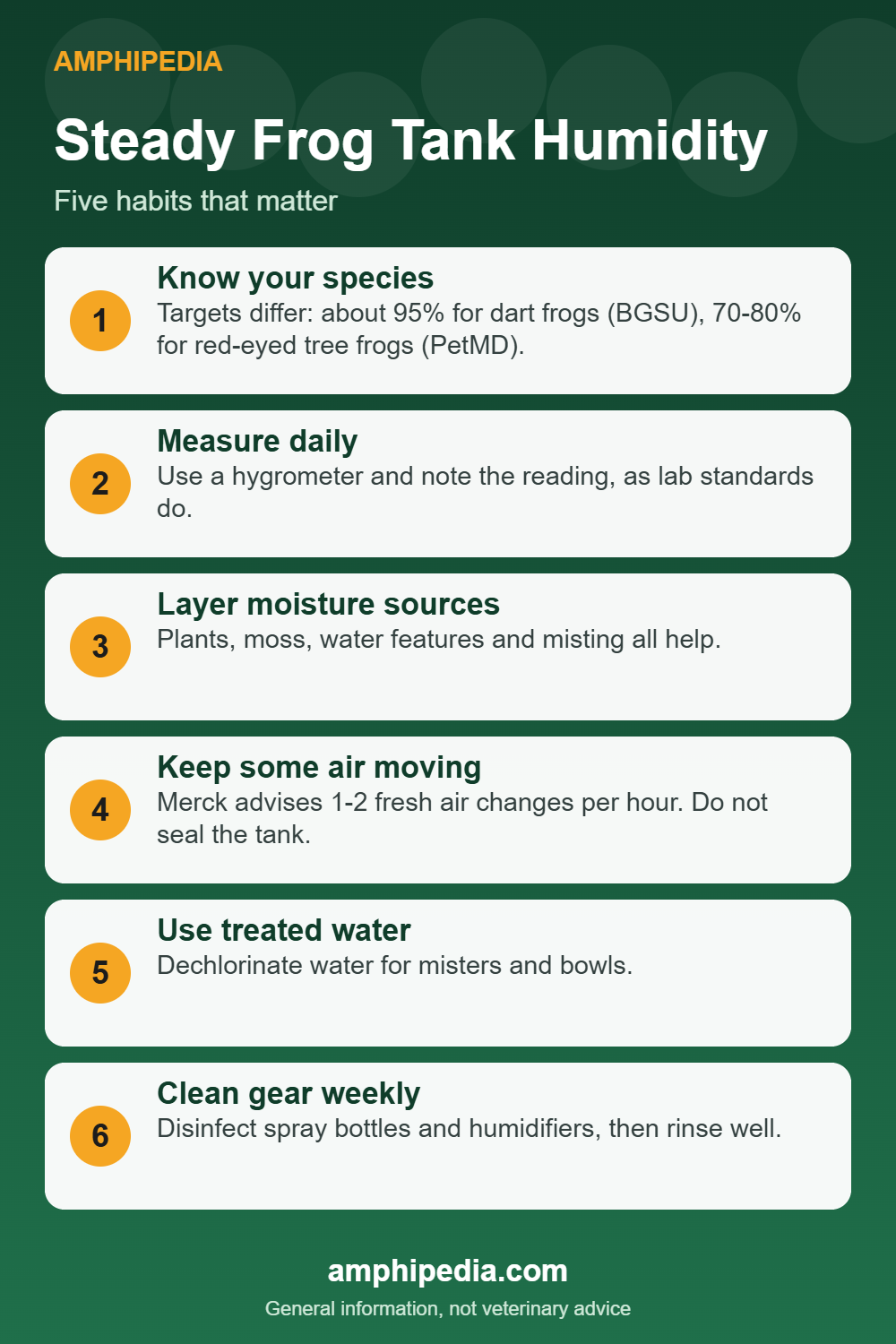
- Humidity targets differ by species. Dart frogs and tree frogs are not the same.
- Measure every day with a hygrometer and note the reading.
- Stack several moisture sources: plants, moss, water features and misting.
- Keep some ventilation. A fully sealed tank can turn stale.
- Use dechlorinated water and clean spray bottles and humidifiers weekly.
Pin this infographicShare on Facebook
Humidity gear worth considering
These are humidity and misting products that match the search terms. Check size, water capacity and cord length against your own tank before you buy.



Product titles, prices and ratings are provided by Amazon and are accurate only at the time they are displayed.
What humidity does a frog tank need?
There is no single number. UC Davis says the humidity range depends on species and life stage, and that labs record it daily. The Merck page we cite gives no percentage either, although another MSD page does (see the comparison below).
Care sheets do give figures for popular pets. The BGSU herpetarium keeps dart frogs in a glass-topped tank at about 95 percent humidity. PetMD lists 70 to 80 percent for red-eyed tree frogs. These sources describe different species, so do not copy one figure to every tank.
Look up your exact species. If sources disagree, aim for the middle of the range and watch your frog. A frog that hides all day and looks dull may be too dry.

Ways to stabilize humidity
Merck lists several ways to add moisture: small streams or waterfalls, ultrasonic humidifiers and frequent misting. Organic substrates and hiding places also slow water loss.
Each method has a trade-off. Misting by hand is cheap but uneven. Timed misters are steadier but need a clean water supply. Foggers raise humidity fast and need a drain-free setup that does not soak the floor.
- Live plants add humidity and cover. Merck notes they also give hiding and perching places.
- Moss and leaf litter hold water and release it slowly.
- A shallow water dish or small pool adds surface area for evaporation.
- A mister or fogger on a timer reduces swings overnight.
- A damp, deep substrate acts as a moisture reservoir.
Choosing a hygrometer
You cannot stabilize what you do not measure. A digital hygrometer with a probe lets you read the tank without opening it.
Look for a clear display, a probe that sits at frog height and a long enough cable. Many keepers run two units, one high and one low, and compare readings.
Check that the readings agree. If two units differ a lot, trust neither and replace one.
Misters, foggers and humidifiers
If you choose a device, think about water first. Merck says water must be free of chlorine, ammonia and other toxins. Use dechlorinated water in any reservoir.
Check how the device sprays. A fine mist that wets leaves is gentler than a hard jet. Make sure the reservoir opens wide enough to scrub.
Pick tough, tank-safe parts. Cords and plugs must stay dry. UC Davis says electrical components should be kept away from water.
Ventilation and mold
High humidity is not the same as stagnant air. Merck advises one to two fresh air changes per hour to prevent disease. At home, that means avoiding a fully sealed box.
The BGSU set-up uses a lid with a small strip of drilled holes. That keeps humidity high while letting some air exchange happen.
If you see mold, remove the affected material, increase air flow a little and reduce standing water. Fix the cause, not just the patch.
Cleaning your humidity gear
Spray bottles, reservoirs and humidifiers can grow slime. For quarantine tanks, Merck advises disinfecting humidifiers and spray bottles weekly. A weekly rinse is a sensible habit for any tank.
Merck gives household bleach at 30 mL per liter of water for tools and housing, with 30 minutes of contact and a thorough rinse. Let parts dry before reuse.
Common mistakes
Most problems come from chasing a number instead of watching the tank.
- Using one hygrometer and trusting it blindly.
- Misting heavily at night, then letting the tank dry all day.
- Sealing every vent to push humidity higher.
- Filling reservoirs with untreated tap water.
- Skipping cleaning because the water looks clear.
Humidity figures compared
| Source | Animal | Humidity figure |
|---|---|---|
| BGSU Herpetarium | Poison dart frogs | About 95 percent, with a glass lid that allows air exchange |
| DartFrog.pet | Dart frogs | 80 to 90 percent, upper 80s to 90 ideal |
| LafeberVet | Poison dart frogs | 80 to 100 percent |
| MSD Veterinary Manual (Housing) | Most amphibians; tropical species | 75 to 80 percent; 85 to 90 percent |
| PetMD | Red-eyed tree frog | 70 to 80 percent |
| Petco | Newts and salamanders | About 70 percent |
| Royal Veterinary College | Salamanders | At least 70 percent |
The range across species is wide, which is the point of this guide. The Merck page cited above gives no percentage, while the MSD Housing page does. Even for dart frogs the figures run from 80 to 100 percent, so treat them as a band to watch rather than a target to hit every hour.
When you pick a band, write down which source and which animal it came from. If you keep a mixed group of species, you cannot hold one number for all of them, and the sources above give no advice on that. House animals with similar needs, or give each its own enclosure, and check the species page before you add a new animal. Ask an exotics vet if a frog looks dull, thin or reluctant to move despite readings that look right.
One real layered build: the BGSU herpetarium
The Bowling Green State University herpetarium describes a dart frog tank built in layers. It uses 2 to 3 inches of washed pea gravel, potted plants such as pothos, philodendron and sansevieria, and about 2 inches of untreated sphagnum moss, which may be covered with living moss.
A shallow rock-bottomed pool sits in one corner, and a small pump moves water under the rocks to a rock pile to make a stream and waterfall. The lid is glass and hinged, with a plastic strip drilled with about six small holes. The page says to keep the room above 70 F, with a preferred range of 75 to 84 F, and to use full-spectrum lighting for plants.
This is one example, not a recipe. It shows the stabilizing effect of water volume, moss and plants working together before any gadget is added.
Airflow numbers that look contradictory
The MSD manual gives 1 to 2 fresh air changes per hour for enclosures. The UC Davis laboratory standard says non-aquatic species require 10 to 15 fresh room air exchanges per hour. The difference is scale: one describes the air in the tank, the other the air in a whole animal room.
UC Davis also says direct exposure to fast-moving air should be avoided, because drafts can make semi-aquatic amphibians desiccate. At home, that means keeping the tank away from fans and vents while still leaving the lid ventilated.
Log the readings, not just the average
UC Davis records daily minimum and maximum temperature and humidity for its frogs and installs temperature alarms in every room that houses them. A pet keeper can borrow the habit. Note the lowest and highest humidity each day and the time of each, then match the swing to your misting schedule.
- A dip before each misting means the interval is too long.
- A peak right after misting that never settles means the bursts are too heavy.
- A slow overnight drift points to substrate or ventilation, not the mister.
Those patterns are our own reading of a daily log, not a sourced test. Use them to ask better questions, not as a diagnosis.
Electrical safety around damp gear
UC Davis says electrical components should be kept away from water and wet surfaces, and that all outlets should be GFCI rated. For a mister or fogger, that means running cords above the water line with a drip loop and plugging into a protected outlet.
Frequently Asked Questions
What is the best humidity for a frog tank?
It depends on the species. Dart frog set-ups can run near 95 percent per BGSU, while PetMD lists 70 to 80 percent for red-eyed tree frogs. Check your species.
How do I keep humidity steady?
Layer sources. Use a moisture-holding substrate, live plants, a water feature and timed misting, then check a hygrometer daily.
Can a tank be too humid?
Yes. Stagnant, soaked tanks encourage mold. Merck advises fresh air exchange, so keep some ventilation.
Is tap water safe in a mister?
Not untreated. Merck says water must be free of chlorine and similar toxins, so use dechlorinated water.
How often should I clean misting gear?
Merck advises weekly disinfection of spray bottles and humidifiers in quarantine setups. Weekly is a good routine for any tank.
Do I need a vet if humidity was wrong?
If your frog looks unwell, see an exotics vet. This guide cannot diagnose illness.
Bottom Line
Steady humidity is built from layers, not one gadget. Start with the right target for your species, then add plants, substrate and a reliable way to add water.
Measure daily, keep some air moving and clean your gear. Those habits do more than any single product.
Sources
- Merck Veterinary Manual: Environment and Husbandry for Amphibians, accessed 12 November 2026. Used for: moisture, ventilation, lighting, substrate, water and cleaning guidance
- UC Davis Office of the Attending Veterinarian: SC-35-100 Husbandry Care of Frogs (2025), accessed 12 November 2026. Used for: laboratory standards for frogs, daily records, drafts, air exchanges, electrical safety
- BGSU Herpetarium: Poison Dart Frogs, General Care, accessed 12 November 2026. Used for: university herpetarium set-up notes for dart frogs
- PetMD: Red-Eyed Tree Frog Care Sheet, accessed 12 November 2026. Used for: the 70 to 80 percent humidity figure
- CDC MMWR: Reptile-Associated Salmonellosis, Selected States, 1998-2002. Used for: Salmonella risk from reptiles and amphibians
- DartFrog.pet: Dart Frog Vivarium Setup, accessed 12 November 2026. Used for: dart frog humidity range
- Basic Information Sheet: Poison Dart Frog (LafeberVet), accessed 12 November 2026. Used for: dart frog humidity range
- MSD Veterinary Manual: Housing for Amphibians, accessed 12 November 2026. Used for: humidity ranges for most and tropical amphibians
- Petco: Salamanders and Newts Care Sheet, accessed 12 November 2026. Used for: newt and salamander humidity
- Royal Veterinary College: Salamander care sheet, accessed 12 November 2026. Used for: salamander humidity



11 Comments