Auto Mist System With a Refillable Reservoir for Frog Terrariums
This post contains affiliate links. As an Amazon Associate I earn from qualifying purchases. Prices and availability are shown by Amazon and can change.
An automatic misting system pumps water from a reservoir through nozzles on a timer, so a frog terrarium gets regular mist without daily work. Choose a reservoir you can refill easily, a timer you can set to short bursts, nozzles that resist clogging, and a drain so water never pools. Use dechlorinated water, and check the humidity with a hygrometer.
Many tropical frogs need frequent misting. DartFrog.pet advises misting dart frogs several times a day and holding humidity around 80 to 90 percent. That is a lot of manual work for one keeper.
An automatic system does the job on a schedule. The trade-off is that you must manage the reservoir, the water and the drainage. This guide explains how to choose and run one safely.
How this was made: prepared with AI assistance and checked against the sources listed at the end. Images are AI-generated illustrations, not photographs of real animals or products.
Key Takeaways
- Automatic misting suits species that need frequent, light misting.
- Use short, regular bursts and a drain so water cannot pool.
- Fill the reservoir with dechlorinated water, never raw tap water.
- Clean the reservoir and nozzles often to prevent buildup and clogging.
- Check humidity with a hygrometer, not by looking at the glass.
- Keep ventilation, because stale air and constant wetness cause problems.
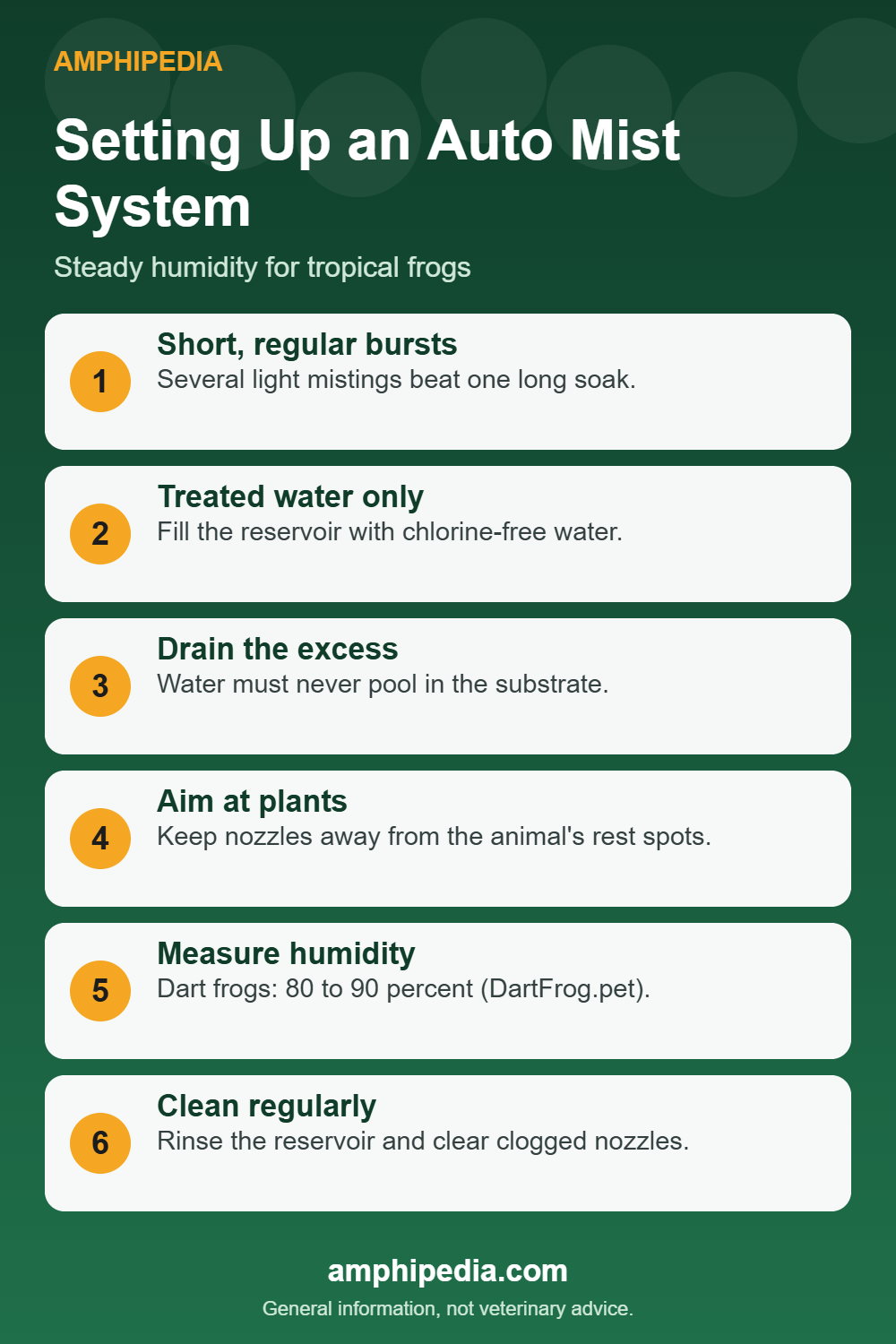
Pin this infographicShare on Facebook
Automatic misting systems to compare
These are automatic misting systems sold for reptile terrariums. Check the nozzle, reservoir and drainage setup against the guide below.


Product titles, prices and ratings are provided by Amazon and are accurate only at the time they are displayed.
How an auto mist system works
A pump draws water from a reservoir. It pushes the water through tubing to one or more nozzles inside the terrarium. A timer turns the pump on for a short burst at set times.
Some designs add a float switch or a level sensor that stops the pump when the reservoir runs low. This protects the pump. A few setups also top up the reservoir from a larger tank, which is what people mean by a refill system.
Who needs one
Frogs from humid forests benefit most. DartFrog.pet lists humidity of 80 to 90 percent for dart frogs, with misting several times a day. The MSD Veterinary Manual says moisture can come from frequent misting, small streams, waterfalls or ultrasonic humidifiers.
Species from drier conditions need less. Check your species’ range first. A system that keeps everything wet all day can harm animals that need a drier day cycle.
Choosing the reservoir
The reservoir is the heart of the system. A bigger tank means fewer refills, but it also means water sits longer.
- A size you can refill without moving the terrarium.
- A clear or marked side so you can see the level.
- A lid to keep out dust and insects.
- Easy access for cleaning the inside.
- A low-water cutoff or float switch.
- A fill port that you can reach without spilling.
Timers, nozzles and drainage
A digital timer lets you set short, repeated bursts. Several short mistings are gentler than one long soak. Aim nozzles at plants and decor, not directly at the animal.
Drainage is essential. Water must leave the tank as fast as it arrives, or the substrate turns swampy. Our guide to a drainage layer explains how to build one.
Water quality
The MSD manual says water for amphibians must be free of chlorine, ammonia, nitrite, pesticides and heavy metals. For a mist system, that means filling the reservoir with treated water.
Hard water may also leave mineral deposits in nozzles, although neither source we cite measures this. Sources differ on the best water, so see the section on which water to use below. See our guide to a dechlorinator for amphibian water.
Change the reservoir water on a regular schedule instead of topping it up forever. Fresh water in a clean reservoir is less likely to grow algae or bacteria.
Setup steps
Take your time. Test the system before you add any animal.
- Place the reservoir at or below tank level, in a spot you can reach.
- Run tubing to the nozzles, and fix it so it cannot kink.
- Aim nozzles at plants and walls, away from the animal’s rest spots.
- Set the timer for short bursts, and watch the first few cycles.
- Check the drainage after each cycle and adjust the burst length.
- Measure humidity with a hygrometer and tune the timer over several days.
Cleaning and common mistakes
Empty and rinse the reservoir regularly, and check the nozzles for blockage. Stale water in a reservoir can grow bacteria and algae.
The MSD manual recommends 1 to 2 fresh air changes per hour to prevent disease. A misting system must not replace ventilation.
- Running the pump with an empty reservoir.
- Misting too long at once, so water pools.
- Using untreated tap water.
- Skipping drainage.
- Relying on timer alone with no hygrometer.
- Never cleaning the reservoir.
Troubleshooting
If the glass is always wet and the soil is soggy, shorten the bursts or run fewer cycles. If the tank dries out between cycles, add one more short burst.
If nothing comes out of a nozzle, check the reservoir level, the tubing for kinks and the nozzle for mineral buildup. Turn off the pump before you open any part.
Related options
If you want a different approach, compare a automatic rainmaker, a compact mist generator or a fog control system.
A humidity alarm adds a safety net while you tune the timer.
Match the misting to the species
Automation fixes the schedule, so the schedule has to be right first. DartFrog.pet gives 80 to 90 percent humidity for dart frogs, with the upper 80s to 90 ideal, and misting several times a day. It aims for temperatures in the 70s F.
The MSD Veterinary Manual does not sort species into wet and dry. It says all amphibians need moisture to prevent desiccation, and that each species has its own preferred optimal temperature zone. Salamanders prefer substantially lower temperatures than frogs and toads, so a mist system built for dart frogs may not suit them.
Drainage design for a timed system
A timer will keep adding water whether or not the last burst has drained. DartFrog.pet describes a drainage layer that keeps water away from the soil:
- A layer of Hydroton or similar clay balls at the bottom.
- A fiberglass screen or weed liner between that layer and the soil, with a check that water passes through easily.
- A drain pipe or siphon to remove excess water, so it never reaches the soil.
- An optional egg crate false bottom for more drainage space.
- A light layer of aquarium-grade charcoal above the separator to absorb ammonia.
The same page says water should never rise to the soil layer. Check the level of the false bottom after the first few cycles, not just the glass.
Which water: dechlorinated, filtered or RO?
The two sources we used differ. The MSD manual asks for water free of chlorine, ammonia, nitrite, pesticides and heavy metals. It describes removing chlorine by circulating water through a carbon filter for at least 24 hours, and splitting chloramine with a dechlorinating agent before carbon filtering.
DartFrog.pet is stricter for dart frogs. It advises distilled or reverse osmosis water and says to avoid tap, well and rainwater. If you keep dart frogs, the stricter rule is the safer one for the reservoir too. For other species, check a care source for that animal.
Mist, airflow and the lid
A sealed, wet tank is not a healthy one. The MSD manual calls for 1 to 2 fresh air changes per hour. DartFrog.pet replaces a screen top with glass to hold humidity, then adds vents made of egg crate with screen mesh, and notes that computer fans can add circulation.
That pairing shows the balance. Keep humidity high with a mostly closed lid, but vent enough that air still moves. If condensation never clears between bursts, shorten the bursts before you close any vents.
A pre-flight check before the frogs go in
- Run the pump for several cycles with no animals and look for leaks at every joint.
- Switch the timer on and off by hand to confirm the schedule works.
- Let the reservoir run low on purpose and confirm the pump stops or you notice it.
- Check that no nozzle sprays the glass lid directly, where it drips back in one spot.
- Record humidity at the same times for three days.
- Plan what happens during a power cut or a week away, and who tops up the reservoir.
The MSD manual also advises disinfecting humidifiers and spray bottles weekly in its quarantine guidance. Treat the reservoir and tubing with the same attention to hygiene, and rinse thoroughly after any cleaning.
Plants also help the system work. The MSD manual says live plants generate humidity and provide hiding and perching places, and DartFrog.pet recommends live plants over fake ones, including bromeliads that hold water. Aim nozzles so mist lands on foliage rather than on the animal.
Frequently Asked Questions
Do dart frogs need automatic misting?
They need frequent misting. DartFrog.pet advises misting several times a day. An automatic system can do this, but it is not the only way.
How often should the system run?
Short bursts several times a day, tuned with a hygrometer. The right schedule depends on your species and room.
What water should I put in the reservoir?
Treated water, free of chlorine. The MSD Veterinary Manual says amphibian water must be free of chlorine, ammonia and heavy metals.
Why does my system clog?
Mineral deposits from hard water are one possible cause. Clean the nozzles and use filtered or treated water.
Can I overmist a terrarium?
Yes. Standing water and constant wetness harm substrate and animals. Use short bursts and a drain.
Is an automatic system a replacement for ventilation?
No. The MSD manual recommends 1 to 2 air changes per hour. Misting adds moisture, not fresh air.
Bottom Line
A good auto mist system saves time and keeps humidity steady, but only if the water, drainage and timing are right. Test it before you rely on it.
Check the hygrometer daily for the first week and adjust. Your frogs will show you whether the tank is too wet or too dry.
Sources
- DartFrog.pet: Dart Frog Vivarium Setup. Used for: humidity, misting, drainage and water for dart frogs, accessed 12 November 2026
- MSD Veterinary Manual: Environment and Husbandry for Amphibians. Used for: moisture, water quality, ventilation, accessed 12 November 2026
- CDC: Reptiles and Amphibians. Used for: Salmonella and hygiene

5 Comments