Automatic Lighting System for Amphibian Tanks
This post contains affiliate links. As an Amazon Associate I earn from qualifying purchases. Prices and availability are shown by Amazon and can change.
An automatic lighting system for an amphibian tank is a timer, or a light with a built-in schedule, that switches the lamp on and off at the same times every day. The MSD Veterinary Manual says lights should be placed on a timer to mimic natural photoperiods. A CB Reptile dart frog guide suggests about 10 to 12 hours of light a day. Axolotls are different: the Royal Veterinary College says they are sensitive to sudden light changes and tanks are often left unlit.
Amphibians follow day and night. A steady light cycle supports normal feeding and resting, and it helps you avoid the mistake of leaving a lamp on all night or forgetting to switch it on.
This guide explains how to automate lighting safely. It covers day length, UVB, shy and nocturnal species, axolotls, the types of timer you can use, and the safety checks that matter around damp tanks.
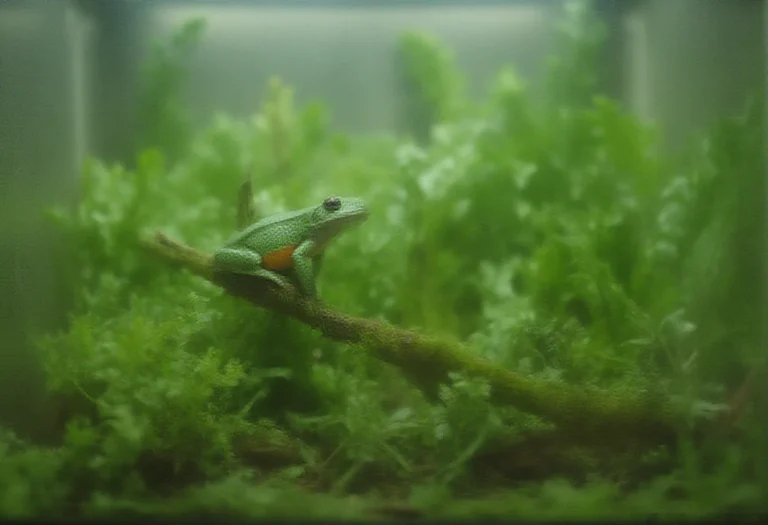
How this was made: prepared with AI assistance and checked against the sources listed at the end. Images are AI-generated illustrations, not photographs of real animals or products.
Key Takeaways
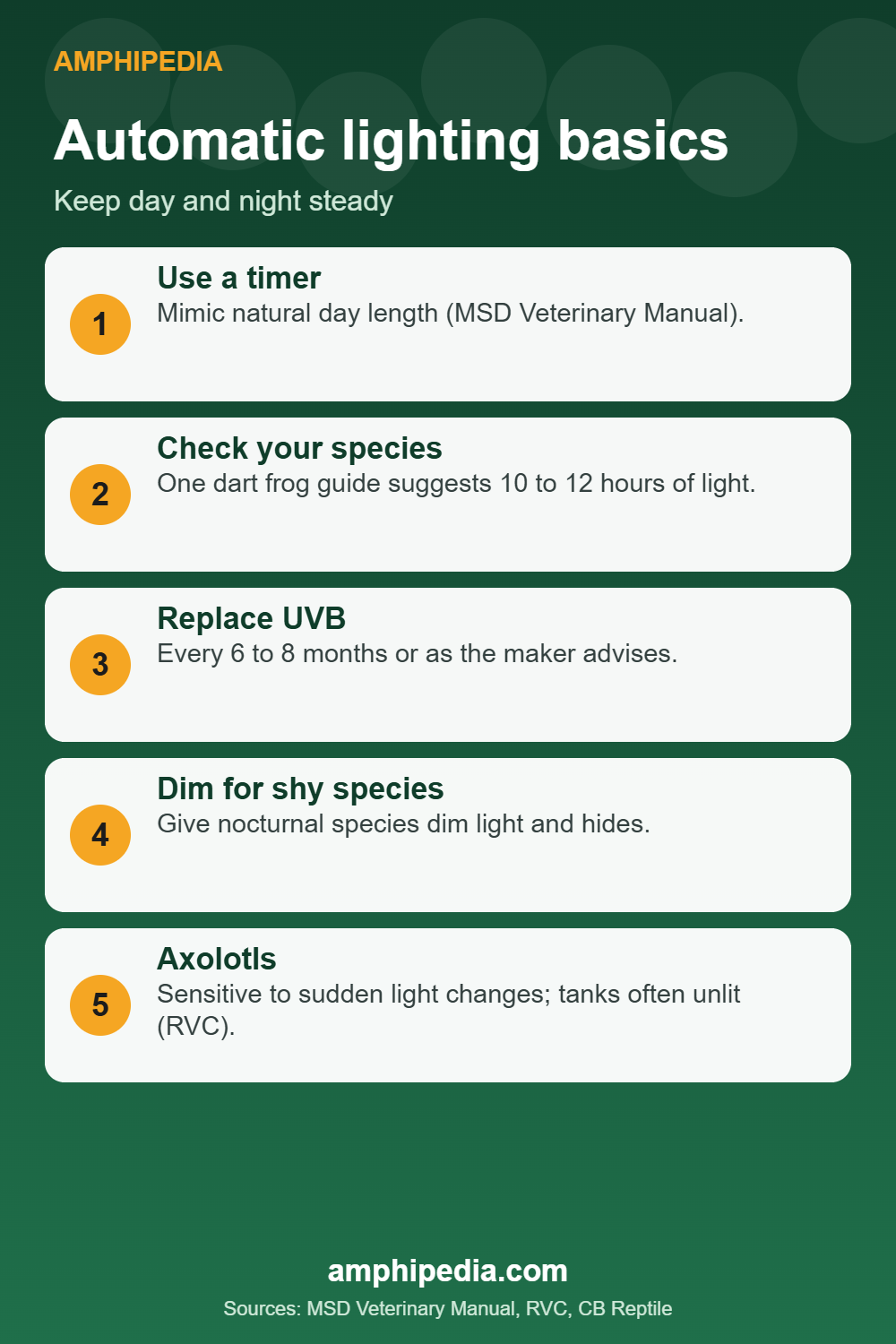
- Put terrarium lights on a timer to mimic natural day length (MSD Veterinary Manual).
- A dart frog guide from CB Reptile suggests about 10 to 12 hours of light daily; confirm for your own species.
- Nocturnal or light-shy species need dim light and plenty of hiding places (MSD).
- Axolotls are sensitive to sudden lighting changes and UVB, and their tanks are often left unlit (RVC).
- UVB bulbs should be replaced every 6 to 8 months or as the maker advises, and glass blocks much of the benefit.
- Use timers rated for the load and keep plugs and controls away from splashes.
Pin this infographicShare on Facebook
Timers and timed lights for a steady day and night
A timer keeps the light cycle the same every day. Check that the timer is rated for the total wattage you plug into it.


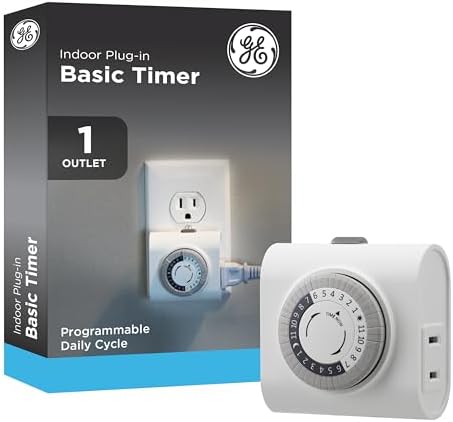

Product titles, prices and ratings are provided by Amazon and are accurate only at the time they are displayed.
Why automate the light cycle
A manual switch depends on your memory. An automatic system keeps the day length the same on busy days, holidays and weekends. A steady rhythm is closer to what wild amphibians experience.
The MSD professional guide states that lights should be placed on a timer to mimic natural photoperiods. It does not give an hour count, so use a species-specific source.
Automation also removes a common night-time problem: lamps left on for 24 hours, which can overheat the tank and disturb resting.
How many hours of light?
It depends on the species and the season. One source, a CB Reptile dart frog care guide, suggests a photoperiod of about 10 to 12 hours of light daily and a gentle UVB lamp designed for low-light amphibians, with shaded areas always available.
Nocturnal or photophobic species need something else. The MSD manual says dim light conditions and plenty of hiding places should be provided for them.
Because sources differ by species, check a care sheet written for your animal and adjust slowly.
UVB, distance and bulb life
The MSD manual states that diurnal species likely use ultraviolet B light (280 to 320 nm) for calcium metabolism, and that UVB is required to prevent metabolic bone disease in many pet amphibians. It also says not all full-spectrum bulbs give adequate UVB.
Lighting should be within 18 inches of the inhabitants, glass attenuates UVB, and UVB bulbs must be changed every 6 to 8 months or as the maker states.
Put the date on the bulb or in a calendar. A bulb can still glow after it has stopped producing useful UVB. Our guide to the UVB light for amphibians covers this in more depth.
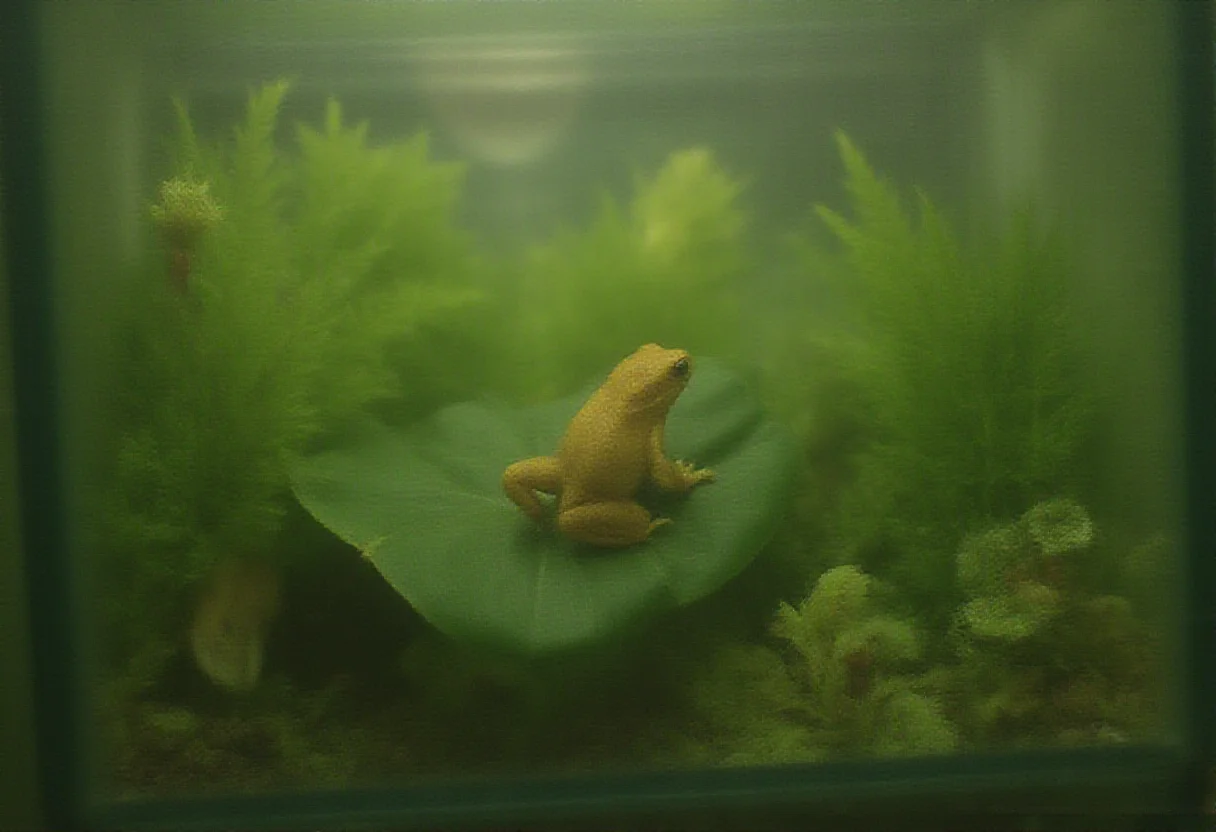
Axolotls and other aquatic species
The Royal Veterinary College says axolotls are very sensitive to sudden changes in lighting and to UVB, so tanks are often left unlit. Reptiles Magazine adds that axolotls do not need light and adjust to bright rooms when given hiding places.
If you add a plant light for live plants, use a gentle fixture, a slow schedule and shaded zones. Do not switch it on and off abruptly in a dark room.
Types of automation
You have three simple routes.
- A plug-in timer that switches an ordinary lamp on and off. Simple and cheap, but it cuts power abruptly.
- A smart plug or app-controlled outlet. It allows schedules from your phone. See our guide to the smart plug for a frog terrarium.
- A light fixture with a built-in schedule or gradual fade, which avoids sudden changes.
- A combined controller for light and heat. See the digital timer and thermostat combo guide.
Safety checks
Water and electricity share a small space in a terrarium, so safety is not optional.
- Check that the timer is rated for the total wattage of everything plugged into it.
- Keep plugs, timers and power strips above the water line and away from misting.
- Use a drip loop in cables so water cannot run down into a socket.
- Use fluorescent or LED lamps where possible, since the MSD manual says they avoid heat production.
- Never cover a hot lamp with plastic or fabric.
- If a fixture feels very hot, move it further away or replace it.
Setting it up step by step
Start with one change at a time, and watch the animals.
- Pick a species-appropriate day length from a reliable care sheet.
- Set the timer to switch on and off at the same time every day.
- Make sure part of the tank always stays shaded.
- Check that the cool end does not overheat during the lit period.
- Watch feeding and activity for a week and adjust gradually.
Common mistakes
Avoid these frequent problems.
- Leaving lights on all day and night.
- Relying on a glass lid with a UVB bulb above it.
- Switching the whole tank from dark to bright at once.
- Forgetting to replace UVB bulbs.
- Overloading a cheap timer with too many devices.
Related guides
Some keepers want a night-time glow for viewing. Our frog-safe LED night light guide explains why dim light must be chosen with care. For motion-based options, see why a timer is better than a motion sensor light.
Lighting needs by species group
Care sheets for other groups give different light advice from the dart frog guide above. Use the group nearest to your animal, then confirm with a source written for the exact species.
| Group | Light guidance | Source |
|---|---|---|
| Fire-bellied newts | 10 to 12 hours of light a day, low-level UVB only | PetMD |
| Salamanders | Full-spectrum light by day, day length matched to the natural habitat | Royal Veterinary College |
| Axolotls | Very low light; room light may be enough | LafeberVet |
| Tadpoles | 12 hours light and 12 hours dark | VetVerified |
PetMD recommends UVB of strength 2.0 or 5.0 for fire-bellied newts, replacement about every six months, and warns that stronger UVB can harm eyes and skin. The Merck manual says 6 to 8 months, or follow the maker. When sources differ, follow the maker label for your bulb and ask a vet.
Matching the timer to the season
The RVC says salamander day length should match the natural habitat, and none of our sources gives a seasonal schedule for pet amphibians. If your species sheet describes a seasonal change, move the on and off times in small steps rather than one large jump.
Write the schedule on a card beside the tank. When a timer is reset after a power cut, you can restore the right times in a minute.
Troubleshooting a timer
Most timer problems are simple. Work through the list before you blame the lamp.
- Lights come on at the wrong hour: check the timer clock, which often resets after a power cut.
- Lights never switch off: look for a manual override switch left in the on position.
- The tank runs warm while lit: read the thermometer at both ends. Merck says every enclosure needs a thermometer and a humidity gauge.
- The lamp still glows but the animal seems dull: check the bulb age, because UVB output fades before the glow does.
- The timer plug feels hot: stop using it and check the total wattage against the timer rating.
Tadpole and froglet tanks
VetVerified gives a 12 hour light and 12 hour dark cycle for tadpoles, and warns that direct sunlight can overheat a tank and cause algae blooms. A timer on a gentle lamp avoids both problems.
Keep the lamp off the water surface and well out of splash range. Raise it away from the tank as the water level drops during metamorphosis.
Frequently Asked Questions
How long should the lights stay on?
A CB Reptile dart frog guide suggests about 10 to 12 hours. The MSD manual says to use a timer to mimic natural photoperiods. Check your own species.
Do axolotls need light?
Not really. The RVC says tanks are often left unlit because axolotls are sensitive to sudden light changes and UVB.
Does glass block UVB?
The MSD manual says glass attenuates the benefits of UVB light, so place the lamp where it can reach the animals without passing through glass.
How often should I replace a UVB bulb?
Every 6 to 8 months or as the manufacturer states (MSD).
Can I use a smart plug?
Yes, if it is rated for the load. Keep it dry and out of reach of splashes.
What about nocturnal species?
The MSD manual says to provide dim light and plenty of hiding places.
Does lighting affect temperature?
Yes, some lamps give off heat. The MSD manual suggests fluorescent or LED bulbs to avoid heat production.
Bottom Line
An automatic lighting system is about consistency. Pick a day length that suits your species, use a rated timer, keep shaded areas, and replace UVB bulbs on schedule.
Start gently, keep notes, and watch behaviour for a week after any change. If your animal seems stressed or stops eating, ask an exotics vet.
Sources
- MSD Veterinary Manual: Housing for Amphibians (pet owner version), accessed Temperature, humidity, UVB, water quality and filtration basics.
- MSD Veterinary Manual: Environment and Husbandry for Amphibians (professional version), accessed Thermal gradients, lighting timers, UVB distance, weekly humidifier disinfection.
- Royal Veterinary College: Axolotl care sheet, accessed Axolotl temperature, filtration, water flow and lighting.
- Reptiles Magazine: Axolotl Care Sheet, accessed Filter type and water flow for axolotls.
- CB Reptile: Dart frog care guide, accessed Dart frog temperature, humidity, photoperiod and misting.
- CDC: Reptiles and Amphibians (Healthy Pets, Healthy People), accessed Salmonella risk, handwashing and where to clean habitat equipment.
- PetMD: Fire Bellied Newt Care Sheet (10 to 12 hours of light, low-level UVB), accessed 12 November 2026
- Royal Veterinary College: Salamander care sheet (lighting, nocturnal habits), accessed 12 November 2026
- LafeberVet: Care of the Axolotl (low light), accessed 12 November 2026
- VetVerified: Setting up an environment for tadpoles (light cycle, sunlight), accessed 12 November 2026

3 Comments