Humidity Probe Extension for a Vivarium: What to Look For
This post contains affiliate links. As an Amazon Associate I earn from qualifying purchases. Prices and availability are shown by Amazon and can change.
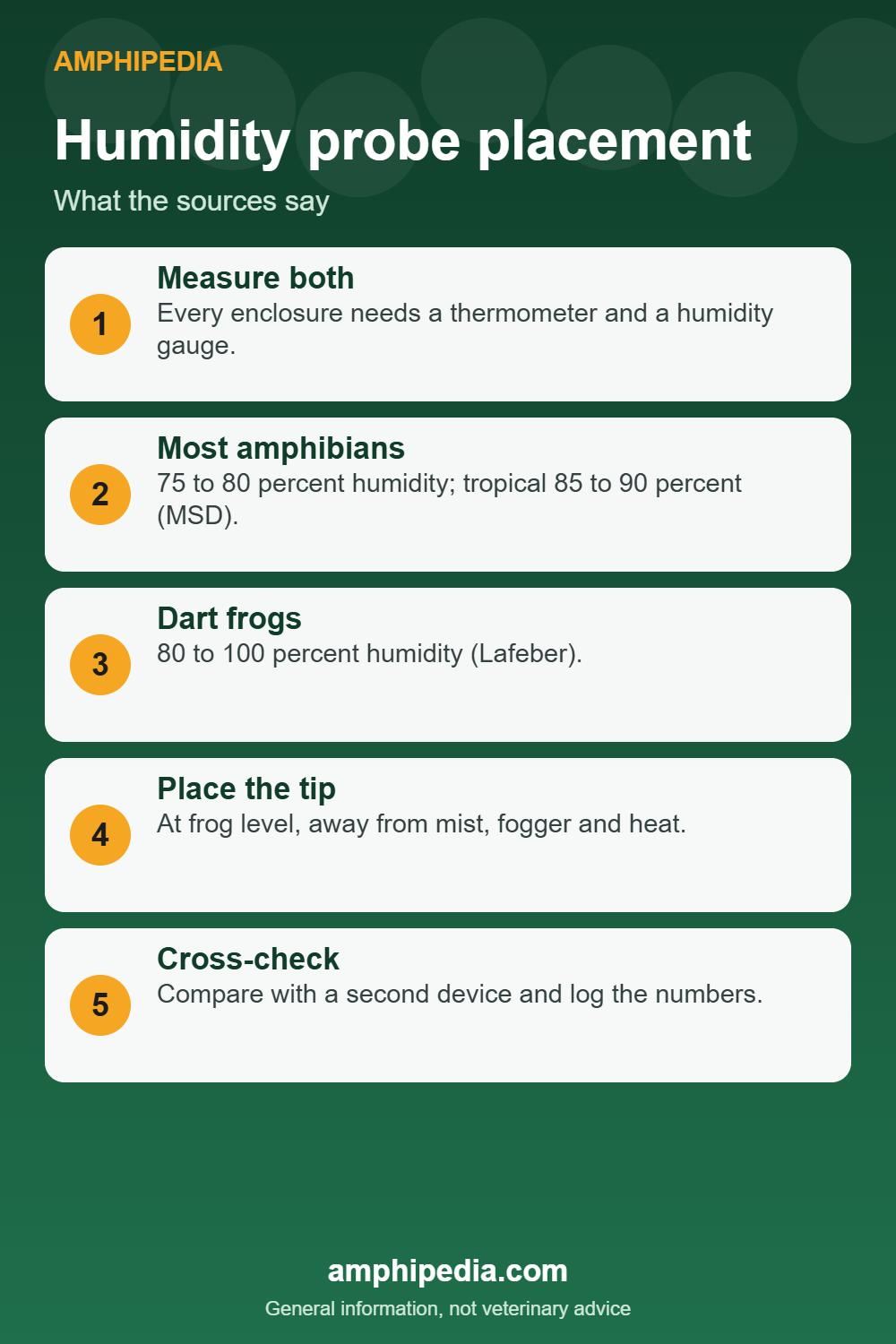
A humidity probe extension lets you put the sensor where the frog lives while the display stays outside the glass. It helps only if the probe sits at animal level, away from mist and heat, and you cross-check it. Sources say every amphibian enclosure needs a humidity gauge and a thermometer. Aim for the range your species needs: 75 to 80 percent for most amphibians, 85 to 90 percent for tropical species, and 80 to 100 percent for poison dart frogs.
Most hygrometers read the air right next to the display. In a vivarium that is often the wrong spot. A probe on a cable moves the sensing tip to the place that matters, so you can read it without opening the lid and stressing the frogs.
This guide explains what a probe cable can and cannot do, which humidity numbers the sources give, where to place the tip, and what to check in a listing before you buy.
How this was made: prepared with AI assistance and checked against the sources listed at the end. Images are AI-generated illustrations, not photographs of real animals or products.
Key Takeaways
- Every amphibian enclosure should have both a thermometer and a humidity gauge (MSD Veterinary Manual).
- Most amphibians do well at 75 to 80 percent humidity; tropical species may need 85 to 90 percent.
- Poison dart frogs: aim for 80 to 100 percent humidity (Lafeber Veterinary).
- Put the probe tip at frog level, away from mist nozzles, fogger outlets and heat sources.
- Compare the probe with a second device before you trust it, and log readings.
- Check cable length, damp tolerance and how the cable passes through the lid before you buy.
Pin this infographicShare on Facebook
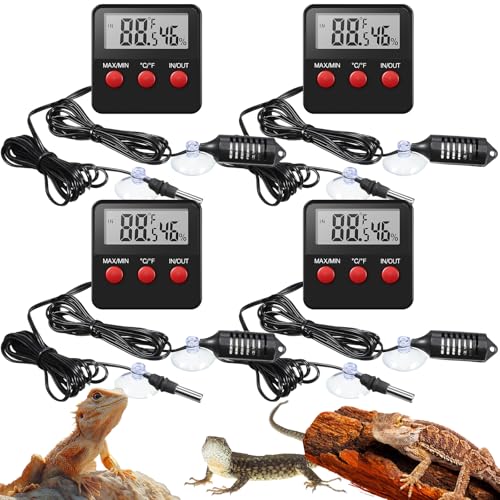
Thermometer and hygrometer units with a probe
These listings are thermometer and hygrometer units that come with an external probe on a cable. Check the cable length, whether the tip is meant for damp use, and the display, then cross-check any reading with a second device.



Product titles, prices and ratings are provided by Amazon and are accurate only at the time they are displayed.
What a probe extension does
A probe is a small sensing tip on a cable. The cable carries the reading to a display that stays outside the tank. Some devices come with a probe built in. Others accept a longer lead. A longer cable helps in a tall or deep enclosure, or when the display must sit on a shelf away from water.
A probe does not make a reading more accurate by itself. It only changes where the air is sampled. If the tip sits in a dry corner by the lid, you will read dry-corner air. If it sits in a spray path, you will read the spray. Placement matters more than cable length.
Humidity and temperature targets
Sources give different ranges for different groups. Use the range for your species and say which source you followed.
| Group | Humidity | Temperature | Source |
|---|---|---|---|
| Most amphibians | 75 to 80 percent | 60 to 70 F (16 to 21 C) | MSD Veterinary Manual |
| Tropical species | 85 to 90 percent | 75 to 80 F (24 to 27 C) | MSD Veterinary Manual |
| Poison dart frogs | 80 to 100 percent | Day 72 to 80 F (22 to 27 C); night 65 to 70 F (18 to 21 C) | Lafeber Veterinary |
Where to put the probe
Place the tip at the height where the frogs spend their time, usually on a plant or branch in the middle of the tank. Keep it out of the direct path of a mist nozzle or fogger outlet, because droplets on the tip can distort the reading.
Keep it away from heat sources too. Lafeber advises avoiding radiant heat for dart frogs because it can dry the enclosure, and a probe near a lamp will read a drier, warmer pocket than the rest of the tank.
The MSD manual describes a thermal gradient, so different areas of a tank can sit at different temperatures. Humidity can vary the same way. If the tank is large, use one probe on the humid side and a second on the drier side.
What to check before you buy
Product listings differ a lot. Read these points before you choose.
- Cable length: measure from the planned tip position to where the display will sit, then add some slack.
- Probe tip: look for a listing that says the tip is meant for humid or wet use. If it does not say so, treat it as a dry-room sensor.
- Both readings: a unit that shows temperature and humidity saves a second device.
- Display: choose one you can read from across the room, with a backlight if the room is dark.
- Power: battery-powered units are simple. Keep spare batteries.
- Cable path: the cable must pass the lid without leaving a gap a small frog or feeder insect can use. Secure, ventilated tops are advised for amphibian tanks (MSD).
- Calibration notes: some listings mention a calibration option. Read the manual before you rely on it.
Setting up a probe step by step
Plan the route before you drill, cut or tape anything. A neat install keeps the reading steady and the enclosure secure.
- Decide the tip position: frog level, mid-tank, clear of the spray path.
- Route the cable along the back or side glass, up to the lid edge.
- Close the gap around the cable so nothing can climb or squeeze out.
- Fix the tip so it cannot fall into the water dish or substrate.
- Leave the display outside, out of reach of splashes.
- Note the first readings after misting and again an hour later, so you learn the rise and fall pattern.
How to check the reading
Cheap sensors can disagree with each other, and the sources do not give an accuracy standard for hobby hygrometers. Treat any single number with care.
- Set the new probe next to a second hygrometer outside the tank for an hour and compare.
- Place the probe in the tank and let it settle for at least a few hours before judging.
- Read it at the same times each day, for example morning and evening, and write the numbers down.
- For temperature, the MSD manual suggests a daily spot check with a laser temperature probe as a cross-check.
- If the two devices keep disagreeing by a large margin, replace the weaker one.
Common mistakes
These errors cause most bad readings.
- Putting the tip in the spray path and chasing a number that is not real air humidity.
- Mounting the display sensor at the top of the tank and calling that the tank humidity.
- Leaving a cable gap in the lid.
- Trusting one cheap device without a second check.
- Raising mist output to fix one reading without watching the frogs and the substrate.
- Reading only at one time of day. Humidity moves with misting and lights.
Humidity and frog behaviour
A number on a screen is not a diagnosis. MSD notes that amphibians need moisture to prevent drying out. Watch the animals and the substrate as well as the display. Lafeber says the substrate should stay damp between misting but not waterlogged.
If a frog stays hidden, looks dull, or sheds oddly, speak to an exotics vet. Do not treat at home based on a hygrometer alone.
Read day and night, not just once
A probe is most useful when you watch how numbers change over a day. Lafeber gives poison dart frogs a daytime gradient of 72 to 80 F (22 to 27 C), with night temperatures that may fall to 65 to 70 F (18 to 21 C), and a relative humidity of 80 to 100%. These figures are for dart frogs only. Check your own species.
Look at the pattern, not one value. Humidity usually spikes after misting and then falls as the tank dries. A healthy pattern is a rise, a slow decline and a recovery, not a flat line at either extreme.
Ventilation changes what the probe reads
The MSD Veterinary Manual says amphibian enclosures need good ventilation, about 1 to 2 air changes per hour. A sealed tank may show a very high reading that hides stale air, while a screen top may never hold the number you want.
If the reading is hard to hold, do not just add more mist. Review the lid, the substrate and the plants first. Lafeber says the substrate should stay damp between misting but not waterlogged, so the substrate is part of the humidity system.
Troubleshooting odd readings
- Reading jumps to 100% right after misting: droplets are on the tip. Wait several minutes, or move the tip out of the spray path.
- Reading is always lower than the glass suggests: the tip may be near the lid, a vent or a lamp. Move it to frog level.
- Two devices disagree by a large margin: put them side by side outside the tank, then decide which to trust. The sources give no accuracy standard for hobby hygrometers.
- Display goes blank or stuck: check the battery, then whether moisture reached the plug or cable joint. Replace damaged cables.
- Number is fine but the frog looks dull: ask an exotics vet, because a reading alone cannot show health.
Keep a short log
For the first two weeks, note the time, the humidity, the temperature and whether you misted. A notebook is enough. Bring it to the vet if your frog becomes ill. The MSD manual says husbandry history, including humidity, temperature and lighting, helps the vet assess the case.
Frequently Asked Questions
Do I need a probe at all?
Not always. A small tank may be fine with a good gauge at frog level. A probe helps when the tank is tall, wet, or hard to open.
What humidity do dart frogs need?
Lafeber Veterinary gives 80 to 100 percent relative humidity for poison dart frogs, with the substrate damp but not waterlogged.
What humidity do most amphibians need?
The MSD Veterinary Manual says 75 to 80 percent for most amphibians and 85 to 90 percent for tropical species.
Can I use a probe made for a reptile tank?
Possibly, if the listing says the tip suits humid use. Check how it handles constant dampness and whether the cable fits your lid.
Is a higher reading always better?
No. Match the species range. Constant saturation without airflow is not a goal. MSD advises good ventilation, about 1 to 2 air changes per hour.
How often should I check it?
Daily is a sensible habit. Log the numbers so changes stand out.
Bottom Line
A probe cable is a small tool with a simple job: put the sensor where the frog lives. Choose by cable length, damp tolerance and a clear display, then check it against a second device.
For related help, see remote temperature and humidity sensors, wireless humidity monitors and smart humidity alarms.
Sources
- MSD Veterinary Manual: Housing for Amphibians (pet owner version), accessed Thermometer and humidity gauge, ranges, ventilation
- MSD Veterinary Manual: Environment and Husbandry for Amphibians, accessed Thermal gradient, daily laser probe spot checks
- Lafeber Veterinary: Basic Information Sheet, Poison Dart Frog, accessed Dart frog temperature and humidity, misting
- CDC: Reptiles and Amphibians, accessed Salmonella and hygiene
2 Comments